The Digital Product Passport (DPP) as a strategic catalyst: Forward-looking integration into modern Product Information Management (PIM)
Introduction: The DPP as a new tool for the European single market
The entry into force of the Ecodesign for Sustainable Products Regulation (ESPR) on 18 July 2024 established a binding legal basis for implementing Europe’s circular economy. The Digital Product Passport (DPP) is a central component of this ambition. It requires comprehensive, machine-readable information covering the entire product lifecycle, from raw material extraction and use through to material recovery. For manufacturers and retailers, sustainability data is therefore shifting from a voluntary marketing activity to a strict compliance requirement that directly determines access to the EU single market.
In this complex information landscape, the consulting portal pim-consultants.com acts as a strategic partner, helping businesses map out the technology path to DPP compliance. The DPP is not a standalone IT project but a comprehensive data management undertaking that cannot be handled efficiently without flexible, high-performance Product Information Management (PIM) and Master Data Management (MDM). Structuring product data effectively not only prepares businesses for regulatory compliance but also creates the information infrastructure for sustainable operations.
The regulatory timeline and evolving market regulation
European legislation has set out an ambitious roadmap for the phased introduction of the Digital Product Passport across all relevant industries. The ESPR provides the overarching framework (the “operating system”), while product-specific requirements are defined through individual legal acts (the “applications”). Key secondary instruments were established as early as February 2026 through regulations restricting the destruction of products. The first mandatory implementation applies to the battery sector from February 2027, followed by a series of product-specific regulations for key sectors such as textiles, iron, steel and electronics.
At the same time, the EU is tightening the legal framework for sustainability communications. When the Empowering Consumers for the Green Transition Directive (EmpCo) takes effect on 27 September 2026, unsubstantiated environmental claims without robust, certified evidence will be prohibited. This increases the pressure on businesses to make verifiable product data available through the DPP, as unsupported marketing claims may be penalised as unfair commercial practices.
The following table summarises the key regulatory milestones and affected product groups:
Technical standardisation: bringing together CEN-CENELEC and GS1 standards
The usability of the Digital Product Passport depends on open, global standards. Standalone proprietary solutions would hinder complex global supply chains and lead to significant transaction costs. For this reason, the European Commission commissioned the standardisation organisations CEN and CENELEC to define cross-cutting system requirements under standardisation request M/604. The responsible committee, CEN/CENELEC JTC 24, presented a modular package of harmonised standards in 2026.
The first set of six core standards was technically ratified in May 2026, followed by supplementary security and authentication standards in September 2026. These standards define the technical architecture of the European DPP ecosystem.
The following overview outlines the structure of the harmonised CEN-CENELEC standards:
In practice, this European framework of standards aligns perfectly with GS1’s globally established standards. On August 28, 2025, GS1 published the important “DPP Provisional Application Standard”, which provides companies with practical guidance on standards-compliant technical implementation. Products are identified using the Global Trade Item Number (GTIN), while locations and companies are uniquely referenced using the Global Location Number (GLN).
The physical access point to the product passport is provided by the GS1 Digital Link. This is a standardised web URL encoded in a two-dimensional barcode, usually a QR code. This approach combines different use cases in a single data format.
When scanned at the retail checkout (point of sale), only the GTIN is read for the purchase transaction, while consumers scanning the code with a smartphone are taken directly to a user-friendly DPP landing page. For more complex industrial scenarios, such as those in the recycling industry, standardised extensions such as the Asset Administration Shell (AAS) or event-based EPCIS data streams can also be used to track repair and recycling events.
The PIM system as a single source of truth alongside ERP, PLM and DAM
Implementing the Digital Product Passport across systems often exposes the shortcomings of IT infrastructures that have evolved over time. In most companies, product data is spread across separate systems: the ERP system manages logistics master data and commercial parameters, the PLM system documents engineering data and bills of materials (BOM), and the DAM system stores unstructured documents such as safety data sheets and certificates. Inflexible legacy systems cannot consolidate this data, enrich it with dynamic circular economy data and export it in a machine-readable format.
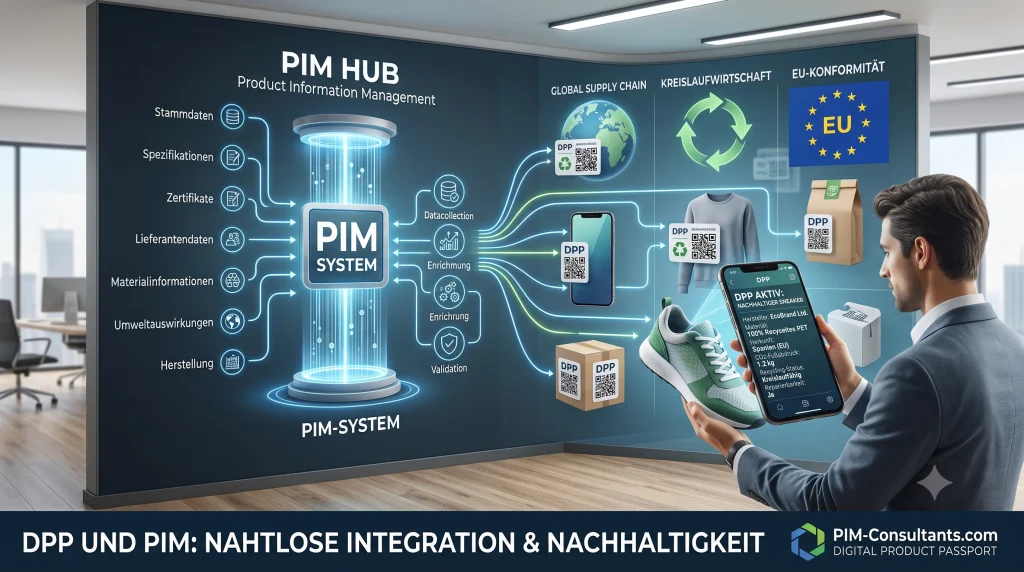
A robust PIM system, as part of an integrated master data management (MDM) strategy, acts as the central hub for orchestrating these complex data flows. It connects the systems at the data level and prepares the raw data for the DPP.
The following table illustrates the distinct roles of each system and the data flows between them in the DPP process:
Advanced platforms such as Syndigo’s Product Experience Cloud demonstrate how a robust PIM system enables DPP creation. Syndigo stands out for its preconfigured industry taxonomies and flexible data models, which enable the rapid integration of new regulatory attributes.
Automated validation rules in the PIM ensure that no product passport is registered with incomplete mandatory fields. Integrated translation and localisation workflows also enable efficient delivery of data in the respective languages of EU countries. Through its integration with GS1 Digital Link, the PIM system directly generates the dynamic URLs that are applied to the product as a physical QR code.
An effective 5-step approach to DPP implementation
A recent webinar by Syndigo and Avensia highlights that preparing for the DPP is not a one-off compliance project, but requires continuous improvement in digital data maturity. To avoid unnecessary investment, companies should focus on what is already feasible and reasonably foreseeable from a regulatory perspective, while waiting where specifications are still missing.
Based on best practices from Syndigo, Avensia and GS1, pim-consultants.com recommends a structured five-step approach:
Step 1: Assessing applicability and regulatory roadmaps (Business Context)
At the start of the project, companies need to define their precise business context. This requires detailed mapping of the product portfolio against the timelines set out in the ESPR and sector-specific delegated acts. Companies need to establish whether their products fall into priority product groups (such as batteries, textiles or construction products) or are subject to cross-sector rules such as the ban on destroying textiles.
The geographical scope also needs to be assessed: since importers and retailers bringing goods into the EU are also directly liable, the DPP has immediate implications for global supplier networks.
Step 2: Conducting a comprehensive data inventory (Data Footprint)
This phase involves a systematic review of the existing data footprint. Companies need to conduct a detailed inventory to determine which required DPP attributes are already available digitally and in which systems they are stored.
Typical mandatory data areas examined as part of this inventory include:
-
Identification data: Availability of GTINs for products and GLNs for production sites and economic operators.
-
Material data: Transparency on chemical ingredients, the presence of Substances of Concern and precise proportions by weight.
-
Circularity data: Documentation of carbon footprints in accordance with ISO 14067, information on repairability, spare parts availability and detailed disassembly instructions for recyclers.
The data gaps identified provide the basis for the subsequent implementation steps.
Step 3: Evaluating and extending the IT infrastructure (Technology Options)
This step involves evaluating technology options and adapting the existing system architecture. Companies need to assess whether their current PIM system is flexible enough to accommodate the DPP’s new, highly relational data structures.
If the system is too inflexible, we recommend migrating to a modern, cloud-based multi-domain PIM platform such as Atamya, Viamedici or Syndigo. Interfaces between ERP, PLM and PIM must also be standardised using robust integration solutions (iPaaS) to ensure automated data flows without redundancy.
The final task is to connect to specialist DPP service providers that manage the eIDAS-compliant registration process in the central EU registry.
Step 4: Establishing collaboration across the supply chain (Strategic Collaboration)
Since a significant share of lifecycle and material data is generated by suppliers, establishing strategic collaboration is essential. Companies need to establish standardised processes and digital portals to request supplier data in a structured format, validate it and import it into their own PIM system with a full audit trail.
Internally, this step requires clear data governance policies. Cross-departmental workflows must be established to define who is responsible for the quality, approval and updating of DPP-relevant data fields.
Step 5: Piloting, verification and ongoing maintenance (Implementation & Execution)
Operational implementation should always begin with a tightly scoped pilot project for a single product category or a selected SKU. This makes it easy to test and optimise the entire process, from data aggregation in the PIM and generation of the GS1 Digital Link through to the planned registration in the central EU registry.
Once the pilot has been successfully validated, the system is gradually scaled across the entire portfolio.
A process for continuously updating the passport must also be established to ensure that events such as repairs, software updates or component replacements are fully documented throughout the product’s lifecycle.
Conclusions and recommendations for manufacturers and retailers
The Digital Product Passport marks a fundamental shift in product communication, transforming product data management from a supporting administrative function into a central driver of business value. Companies that view the DPP not as a burdensome compliance obligation but as a strategic opportunity can gain significant competitive advantages. A transparent, easily accessible product passport demonstrably strengthens consumer trust, protects against greenwashing penalties under the EmpCo Directive and opens up entirely new, data-driven after-sales business models.
The experts at pim-consultants.com recommend that companies make good use of the time remaining before the first product-specific obligations take effect. Companies that delay modernising their PIM landscape and cleansing their data risk significant revenue losses from 2027 as their products face losing access to the European market. The PIM system is, and will remain, the information technology backbone of the Digital Product Passport. Only centralised, quality-assured and highly automated data management can address the logistical challenge of the DPP efficiently, in compliance with the law and with long-term resilience.