- General
Akeneo Community Edition 2026: Not discontinued, but changing
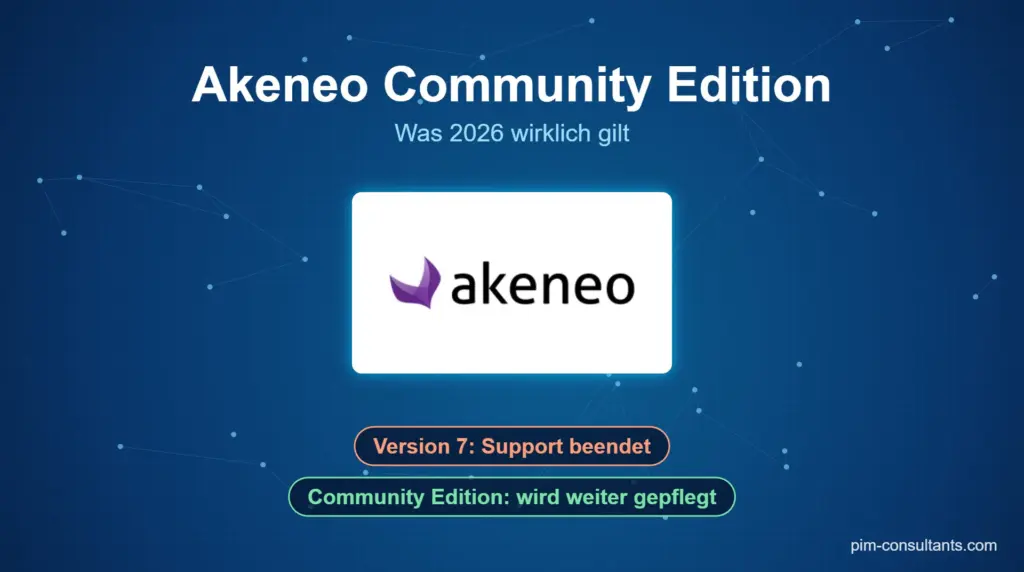
Since 30 September 2026, Akeneo PIM 7.0 Enterprise Edition On-Premise and PaaS (Flexibility) have no longer received support or security patches. The Community Edition is not affected: Akeneo continues to maintain it, with the current version, 2026.4, released on 28 August 2026. With so much conflicting information circulating in the market, we explain the facts and the options now available to companies running Akeneo 7.
Key takeaways
- Support for Akeneo 7.0 Enterprise Edition On-Premise and PaaS (Flexibility) ended on 30 September 2026. These installations no longer receive technical support, bug fixes or security patches.
- The Community Edition is not being discontinued. Since 2026, it has used calendar-based versioning. The latest release, 2026.4, came out on 28 August 2026 with support for MySQL 8.4 LTS.
- Akeneo directs Enterprise customers who want to retain SLA-backed support to its SaaS version (Serenity). Custom code and bundles are not carried over during migration.
- Akeneo 7 runs on PHP 8.1 and MySQL 8.0. Neither receives security updates any longer, so continuing to run it without support is only a stopgap.
- Our view: a good opportunity to review your PIM strategy, but no reason to rush into a migration.
What ended on 30 September 2026
Akeneo publishes fixed support dates for its self-managed editions. For version 7.0, released on 8 March 2023, the end date was 30 September 2026. Under Akeneo’s own policy, a version receives neither technical support nor bug fixes or security patches after that date. According to endoflife.date, the final patch in the 7.x series, 7.0.88, was released two days before the deadline.
The scope is what matters. Akeneo’s support page explicitly applies only to the PaaS and On-Premise editions, not to the Community Edition. The SaaS version no longer uses version numbers at all; Akeneo deploys updates continuously.
| Edition | Status since 1 October 2026 | What this means |
|---|---|---|
| Akeneo 7.0 Enterprise Edition On-Premise | No support or patches | Continues to run, but without fixes. Moving to SaaS is the only way to retain vendor support. |
| Akeneo 7.0 PaaS (Flexibility) | No support or patches | Same as On-Premise. The existing URL is retained when migrating to SaaS. |
| Akeneo SaaS (Serenity, Growth, Advanced and Premium packages) | Continuously updated | No version upgrades required. Akeneo deploys feature and security updates automatically. |
| Community Edition | Still maintained, currently 2026.4 | Fixes are available by upgrading to the latest version, without vendor support. |
An Akeneo 7 installation does not stop running on 1 October. However, it no longer receives fixes, even for newly discovered security vulnerabilities.
How future-ready is your PIM setup?
End of support, a move to SaaS, AI agents: our assessment reveals the maturity of your product data and PIM architecture, and which options are right for you.
The Community Edition lives on, but things are changing
Over the past few months, several blog posts by competitors and service providers have claimed that the Community Edition is being discontinued or that its support also ends on 30 September 2026. Akeneo’s own documentation says otherwise: the Community Edition will continue to be supported, with bug fixes and security fixes for Community features available by upgrading to a newer version. We initially repeated the incorrect claim ourselves and have since corrected our comparison pages.
The release list on GitHub confirms this:
- February 2026: technical update with PHP 8.3 replacing 8.1, MySQL 8.0.34 and Elasticsearch 8.17.
- 30 March 2026: version 2026.3; Akeneo also explains the new versioning scheme in the project documentation.
- 28 August 2026: version 2026.4 with support for MySQL 8.4 LTS, bug fixes and fixes carried over from the 7.0 branch.
The new versioning scheme changes the rules, however. Akeneo now numbers releases by year and sequence number (vYYYY.Minor) and no longer uses semantic versioning. Backward compatibility between versions is explicitly not guaranteed, and breaking changes can occur in any release. According to endoflife.date, only the latest version receives bug fixes and security patches. Organisations using the Community Edition therefore need to update and test regularly rather than stay on a long-term release for years.
The division between the two offerings is equally clear. The new features Akeneo introduced in July 2026, including the agentic interface “Agentic Ziggy” and prompt-based image editing in the DAM, belong to the Product Cloud, its SaaS platform. The Community Edition release notes focus on technical updates and bug fixes. The Community Edition therefore remains a maintained open-source foundation, but it is not where Akeneo delivers new features.
The options now available to Enterprise customers running Akeneo 7
For companies running Akeneo 7 Enterprise on their own infrastructure or as PaaS, there are essentially five options:
| Option | Benefits | What to consider |
|---|---|---|
| 1. Move to Akeneo SaaS | Akeneo’s recommended route; automatic updates and security patches; access to new AI features | Custom code and bundles cannot be carried over; customisations are only possible through APIs and apps; your contract must cover SaaS |
| 2. Move to Community Edition 2026.x | No licence fees, continued self-hosting, maintained by the vendor | Enterprise features such as the Rules Engine, approval workflows, granular permissions and asset management are not included; no vendor support; ongoing upgrades required |
| 3. Continue without support | No project required, no additional costs in the short term | No security patches; PHP 8.1 and MySQL 8.0 no longer receive security updates; risk increases every month |
| 4. Third-party long-term maintenance | Buy time and stabilise operations | Service providers and community forks such as LibrePIM (not an official Akeneo project) build on the Community codebase, not the Enterprise features |
| 5. Switch to another PIM | An opportunity to reassess requirements, deployment model and costs | Selection and migration take time; the data model, integrations and processes need to be set up anew |
Moving to Akeneo SaaS in detail
Akeneo describes the migration process in considerable detail in its documentation. It requires Akeneo 7 with the latest patch; older versions must first be upgraded to 7. The Customer Success Manager confirms that the contract covers SaaS. Custom code and bundles must be removed beforehand because the SaaS version does not support them. Customisations are then only possible through API connections and apps from the App Store, including custom-developed apps. Akeneo handles the migration itself once a support ticket has been submitted. According to Akeneo, it typically takes two to four hours, longer for large catalogues, and each environment (test, staging, production) is migrated separately.
The real effort therefore lies not in moving the data, but in adapting the customisations. Companies that have built custom bundles for imports, exports, calculations or interfaces over the years need to rebuild them as apps or through the API, or replace them. These customisations should be inventoried before any decision is made.
Why waiting is not a long-term solution
Akeneo 7 runs on PHP 8.1, MySQL 8.0 and Elasticsearch 8.4. PHP 8.1 has received no security updates since December 31, 2025, and according to Akeneo’s own release notes, MySQL 8.0 reached its end of life in April 2026. An unsupported Akeneo 7 installation therefore relies on several components that no longer receive security maintenance. For a system that syndicates product data to an online store, marketplaces and retailers, this will become an issue at the next security review, if not sooner.
Running Akeneo 7? We can help you decide
Whether you are considering Akeneo SaaS, the Community Edition or a switch to another system, our assessment evaluates your product data, customisations and processes to identify the right path for your business.
Five questions to guide your decision
- Which enterprise features do you actually use? The rules engine, approval workflows, category-based permissions and asset management determine whether the Community Edition is even an option.
- How much custom code does your installation contain? Every custom bundle must either be rebuilt as an app or API integration for SaaS, or removed.
- What are your operational and data requirements? Hosting, data location and internal IT policies can make SaaS a suitable option or rule it out.
- What is the total cost? A SaaS subscription replaces licensing, hosting, maintenance and upgrades. A fair comparison requires all costs to be considered over several years.
- What role should AI agents play? Akeneo offers its own MCP server and agentic capabilities in the Product Cloud. We explain what MCP means for product data in our article on MCP and Agentic Commerce.
If you are currently selecting a PIM system
Pay attention to which edition you are comparing. The Community Edition is a solid, free core PIM system, but it is not the product Akeneo shows in its presentations. Ask for written confirmation of the features included in each edition. Our open-source PIM comparison covers other free systems, while our Akeneo alternatives page covers both commercial and open-source options.
Our assessment
Akeneo is drawing a clear line: enterprise features are now available only as SaaS, while the Community Edition remains a maintained open-source foundation. This fits a pattern we are seeing across the market. Stibo Systems also delivered its final on-premise feature release with version 2024.4, as we described in our article on Stibo Systems and TecDoc, and Pimcore switched from GPLv3 to its own open-core licence in 2025. With its acquisition of PricingHUB in June 2026, Akeneo is also continuing to expand the Product Cloud, as we discussed in our PIM Consolidation Report 2026.
For enterprise customers running Akeneo 7, we consider three things critical. First, the installation should not continue running for months without patches: a clear timeline is needed. Second, it is worth taking stock of your customisations before speaking to Akeneo, as these determine the effort required to move to SaaS. Third, the move to Akeneo SaaS should be compared with two or three alternatives. In our experience, a structured PIM selection takes two to three months. That is time well spent if the next platform is expected to serve your business for many years.
For Community Edition users, the situation is less concerning than it is often portrayed. Moving from 7.0 to 2026.x is the intended upgrade path. However, anyone who needs AI features, approval workflows or vendor support will not find them in the Community Edition. And anyone reading articles about the supposed end of the Community Edition should check who wrote them: often, there is a migration offer behind them.
Akeneo SaaS or an alternative?
We provide an independent, vendor-neutral comparison based on your product data and process requirements, and support you from evaluation through to migration.
Frequently asked questions
Is the Akeneo Community Edition being discontinued?
No. The end of support on 30 September 2026 only affects Akeneo 7.0 Enterprise Edition on-premise and PaaS deployments. According to Akeneo, the Community Edition will continue to be maintained. The current version, 2026.4, was released on 28 August 2026.
What happens to Akeneo 7 after 30 September 2026?
The software will continue to run, but Akeneo will no longer provide technical support, bug fixes or security patches for it. In addition, PHP 8.1 and MySQL 8.0, on which Akeneo 7 is built, no longer receive security updates themselves.
How do enterprise customers move to Akeneo SaaS?
Through their Customer Success Manager and a support ticket with Akeneo. Akeneo 7 with the latest patch is required, and custom code and custom bundles must be removed beforehand. According to Akeneo, the move typically takes two to four hours per environment.
How do I upgrade the Community Edition from 7.0 to 2026.x?
Akeneo recommends applying all migrations from the 7.0 branch beforehand. Because the new versioning scheme does not guarantee backwards compatibility, the version should be pinned in composer.json and every update tested in advance.
What alternatives to Akeneo are available?
That depends on your industry, data model, deployment model and budget. You can find an overview and assessment on our Akeneo alternatives page and in our comparisons of Akeneo vs. Pimcore, Akeneo vs. Salsify and inriver vs. Akeneo. Our PIM vendor directory lists all vendors, with filters for pricing model, licensing model and industry.
Sources
- Akeneo: PaaS (Flexibility) and on-premise Support Dates
- Akeneo: Supported versions table
- Akeneo: Everything you need to know about our PIM versions
- Akeneo: Migrate to Serenity (SaaS)
- Akeneo: Upgrade from 6.0 to 7.0 (system components)
- Akeneo PIM Community Edition: Releases on GitHub
- Akeneo PIM Community Edition: Release v2026.4 (28 August 2026)
- Akeneo PIM Community Edition: README with versioning scheme
- endoflife.date: Akeneo PIM
- PHP: Supported Versions
- IT Brief UK: Akeneo launches Agentic Ziggy for product data teams (9 July 2026)
- Packagist: LibrePIM
- PIM-Consultants: Akeneo vendor profile
As of 24 October 2026. Information is based on vendor statements and the public repository and is subject to change.
Have any questions? We are happy to advise you.
Are you running Akeneo 7 and want to know which path is right for you? Get in touch.
Request an Agentic Readiness Assessment
Want to know whether your PIM and product data are ready for AI agents and syndication, regardless of your vendor? Leave your contact details and briefly tell us which PIM system you use and where you currently stand.
We will get back to you with a proposal for an Agentic Readiness Assessment tailored to your business.
More PIM insights
News & Blog
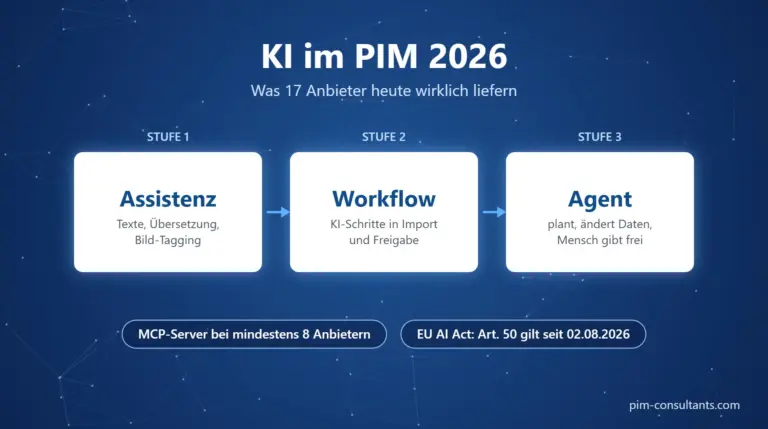
AI in PIM 2026: What vendors actually deliver today
Which AI capabilities PIM vendors actually deliver in 2026: an overview of agents, MCP servers, custom AI models and pricing across 17 vendors, plus obligations under the EU AI Act.
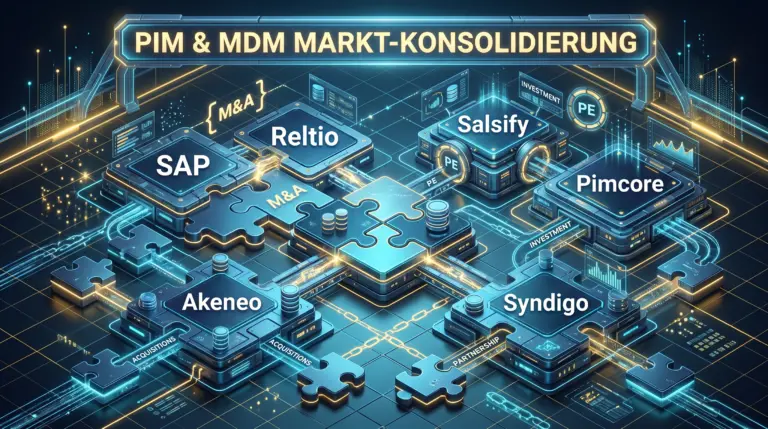
Billion-Dollar Deals, Private Equity and Platform Mergers: The Comprehensive PIM Consolidation Report 2026
Cinven buys Salsify, Tenzing takes over Pimcore, Akeneo acquires PricingHUB: an overview of all PIM deals in 2025/2026, the three patterns behind them and what users should now look out for in their contracts.

Beyond Chatbots: How Model Context Protocol (MCP) and Agentic Commerce Turn PIM into the Nervous System
AI agents read product data, not product pages. How the Model Context Protocol (MCP) works, which PIM vendors already offer MCP servers, and how to prepare your data model and governance.
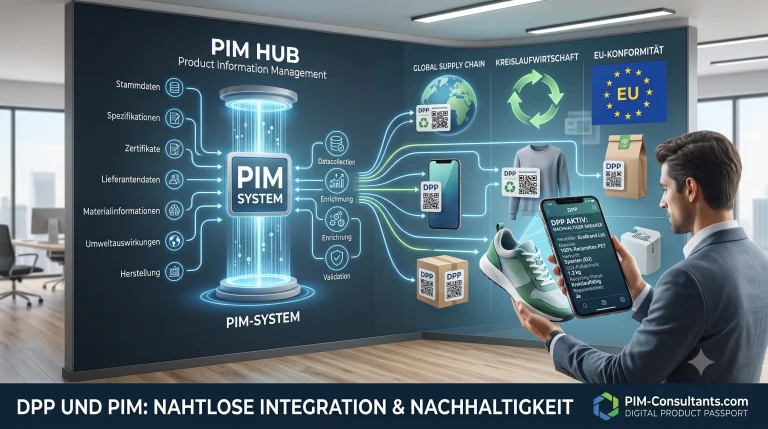
Digital Product Passport (DPP) & PIM: A Strategic Guide
How do you prepare your PIM for the Digital Product Passport? Learn how robust data governance and GS1 standards help you meet EU requirements.
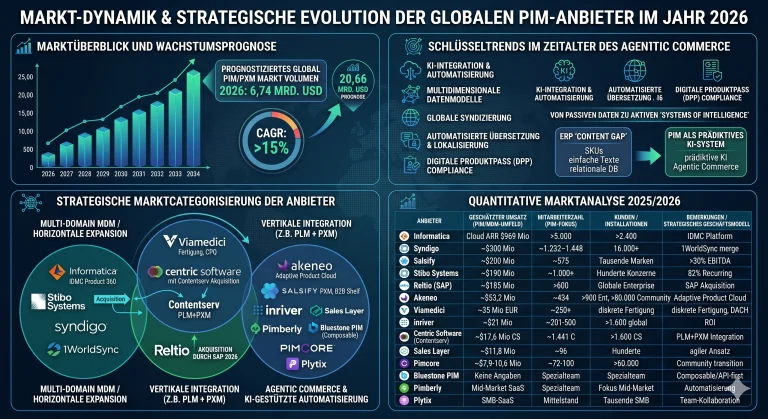
PIM Vendors: Evolution, AI & Strategy
In recent years, PIM has evolved from an administrative necessity into one of the most business-critical strategic disciplines in the digital economy.
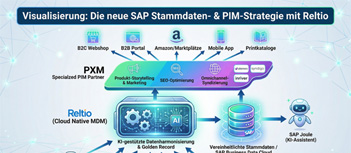
Strategic Analysis: SAP’s Acquisition of Reltio and the Transformation of the Global PIM Ecosystem
The strategic realignment of the world’s leading PIM vendors in the age of agentic artificial intelligence, illustrated by SAP’s acquisition of Reltio.