- General
Billion-Dollar Deals, Private Equity and Platform Mergers: The Comprehensive PIM Consolidation Report 2026
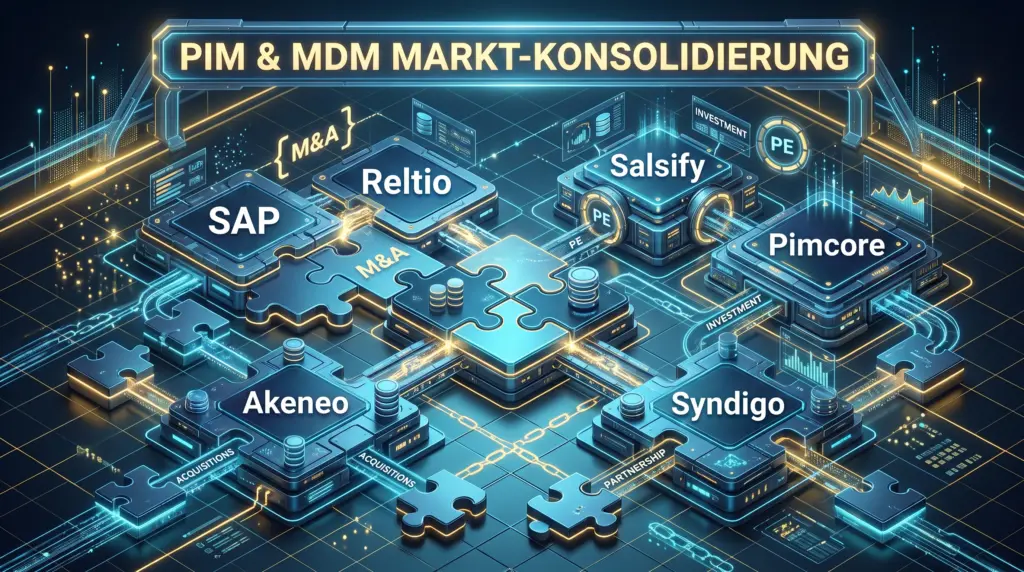
Within eleven weeks, three well-known PIM vendors have gained new owners or expanded into new business areas. Akeneo is acquiring pricing specialist PricingHUB, private equity firm Cinven is acquiring Salsify, and Tenzing is becoming Pimcore’s majority owner. Together with SAP’s acquisition of Reltio and Syndigo’s roll-up strategy, these deals are fundamentally reshaping the vendor landscape. For customers, this raises a practical question: what does a change of ownership mean for contracts, pricing and roadmaps?
Updated on 29 October 2026: New additions cover Stibo Systems’ search for an investor, the reorganisation of censhare under Entirely (DuMont), the acquisition of Onedot and changes of ownership at DAM vendors WoodWing and Extensis Portfolio. On 26 October, we had already added Main Capital/4ALLPORTAL, Trustana, zetVisions and Prodsphere.
Key takeaways
- Cinven is acquiring Salsify (announced on 22 July 2026). The parties did not disclose a purchase price; an industry podcast reports a figure of around $1 billion, roughly half its 2022 valuation.
- Tenzing is replacing Nordwind Growth as Pimcore’s majority owner (27 August 2026) and plans international expansion and acquisitions.
- Akeneo is acquiring PricingHUB (11 June 2026), bringing product data and pricing together.
- Update, 26 October 2026: Main Capital is acquiring a majority stake in 4ALLPORTAL, Graas has acquired Trustana, and Volaris has acquired zetVisions. Consolidation is now reaching mid-sized vendors too.
- Update, 29 October 2026: Stibo Systems is seeking a minority investor for the first time, censhare is now part of martech group Entirely (DuMont), and vendors in the DAM market are also changing hands (WoodWing, Extensis Portfolio).
- Three patterns are shaping the market: private equity is acquiring independent vendors, platform companies are securing the data layer, and the boundaries of the PIM category are blurring.
- Customers should proactively review their contracts when ownership changes, particularly price escalation clauses, data portability, roadmap commitments and change-of-control provisions.
PIM consolidation in 2026: the deals at a glance
Consolidation is unfolding in two waves: first, platform companies such as Dassault Systèmes, Salesforce and SAP acquired data management specialists. Since summer 2026, private equity firms have been acquiring the major independent PIM vendors.
| Date | Target company | Buyer / investor | Type | Value | Strategic rationale |
|---|---|---|---|---|---|
| 26.10.2026 | 4ALLPORTAL (Gütersloh) | Main Capital Partners (private equity) | Majority stake, founders and management retain stakes | Undisclosed | Expansion of PIM and MDM, international growth, acquisitions |
| 21.10.2026 | Stibo Systems (Aarhus) | Not yet determined; bank DNB Carnegie is managing the sale process | Minority investor sought, Stibo Foundation retains control | Undisclosed | Capital, industry expertise and connections for international growth and acquisitions |
| 19.10.2026 | WoodWing (Netherlands), DAM | Omnidocs (Main Capital) | Merger of two Main Capital portfolio companies | Undisclosed | DAM and document creation within one group; Main also holds a stake in 4ALLPORTAL |
| 27.08.2026 | Pimcore (Salzburg) | Tenzing (private equity) | Majority stake, replacing Nordwind Growth | Undisclosed | International growth, acquisitions, AI-native data platform |
| 13.08.2026 | Trustana (Singapore) | Graas | Acquisition alongside a $17 million Series B funding round for Graas | Undisclosed | PIM as the data foundation for agentic commerce |
| 22.07.2026 | Salsify (Boston) | Cinven (private equity) | Acquisition | Undisclosed; approximately $1 billion according to an industry podcast | European expansion, data layer for agentic commerce |
| 11.06.2026 | PricingHUB | Akeneo | Acquisition | Undisclosed | Product data and pricing in a single decision-making layer |
| 30.03.2026 | zetVisions (Heidelberg), provider of SPoT | Volaris Group (Constellation Software) | Acquisition | Undisclosed | Long-term investment, independent operations |
| 27.03.2026 (completed 07.05.2026) | Reltio | SAP | Acquisition | Not disclosed | MDM for SAP Business Data Cloud and AI agents |
| 10.03.2026 | Taggstar | Syndigo | Acquisition | Not disclosed | AI-powered conversion messaging based on product data |
| 09.03.2026 | Extensis Portfolio, DAM | Axle AI (acquired from Monotype) | Product line acquisition | Not disclosed | Continues to operate as Portfolio DAM LLC with the same licensing and pricing models |
| 24.11.2025 | Aarini Consulting (Netherlands) with its PIM system Prodsphere | Amista (Ando Group) | Acquisition of the Dutch business | Not disclosed | SAP data consulting plus a proprietary PIM system |
| 18.11.2025 (completed) | Informatica | Salesforce | Acquisition | Approx. $8 billion | Data foundation for Agentforce |
| 03.09.2025 | 1WorldSync | Syndigo | Acquisition | Combined enterprise value > $3.5 billion | Largest product data syndication network |
| 02.07.2025 | censhare (Munich) with MARMIND, ELAINE and Facelift | Entirely AG (DuMont) | Restructuring: DuMont brings its martech subsidiaries together under a new holding company | Not applicable | Martech group spanning content, marketing planning, marketing automation and social media |
| 25.02.2025 | Contentserv | Centric Software (Dassault Systèmes) | Acquisition | Enterprise value of €220 million | PLM and PXM from a single provider |
| 19.02.2025 | DynamicWeb (Denmark) | SignUp Software | Acquisition | Not disclosed | Commerce, CMS and PIM for the Microsoft Dynamics ecosystem |
| 02/2025 | Onedot (Zurich), AI-powered product data onboarding | Exuberance Capital (Armin Dressler) | Acquisition following bankruptcy, with operations continuing under the newly formed PXMize Data AG | Not disclosed | Fresh start backed by an investment commitment; the Onedot brand remains |
| 17.12.2024 | Quable | Ibexa (QNTM Group) | Majority stake | Not disclosed | DXP and PIM on a single platform |
As of 29 October 2026. No closing announcement has yet been issued for the acquisitions of Salsify and Pimcore; both remain subject to regulatory or antitrust approvals.
Cinven acquires Salsify: an exit at a discount
On 22 July 2026, Cinven announced its acquisition of Salsify. Founded in 2012, the Boston-based provider says it serves more than 2,000 customers and over 70,000 users. Around 750 million products are published across approximately 2,600 retail platforms through its platform. In the announcement, CEO Piyush Chaudhari welcomes Cinven as a “new partner” for the company’s next chapter.
The parties did not disclose a purchase price. The Inorganic Podcast, which specialises in software M&A, puts it at around one billion US dollars in cash, citing sources among former employees; this figure has not been confirmed. By comparison, Salsify was valued at around two billion US dollars in its 2022 funding round led by TPG. If the figure is accurate, the sale represents an exit at a substantial discount. This is consistent with the broader SaaS market, where valuations have fallen sharply since the 2021/2022 peak.
Cinven gives two reasons for the acquisition. First, it says Salsify is well positioned to benefit from agentic commerce as an “essential data layer”, because brands need rich, structured and up-to-date product data. Second, the investor sees a “significant untapped market opportunity in Europe”.
Our assessment: Private equity owners invest with a limited holding period and clear return targets. Three levers are familiar from comparable software transactions: higher prices at contract renewal, sales of additional modules, and standardisation of services and implementation. This does not necessarily mean Salsify will follow the same path, but it should factor into any contract strategy. For the DACH market, the announced European expansion also means more competition for enterprise customers, alongside Akeneo, Centric PXM (formerly Contentserv) and established regional providers.
Tenzing acquires majority stake in Pimcore: growth capital for the open-core provider
On 27 August 2026, British investor Tenzing announced that it would acquire a majority stake in Pimcore. Tenzing replaces Nordwind Growth, which had held just over 73% of the shares since the Series B funding round in 2022. Founded in 2009, the Salzburg-based company has more than 400 enterprise customers and over 120,000 installations. The capital comes from Tenzing’s third fund, worth £900 million. The transaction is subject to antitrust approval.
Co-CEOs Dietmar Rietsch and Matthias Blauth stress that the open-core model, deployment options and product strategy will remain unchanged. Reported plans include international expansion, potential acquisitions, greater partner enablement and AI-native development. Explaining the timing, Rietsch says that governed data has become “the bottleneck for enterprise AI”. Tenzing’s Milan Kellner highlights Pimcore’s ability to give companies a trusted version of their product, customer and asset data.
Our assessment: The investment follows Pimcore’s switch from the GPLv3 open-source licence to its own “Pimcore Open Core License” in 2025, which we analysed in our PIM vendor comparison 2026. The pattern is consistent: first, make the licence commercially viable, then bring in capital for growth and acquisitions. For users, this is initially good news, as the vendor becomes larger and more financially stable. However, anyone relying on the Community Edition or working with partners on the basis of low-cost licences should keep a close eye on licensing terms, Enterprise Edition pricing and the partner programme.
Akeneo acquires PricingHUB: product data and pricing converge
On 11 June 2026, Akeneo announced its acquisition of PricingHUB, a price management platform. Financial details were not disclosed. PricingHUB will continue to operate as a separate business unit. Founded in Nantes, Akeneo had previously acquired Sigmento (2018) and Unifai (2023).
Akeneo CEO Romain Fouache cites agentic commerce as the rationale: when AI agents select products, product data and prices “can no longer be managed separately”. PricingHUB co-founder Jérôme Laurent describes a shared “decision layer”.
Our assessment: The deal breaks with the traditional division of responsibilities, where pricing logic resided exclusively in ERP, CPQ or specialised revenue management systems. The idea makes sense, as agents compare attributes, availability and price in a single step. For users, however, it raises new questions: which system is the source of truth for prices? How are pricing rules synchronised from the ERP? In future, incorrect attributes will affect not just discoverability, but pricing calculations and margins directly. Data quality thus becomes a financial metric.
Can your product data stand up to scrutiny from an AI agent?
When agents compare attributes, availability and price in a single step, data quality determines product selection and margins. Our vendor-independent Agentic Readiness Assessment measures where your PIM stands today.
October 2026 update: consolidation reaches mid-sized vendors
Following the summer’s major deals, consolidation has also reached smaller and regional vendors.
- Main Capital and 4ALLPORTAL: On 26 October 2026, software investor Main Capital Partners announced that funds it advises would acquire a majority stake in Gütersloh-based 4ALLPORTAL. The founders and management will retain stakes in the business. 4ALLPORTAL reports more than 100 corporate customers and over 100,000 users, primarily in the DACH region. Plans include expanding PIM and MDM capabilities, international expansion, AI features and targeted acquisitions.
- Graas and Trustana: In August 2026, Singapore-based commerce AI provider Graas acquired Trustana, a PIM vendor also based in Singapore. At the same time, Graas closed a US$17 million funding round.
- Volaris and zetVisions: In spring 2026, Volaris Group, a subsidiary of Canadian software group Constellation Software, acquired Heidelberg-based zetVisions GmbH. Its zetVisions SPoT solution is an SAP add-on for master data management. According to zetVisions, it will continue to operate independently.
- Amista and Prodsphere: In November 2025, Belgian SAP service provider Amista, part of the Ando Group, acquired the Dutch business of Aarini Consulting, including its PIM system Prodsphere. The entities in Singapore, Dubai and India were not part of the transaction.
- ON EBX: Not an acquisition, but a spin-off. Since March 2026, Cloud Software Group has operated the MDM system TIBCO EBX as a separate business unit, ON EBX. According to the vendor, existing contracts and support arrangements remain in place.
- Perfion and Boyum IT: Boyum IT Solutions acquired Danish vendor Perfion back in 2023. Boyum is majority-owned by private equity investor Volpi Capital, which plans further acquisitions in the product data sector. Read more in our article Perfion is now part of Boyum IT.
Our assessment: The pattern seen over the summer is continuing among mid-sized vendors. Main Capital has explicitly announced plans for acquisitions, so 4ALLPORTAL is likely to become a platform for further deals. Volaris is part of Constellation Software, which typically holds acquired companies for the long term and lets them operate independently. For customers of smaller vendors, the same advice applies as for Salsify and Pimcore: review your contract, price escalation clauses and roadmap now, not at the next renewal.
Update, 29 October 2026: Stibo opens up to investors, DAM follows suit
- Stibo Systems seeks a minority investor: On 21 October 2026, it emerged that the foundation-owned Stibo Group was seeking a co-owner for its subsidiary Stibo Systems for the first time. DNB Carnegie is managing the process, which is expected to run into 2027. The foundation will retain control. The funding is intended to finance international growth and acquisitions. Stibo Systems reported record revenue of DKK 1.31 billion for 2025/26 (up 6%). At the same time, Stibo is moving to a SaaS-only model. Read more in Stibo Systems moves to SaaS only.
- censhare joins the Entirely martech group: DuMont, the majority owner of censhare since 2019, brought its marketing software businesses together in July 2025 under the newly established Entirely AG, based in Baar, Switzerland. Alongside censhare, the group includes marketing planning software MARMIND, marketing automation platform ELAINE and social media software Facelift, with more than 400 employees and over 2,800 customers in total. Former censhare CEO Tobias Ackermann became CEO of Entirely.
- Onedot relaunches under new ownership: The Zurich-based specialist in AI-powered product data onboarding filed for bankruptcy in November 2024. In February 2025, Armin Dressler’s investment firm Exuberance Capital, based in Kreuzlingen, acquired the business. It continues to operate under the newly established PXMize Data AG, retaining the Onedot brand. Founder Bernhard Bicher and his team have stayed on.
- DAM: WoodWing and Extensis Portfolio: Main Capital, the majority owner of WoodWing since 2020, merged the DAM vendor with its portfolio company Omnidocs on 19 October 2026. Alongside 4ALLPORTAL, this places DAM and PIM software under the same investor. In March 2026, Monotype sold its DAM software Extensis Portfolio to Axle AI. It continues to operate as Portfolio DAM LLC with the same licensing and pricing models. Back in January 2025, AshGrove Capital invested £32 million in content and DAM vendor Amplience.
- Pimberly funds growth with debt: No change of ownership, but £5 million in venture debt from Virgin Money (December 2025) to support growth in the UK and the US. According to Pimberly, its annual recurring revenue exceeded $10 million in June 2026, and it has not ruled out acquisitions of its own.
Our assessment: With Stibo, one of Europe’s last major independent MDM and PIM vendors is opening up to an external investor. A minority stake changes little for customers initially. But it increases the pressure to grow and improve margins, just as the business shifts to SaaS. The DAM market shows the same pattern as PIM: financial investors are bringing vendors together, and DAM, PIM and content creation are converging within groups. Companies that procure PIM and DAM separately should know who owns both vendors and review their contracts accordingly.
The first wave: platform giants secure the data layer
The summer deals build on an initial wave in which major software groups acquired data management specialists. We have assessed these deals in detail in separate analyses. Here is a brief summary.
- SAP and Reltio: On March 27, 2026, SAP announced its acquisition of MDM provider Reltio; the deal closed on May 7, 2026. Reltio is intended to strengthen SAP Business Data Cloud and make SAP and non-SAP data usable for AI agents. SAP has committed to keeping it available as a standalone solution. For details, see our analysis of SAP’s acquisition of Reltio.
- Salesforce and Informatica: Salesforce completed the acquisition, worth around US$8 billion, on November 18, 2025. Informatica’s MDM is being integrated into Data 360 and Agentforce, and its PIM solution, Product 360, is now also part of Salesforce. CEO Marc Benioff: “Data and context is the true fuel of Agentforce, and without clean, connected, trusted data there is no intelligence, only hallucination.”
- Centric Software and Contentserv: Dassault Systèmes subsidiary Centric acquired Contentserv at an enterprise value of €220 million (announced on February 25, 2025). At the time, Contentserv served more than 1,600 customers in 90 countries and now operates as Centric PXM.
- Syndigo and 1WorldSync: The acquisition of 1WorldSync in September 2025 created a company with an enterprise value of more than US$3.5 billion, over 18,000 customers in 60 countries and connections to more than 3,500 retailers. Conversion specialist Taggstar followed in March 2026. Read more in our investor perspective on vendor consolidation.
- Ibexa and Quable: In December 2024, DXP provider Ibexa, part of QNTM Group, acquired a majority stake in French cloud PIM provider Quable.
Three patterns behind the consolidation
1. Private equity is acquiring independent vendors. Salsify, Pimcore and 4ALLPORTAL join a long list: inriver has been majority-owned by Thomas H. Lee Partners since 2022, Syndigo is backed by financial investors, and Perfion is majority-owned by Volpi Capital through Boyum IT. This brings capital, but also pressure to deliver returns and a “buy and build” strategy. Further acquisitions are likely.
2. Platform companies are securing the data layer. SAP, Salesforce and Dassault Systèmes are not buying PIM functionality, but control over the golden record. Their rationale is the same: AI agents need reliable, connected master data. SAP Executive Board member Muhammad Alam put it this way: “AI cannot reach its full potential when data is fragmented across business units, platforms and domains without connection or context.” For users, the risk is greater lock-in to the respective suite.
3. The boundaries of PIM are blurring. PIM is expanding into adjacent disciplines: pricing at Akeneo, conversion optimization at Syndigo, digital experience at Ibexa and Quable, and PLM at Centric. Traditional feature comparisons are becoming less meaningful. Selecting a PIM today often means choosing a platform strategy too.
The common driver is agentic AI. Whether Cinven, SAP or Salesforce, all justify their investments with the same thesis: structured product data is a prerequisite for AI agents. Our article on MCP and Agentic Commerce explains why.
Investors are betting on AI-ready product data. Are you?
Whether your vendor changes ownership or not, what matters is whether your architecture, data model and governance can support autonomous AI workflows. We assess this using the ROOT© methodology and translate the findings into a prioritized roadmap.
What PIM consolidation means for users
Each type of deal brings its own opportunities and risks, and calls for a different response.
| Deal type | Examples | Opportunities | Risks | Recommendation |
|---|---|---|---|---|
| Private equity acquisition | Salsify, Pimcore, 4ALLPORTAL | Capital for product development, more stable funding, acquisitions | Price increases at renewal, upselling, standardized service | Secure terms early, negotiate price caps |
| Acquisition by a platform company | Reltio, Informatica, Contentserv | Deep suite integration, investment protection | Lock-in, lower priority for third-party connectors, rebranding and migration | Get connector and roadmap commitments in writing, assess the architecture for ease of replacing components |
| Adding functionality through acquisition | PricingHUB, Taggstar | New functionality from a single provider | Unclear system-of-record responsibilities, bundles, additional costs | Clarify which system is the system of record, assess modules independently |
Five warning signs: when to review your PIM contract
- A change of ownership at your vendor or its parent company.
- A new platform, rebranding or a “next-generation” version, often a precursor to mandatory migration.
- Changes to the licensing or pricing model, such as a shift from user licences to usage-based or AI quotas.
- Changes in account management, support or the partner programme.
- Postponed or cancelled roadmap items, particularly connectors to third-party systems.
Negotiation strategies for existing customers
A change of ownership is not a reason to switch, but it is a reason to review. Switching vendors on impulse usually costs more than it saves. A better approach is to strengthen your negotiating position systematically:
- Limit price escalation clauses: Link annual increases to an index or set a fixed cap.
- Use timing to your advantage: Vendors are often open to negotiation around a change of ownership. Multi-year contracts lock in terms.
- Agree a change-of-control clause: Secure a special termination right or price protection in the event of future ownership changes.
- Make data portability a contractual requirement: Ensure full export of data, the data model, relationships and assets in open formats, including exit support.
- Secure roadmap and connector commitments: Contractually safeguard critical integrations with ERP, online stores and marketplaces.
- Make AI costs transparent: Clarify how AI features, agent access and MCP calls are billed today and in the future.
Measure first, then negotiate
Knowing how AI-ready your data foundation is gives you clear arguments when negotiating roadmap, connector and AI cost commitments. The Agentic Readiness Assessment provides a measurable baseline.
Conclusion: neutrality is becoming scarce
Consolidation in the PIM market entered a second phase in 2026. Financial investors are following strategic buyers, and both justify their investments by pointing to the importance of structured product data for AI agents. For customers, this means vendors are becoming larger, financially stronger and broader in scope, but also more focused on returns. This makes advice that does not depend on a vendor’s licence revenue all the more important.
PIM Vendor & Contract Review
We review your existing PIM contracts, assess the impact of a change of ownership on your roadmap and support renegotiations or a structured PIM selection, independently of any vendor. Have questions? We are happy to advise you.
Frequently asked questions
Who acquired Salsify?
The international private equity firm Cinven. The acquisition was announced on 22 July 2026. As of October 2026, it has not yet closed and remains subject to regulatory approval.
How much did Cinven pay for Salsify?
No price was officially disclosed. An industry podcast, citing former employees, reports a figure of around US$1 billion. In 2022, Salsify was still valued at around US$2 billion.
What does Tenzing’s investment mean for Pimcore customers?
According to Pimcore, the open-core model, deployment options and product strategy remain unchanged. Customers and partners should nevertheless monitor licensing terms, pricing and the partner programme, as Tenzing plans expansion and acquisitions.
Why did Akeneo acquire PricingHUB?
Akeneo wants to bring product data and pricing together in a single decision layer. The driver is agentic commerce, where AI agents evaluate attributes, availability and price together.
Do licence prices rise after a private equity acquisition?
Not necessarily, but price adjustments at contract renewal are a common lever. Indexed or capped pricing clauses and a change-of-control provision provide planning certainty.
Should I switch PIM vendors because of an acquisition?
Not on impulse. A change of ownership is an opportunity to review your contract, roadmap and architecture. Switching is only worthwhile when features, costs or integration capabilities demonstrably no longer fit your strategy.
Sources
- Salsify: Press Release: Cinven to acquire Salsify, Inc.
- Hoodline: Boston tech darling Salsify gets snapped up by Cinven
- Inorganic Podcast: Salsify exits to Cinven for ~$1B
- TPG: Salsify closes $200 million investment
- Tenzing: Our investment into Pimcore
- Dechert: Dechert advises Tenzing on its investment in Pimcore
- brutkasten: Pimcore gets a new majority owner
- Pimcore: Breaking free: Pimcore says goodbye to GPL and enters a new era with POCL
- Akeneo: Akeneo announces acquisition of PricingHUB
- Akeneo: Akeneo acquires Sigmento
- SAP News: SAP to acquire Reltio
- SAP News: SAP completes acquisition of Reltio
- 406 Ventures: SAP to acquire Reltio to make SAP and non-SAP data AI-ready
- ChannelLife: Salesforce to acquire Informatica for equity value of USD 8 billion
- Salesforce: Salesforce completes acquisition of Informatica
- Dassault Systèmes: Centric Software’s acquisition of Contentserv
- Digital Commerce 360: Syndigo acquires 1WorldSync
- Syndigo: Syndigo acquires Taggstar
- Ibexa: Ibexa and Quable: the alliance of two market leaders
- inriver: inriver announces growth investment from Thomas H. Lee Partners
- Main Capital Partners: Main partners with 4ALLPORTAL
- Trustana: Trustana acquired by Graas
- Startup Researcher: Graas acquires Trustana and closes USD 17 million Series B
- Unternehmeredition: Volaris Group acquires zetVisions
- Amista: Amista strengthens data cloud capabilities with acquisition of Aarini
- Business Wire: EBX Is Now Part of ON EBX
- Stiften.dk: 232-year-old Aarhus giant seeks a new co-owner (21.10.2026)
- NKP M&A Insights: Stibo Group is working with DNB Carnegie to explore a minority sale in Stibo Systems
- new business: DuMont consolidates MarTech subsidiaries under Entirely AG (02.07.2025)
- Netzwoche: New MarTech company Entirely launches
- HORIZONT: Acquisition: Onedot becomes PXMize Data (19.02.2025)
- Startupticker: Investor enables a fresh start for Onedot (13.03.2025)
- Dutch IT Channel: Main Capital brings Omnidocs and WoodWing together (19.10.2026)
- Monotype: Axle AI acquires Extensis Portfolio (09.03.2026)
- Dynamics Communities: SignUp Software acquires DynamicWeb
- Retail Tech Innovation Hub: Amplience bags £32 million investment from AshGrove Capital
- Pimberly: Pimberly secures £5 million venture debt funding from Virgin Money
Request an Agentic Readiness Assessment
Want to know how well your PIM and product data are prepared for AI agents, or what a change of ownership at your vendor means for your contract and roadmap? Leave your contact details and briefly tell us which PIM system you use.
We will get back to you with a proposal for an Agentic Readiness Assessment or Vendor & Contract Review tailored to your business.
PIM Market Update Newsletter
Acquisitions, new vendors, practical tips: by email every six to eight weeks
Concise and vendor-neutral: developments in the PIM market and what they mean for your selection process. Unsubscribe at any time.
More PIM insights
News & Blog
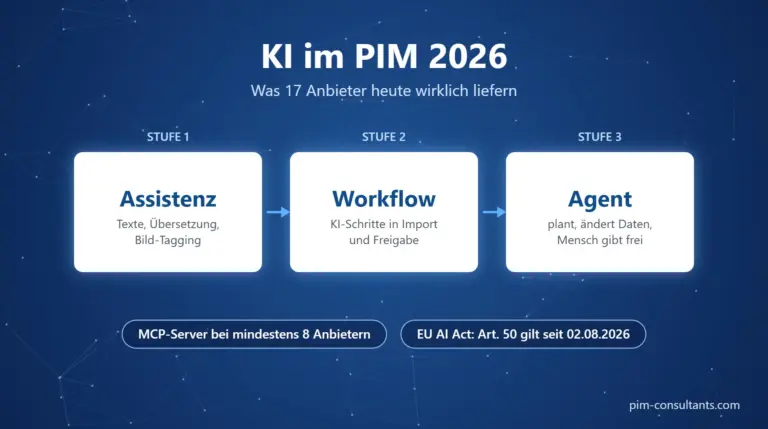
AI in PIM 2026: What vendors actually deliver today
Which AI capabilities PIM vendors actually deliver in 2026: an overview of agents, MCP servers, custom AI models and pricing across 17 vendors, plus obligations under the EU AI Act.
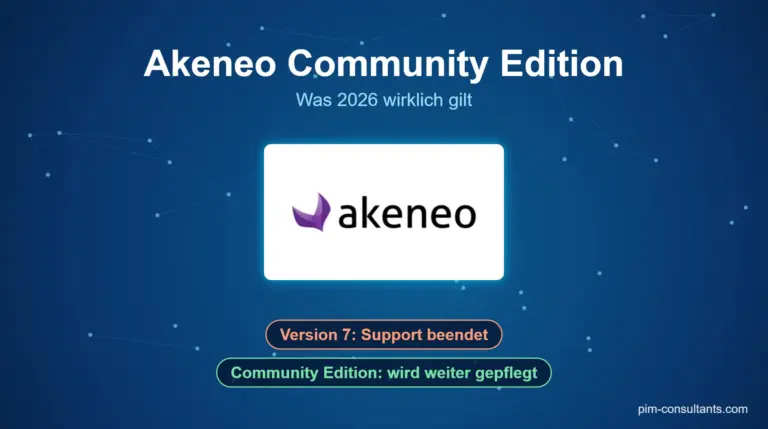
Akeneo Community Edition 2026: Not discontinued, but changing
Has the Akeneo Community Edition been discontinued? No. Support for Akeneo 7 On-Premise and PaaS ended on 30 September 2026. Here are the facts and the five options now available to Enterprise customers.
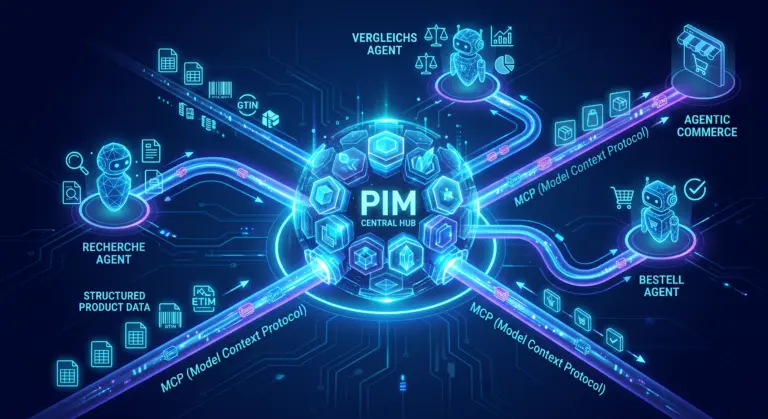
Beyond Chatbots: How Model Context Protocol (MCP) and Agentic Commerce Turn PIM into the Nervous System
AI agents read product data, not product pages. How the Model Context Protocol (MCP) works, which PIM vendors already offer MCP servers, and how to prepare your data model and governance.
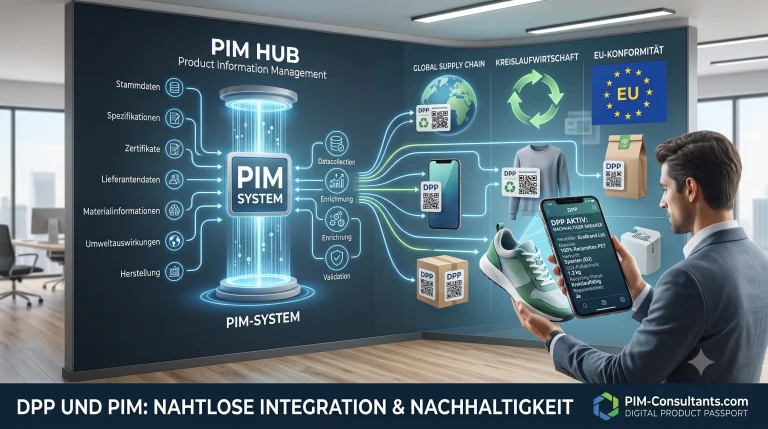
Digital Product Passport (DPP) & PIM: A Strategic Guide
How do you prepare your PIM for the Digital Product Passport? Learn how robust data governance and GS1 standards help you meet EU requirements.
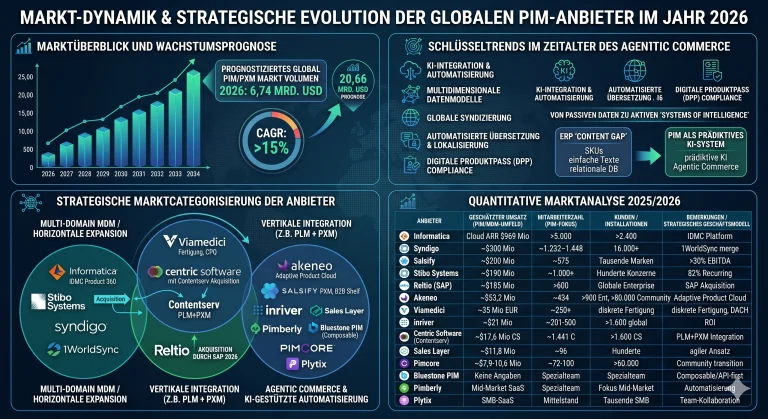
PIM Vendors: Evolution, AI & Strategy
In recent years, PIM has evolved from an administrative necessity into one of the most business-critical strategic disciplines in the digital economy.
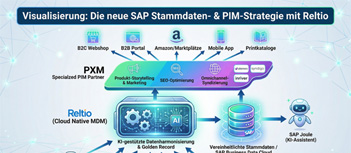
Strategic Analysis: SAP’s Acquisition of Reltio and the Transformation of the Global PIM Ecosystem
The strategic realignment of the world’s leading PIM vendors in the age of agentic artificial intelligence, illustrated by SAP’s acquisition of Reltio.