- General
AI in PIM 2026: What vendors actually deliver today
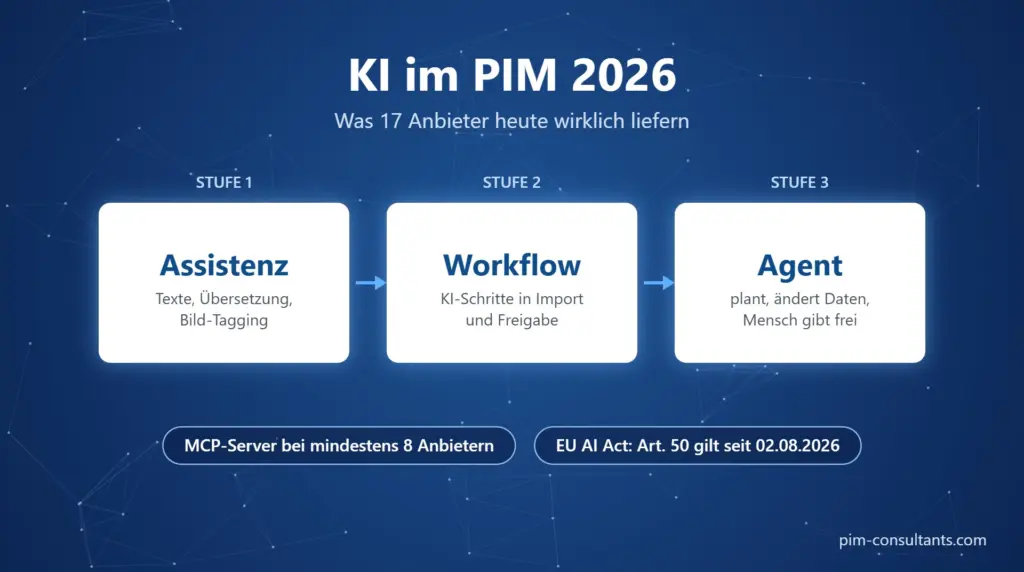
Almost every PIM vendor is promoting AI in 2026, and many now talk about “agents”. From the outside, it is hard to tell what is usable in the product and what exists only in a press release. We reviewed public information from 17 vendors: help centres, documentation, release notes and press releases, as of October 2026. Our wiki article AI in PIM explains what AI can do in PIM in principle. Here, we look at the current state of the market.
Key takeaways
- Almost all PIM systems can now generate and translate text, classify products and tag images. These capabilities are no longer a differentiator.
- Agents that plan and execute multiple steps are publicly documented by Akeneo, Pimcore and Bluestone. At Syndigo, inriver and Stibo Systems, they are mainly at the announcement stage.
- At least eight vendors have documented an MCP server through which external AI assistants can access product data. This is becoming standard.
- Hardly any vendor publicly states whether an AI feature is generally available or still in beta. You should specify this in the contract.
- The transparency obligations under the EU AI Act have applied since 2 August 2026. Generated product images and text without meaningful editorial review may require labelling.
Three levels: assistance, workflow, agent
In PIM, the term AI covers very different capabilities. For this comparison, we distinguish three levels:
- Assistance: A feature performs a single task at the click of a button, such as writing product copy from attributes, translating it or tagging an image. A person initiates the task and reviews the result.
- AI in workflows: AI steps run automatically within imports, rules or approval processes, for example extracting attributes from supplier PDFs or triggering translations after every change.
- Agent: An agent is given a goal, plans the steps itself, reads and modifies data, and reports the result. The key question here is who approves changes.
What vendors deliver today
The table shows what vendors publicly document. “Announced” means there is a press release or release note, but no information on availability. Where an entry is missing, we found no public evidence. That does not mean the feature does not exist.
| Vendor | AI features in the product | Agents | MCP server | Can use your own AI model |
|---|---|---|---|---|
| Akeneo | AI Configurations for generation, translation and image tagging, Ziggy assistant | Agentic Ziggy with planning and execution, announced July 2026 | yes, since January 2026, scope depends on the package | yes, as a paid add-on (OpenAI, Anthropic) |
| Salsify | Intelligence Suite in the workflow engine, Angie assistant | SalsifyIQ, announced May 2026 | announced May 2026 | OpenAI, Google, Anthropic or Azure, according to the trade press |
| inriver | Inspire for text and translation, Enrich Assistant | Agents in multi-step workflows, Spring Release March 2026 | yes, since September 2025 | Azure OpenAI |
| Stibo Systems | ProductGen AI for text and translation with an approval workflow | AgentWorkx, announced September 2026 | yes, since June 2026 | own Azure subscription supported, own models for agents planned |
| Syndigo | Synapse and SynapseGo for onboarding, enrichment and syndication | yes, SynapseGo with initial beta customers (April 2026) | no evidence found | not specified |
| Pimcore | Copilot with text generation (Enterprise Edition) | Agent Bundle with proposal, review and approval, listed under “Pimcore Labs” | yes, in the Agent Bundle | yes, per agent, including self-hosted models |
| Viamedici | AI Hub with ChatGPT, Google Vision and DeepL, Data Expert (since October 2026), AI translation | no evidence found | yes, according to the Viamedici blog | integration with external services |
| ATAMYA | Text generation, Smart Import with confidence scores, DeepL | yes, AI Agents depending on the edition | in development | yes (OpenAI, Claude, Gemini, Bedrock, Azure, on-premises) |
| Centric PXM | over 75 AI use cases, according to the product page | Centric AI announced, not PXM-specific | announced, platform-wide | not specified |
| Bluestone PIM | AI Enrich, AI Linguist, AI Analyst | yes, AI Agent with confirmation before every change | yes | yes, own API key for Anthropic, Google or OpenAI |
| Perfion | Generate with AI, AI Mapper for imports, DeepL with glossary | no evidence found | no evidence found | ChatGPT integration |
| Sales Layer | AI Agents for text, translation, categorization and data quality | yes, trigger-based, optional review mode | yes, since June 2025, at no extra cost | not specified |
| Plytix | AI Content Studio for text and image editing | no evidence found | no evidence found | not specified |
| Quable | text generation, bulk enrichment, image tagging | no evidence found | no evidence found | not specified |
| Struct | AI Assistant with review mode, only in Struct PIM 4 | governance agent in preview | in preview (June 2026) | own OpenAI API key |
| SAP Commerce Cloud | Joule Catalog Optimization Agent checks text, attributes and translations | yes, generally available since Q1 2026, AI Units required | not specified | not specified |
| Informatica | CLAIRE Copilot in Product 360 (documentation questions) | Data Quality Agent generally available, Agentic MDM planned for Q4 2026 | yes, for catalog and governance | not specified |
Information based on vendor websites, documentation and press releases as of 26 October 2026. Please verify in a proof of concept before making a decision.
Which PIM has the right AI capabilities for you?
In the PIM vendor directory, you can filter by AI and MCP, industry, ERP and company size.
Five findings from the analysis
1. Availability often remains unclear
Only SAP and Informatica explicitly describe individual agents as generally available. Syndigo mentions beta customers, while Struct refers to a preview. Most other vendors use “introduces” or “launches” in their press releases without specifying when the feature will be available or which package includes it. Stibo Systems asks users to register their interest in AgentWorkx. For your selection process, this means asking vendors to demonstrate what is running in the product today and ensuring the quote specifies which AI features are included.
2. MCP is becoming standard
The Model Context Protocol (MCP) enables AI assistants such as Claude, ChatGPT or Copilot to access product data. MCP servers are documented for Akeneo, inriver, Stibo Systems, Pimcore, Bluestone, Sales Layer, Viamedici and Informatica. Salsify, Struct, Centric and ATAMYA have announced one or offer a preview. What matters is whether the server has read-only or also write access, and what permissions it has. Akeneo recommends a dedicated API user with minimal permissions. For more background, read our article MCP and Agentic Commerce.
3. Approval processes vary considerably
Pimcore documents its approval process most clearly: every write action by an agent is proposed, reviewed and approved. Akeneo states that Agentic Ziggy changes nothing without consent. Bluestone asks before making any change. Other vendors, by contrast, promote workflows without manual intervention. For product data with legal implications, such as safety instructions, hazardous substance information or technical specifications, you should insist on an approval step.
4. Using your own AI model often costs extra
Many companies want to use an AI model that their IT department has already approved, for example through Azure OpenAI. This is possible with Pimcore, ATAMYA, Bluestone and Struct, and with Stibo Systems if you have your own Azure subscription. With Akeneo, using your own model is a paid add-on, while the standard model is included in the package. Clarify where your data is processed and whether it is used for training.
5. AI pricing is rarely made public
Plytix is the most transparent: every plan includes 500 AI credits per month, with one credit per text and 10 to 30 per image. Bluestone states that its subscription includes one million tokens per day for the agent, while Sales Layer provides the MCP server at no extra charge. SAP charges AI Units for the Catalog Optimization Agent. For the other vendors, AI is tied to the package or edition, and prices are not public. Ask for AI costs to be itemised separately in the quote, including a scenario in which you significantly scale up usage.
Benefits documented by customers
Public metrics linked to named customers are rare. Here is what we found:
| Customer | Vendor | Result reported by the source |
|---|---|---|
| Kerry Group | Salsify | Product review in 5 minutes instead of 20 to 30 |
| Synchro Diffusion | Akeneo | Enrichment 66% faster, completeness increased from 40% to 90% |
| Elemis | Akeneo | Launch-day analysis in around 30 minutes instead of around 3 hours (estimate) |
| Lyreco | Stibo Systems | Text generation 80% faster, across 25 markets |
Most other figures on the market come from vendor surveys or events without named customers. During the selection process, ask for reference customers using an AI feature in production and for details of their starting point.
Is your product data ready for AI agents?
The Agentic Readiness Assessment shows where your data, processes and systems stand today and what needs to be done before deploying agents.
What the EU AI Act means for AI in PIM
The transparency obligations under Article 50 of the AI Act have applied since 2 August 2026. The Digital Omnibus adopted in July 2026 (Regulation (EU) 2026/1744) did not postpone this deadline, although it did postpone the obligations for high-risk systems. Three points are particularly important for product data:
- Chatbots and product advisers must be identifiable as AI.
- Providers of generative AI, including PIM vendors with built-in text generation, must mark generated content in a machine-readable format. Systems already on the market before August 2026 have a transition period until 2 December 2026. Ask your vendor how it is implementing this.
- Generated product images that depict a product differently from how it actually looks may qualify as deepfakes and must then be labelled accordingly. For text, the question is whether a human takes editorial responsibility for it. Under the Commission’s guidelines, a purely formal review is not sufficient.
The obligations for high-risk systems under Annex III do not apply until 2 December 2027 and generally do not affect typical product data processes. Seek legal advice on the classification of your use case. This article does not constitute legal advice.
Questions you should ask every vendor
- Which AI features are generally available today, which are in beta or announced, and which are included in our package?
- Can agents change data, and what does the approval step look like?
- Is there an MCP server, does it have write access, and how are permissions and logging managed?
- Can we use our own AI model or Azure subscription, and what does that cost?
- How is AI content labelled under the AI Act, and is that labelling retained when content is syndicated to retailers?
- Which reference customer is using the feature in production, and what measurable benefits has it delivered?
Want to assess the AI claims of your shortlisted vendors?
In a free initial consultation (30 minutes), we identify which AI features will genuinely benefit your product data and how to test them in a proof of concept.
Frequently asked questions
Which PIM systems have AI agents?
Multi-step agents with approval workflows are publicly documented for Akeneo (Agentic Ziggy), Pimcore (Agent Bundle) and Bluestone PIM (AI Agent). SAP offers a generally available Catalog Optimization Agent for SAP Commerce Cloud. Syndigo, inriver and Stibo Systems have announced agents, with Syndigo already working with initial beta customers.
What is an MCP server in PIM?
An MCP server makes product data accessible to AI assistants such as Claude, ChatGPT or Copilot via the open Model Context Protocol. Depending on their permissions, assistants can either read data only or also modify it. MCP servers are documented for Akeneo, inriver, Stibo Systems, Pimcore, Bluestone and Sales Layer, among others.
Can I use my own AI model in the PIM system?
Yes, several vendors support this, including Pimcore, ATAMYA, Bluestone and Struct, as well as Stibo Systems via your own Azure subscription. Akeneo offers support for your own model as a paid add-on. Clarify costs, data processing and training before signing a contract.
Does AI-generated product copy need to be labelled?
It depends on the specific case. The transparency obligations of the EU AI Act have applied since 2 August 2026. As providers, PIM vendors must label content in a machine-readable format. Whether you also need to label it depends, among other things, on whether a human takes editorial responsibility for the copy. Generated product images that depict the product differently may qualify as deepfakes. Seek legal advice on your specific case.
Sources
- Akeneo: AI Configurations
- Akeneo: Security and privacy of AI features
- Akeneo: Agentic Ziggy (July 2026)
- Akeneo: MCP Server
- Salsify: SalsifyIQ (May 2026)
- Digital Commerce 360: Salsify Intelligence Suite
- Salsify: Kerry Group and VitrA
- inriver: Inspire
- inriver: Agents and workflow orchestration (March 2026)
- inriver: MCP
- Stibo Systems: ProductGen AI
- Stibo Systems: MCP Server (June 2026)
- Stibo Systems: AgentWorkx (September 2026)
- Stibo Systems: Lyreco
- e-commerce.news: Syndigo SynapseGo
- Pimcore: Agent Bundle
- Pimcore: Copilot
- Viamedici: EPIM 5 Update 5
- Viamedici: MCP servers in PIM
- ATAMYA: AI in PIM
- ATAMYA: Features by edition
- Centric Software: Centric PXM
- Bluestone PIM: AI Agent
- Bluestone PIM: MCP Server
- Boyum: AI features in Perfion
- Sales Layer: MCP Server
- Plytix: Pricing and AI credits
- Quable: AI in PIM
- Struct: AI Assistant
- Struct: Roadmap 2026
- SAP: Business AI Release Highlights Q1 2026
- Salesforce: Informatica agents (June 2026)
- Akeneo: Synchro Diffusion
- Akeneo: Elemis
- Regulation (EU) 2026/1744 (Digital Omnibus on AI)
- European Commission: Guidelines on transparency obligations (July 2026)
As of: 26 October 2026
Have any questions? We are happy to advise you.
Want to know which AI features make sense for your product data and which vendors already offer them? Get in touch.
Request vendor-neutral advice
Planning to add AI features to your PIM system or currently evaluating vendors? Send us a brief message outlining the systems you use and where you are in the process.
We will get back to you with an initial assessment and suggested next steps.
PIM Market Update newsletter
Acquisitions, new vendors and practical tips: by email every six to eight weeks
Concise and vendor-neutral: what is changing in the PIM market and what it means for your selection process. Unsubscribe at any time.
More PIM insights
News & Blog
Akeneo Community Edition 2026: Not discontinued, but changing
Has the Akeneo Community Edition been discontinued? No. Support for Akeneo 7 On-Premise and PaaS ended on 30 September 2026. Here are the facts and the five options now available to Enterprise customers.
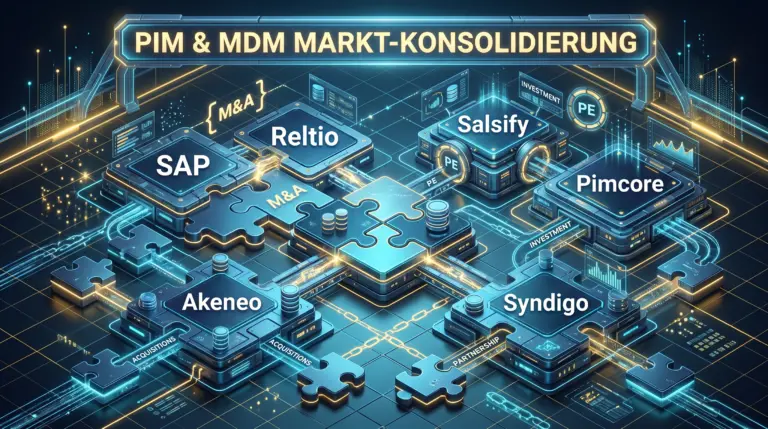
Billion-Dollar Deals, Private Equity and Platform Mergers: The Comprehensive PIM Consolidation Report 2026
Cinven buys Salsify, Tenzing takes over Pimcore, Akeneo acquires PricingHUB: an overview of all PIM deals in 2025/2026, the three patterns behind them and what users should now look out for in their contracts.
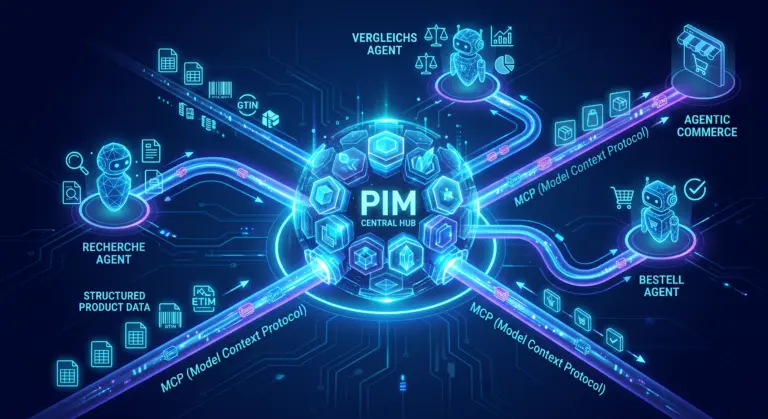
Beyond Chatbots: How Model Context Protocol (MCP) and Agentic Commerce Turn PIM into the Nervous System
AI agents read product data, not product pages. How the Model Context Protocol (MCP) works, which PIM vendors already offer MCP servers, and how to prepare your data model and governance.
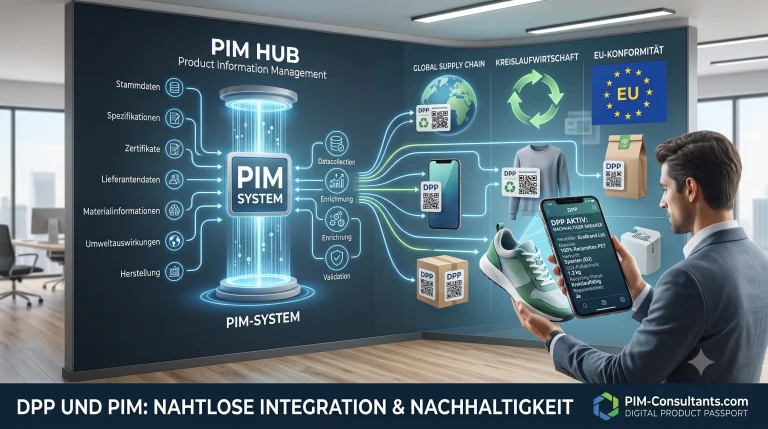
Digital Product Passport (DPP) & PIM: A Strategic Guide
How do you prepare your PIM for the Digital Product Passport? Learn how robust data governance and GS1 standards help you meet EU requirements.
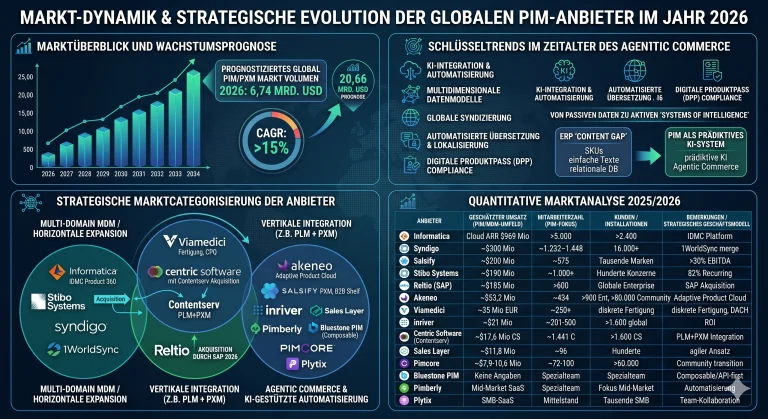
PIM Vendors: Evolution, AI & Strategy
In recent years, PIM has evolved from an administrative necessity into one of the most business-critical strategic disciplines in the digital economy.
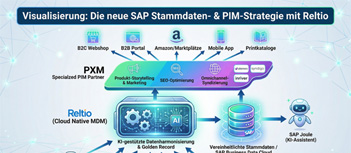
Strategic Analysis: SAP’s Acquisition of Reltio and the Transformation of the Global PIM Ecosystem
The strategic realignment of the world’s leading PIM vendors in the age of agentic artificial intelligence, illustrated by SAP’s acquisition of Reltio.