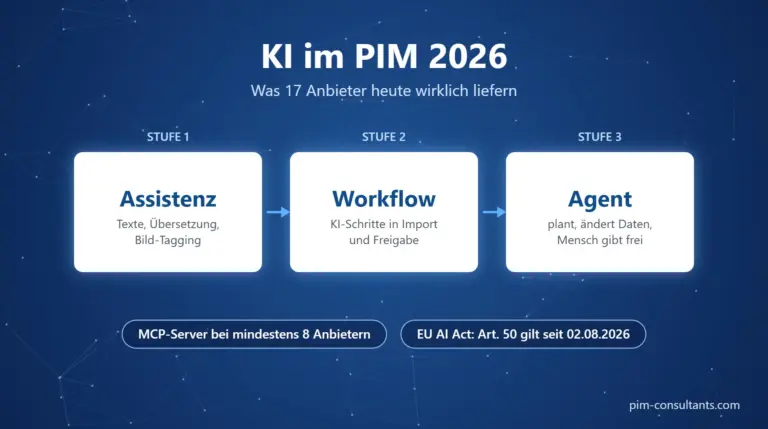
AI in PIM 2026: What vendors actually deliver today
Which AI capabilities PIM vendors actually deliver in 2026: an overview of agents, MCP servers, custom AI models and pricing across 17 vendors, plus obligations under the EU AI Act.
AI in PIM: the current state of play
Looking for the latest on AI in PIM? Our overview, “AI in PIM 2026: What vendors actually deliver today”, shows which AI capabilities PIM vendors are already delivering and which are still just announcements.
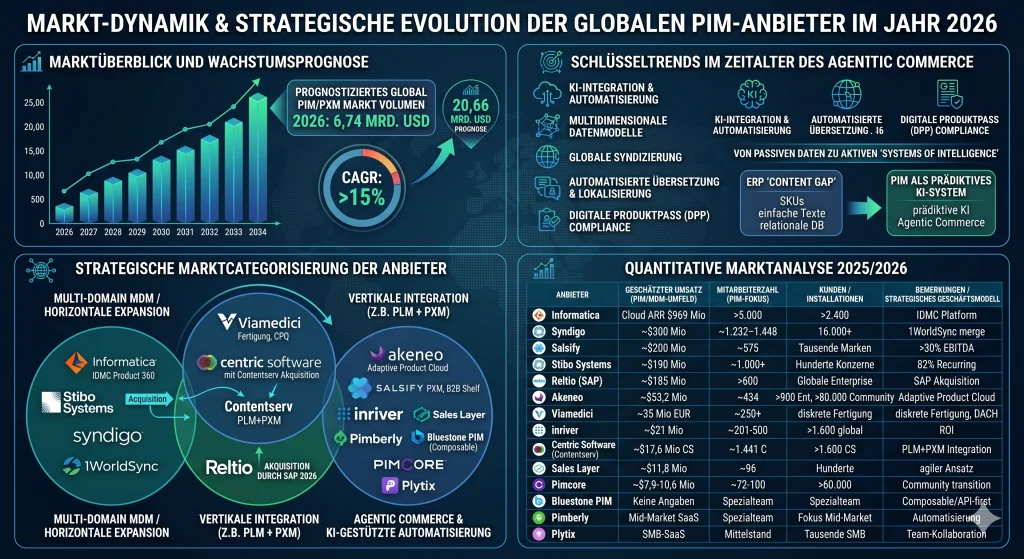
Over the past ten years, managing product information has evolved from a back-office administrative necessity into one of the most business-critical disciplines in the digital economy. In 2026, the market for Product Information Management (PIM) and the closely related field of Product Experience Management (PXM) is shaped by consolidation, architectural paradigm shifts and the integration of artificial intelligence (AI). Macroeconomic forecasts put the global PIM market at approximately $6.74 billion in 2026, with a compound annual growth rate (CAGR) of over 15% leading to a projected market size of $20.66 billion in 2034.
Historically, PIM systems primarily served as central databases for storing stock keeping units (SKUs), simple text descriptions and basic attributes to automate the production of printed product catalogues. Later, their scope expanded to bridge the functional gap between operational Enterprise Resource Planning (ERP) systems and emerging digital sales channels. ERP systems, designed for transactional and logistical efficiency, are not suited to managing marketing-focused, emotionally engaging, localised product data enriched for specific channels. Attempting to power e-commerce solely from an ERP system inevitably creates a “content gap” that undermines digital competitiveness.
By 2026, however, the requirements for PIM systems have evolved further across multiple dimensions. Companies need systems that do more than passively store data: they must actively generate it, in some cases intelligently. Today’s modern PIM systems orchestrate highly complex, multidimensional data models, manage automated syndication to marketplaces and retailer portals, automate translation and localisation workflows, and ensure compliance with global regulations such as the European Digital Product Passport (DPP).
In 2026, PIM vendors increasingly differentiate themselves through their underlying strategic direction and architectural philosophy. The most globally significant systems analysed in this study include Syndigo, Stibo Systems, Salsify, Reltio (now part of SAP), Centric Software (which acquired European pioneer Contentserv), Viamedici, Pimcore, Akeneo and Informatica. This leading group is complemented by specialists and challengers such as inriver, Sales Layer, Pimberly, Bluestone PIM and Plytix, which are shaping the market through innovative architectural approaches or a strong niche focus.
While some of these vendors pursue horizontal expansion to build industry-agnostic, multi-domain solutions, others focus on vertical integration within specific industrial value chains or on transforming into AI-powered automation platforms for what is known as “agentic commerce”. This study analyses these vendors’ quantitative market positions, evaluates their strategic priorities for international expansion and horizontal and vertical integration, and examines the impact of AI on the vendors, their software architectures and the global commerce industry as a whole.
Measuring market share, revenue and installed bases in the PIM sector requires complex market analysis, as vendors’ business models and software categories increasingly overlap. Some software companies operate as specialist best-of-breed PIM/PXM vendors, whose reported company revenue corresponds almost entirely to their contribution to the PIM market’s total revenue. Others offer PIM as one of several domains within a comprehensive Master Data Management (MDM) suite. The following table consolidates the available market data for 2025/2026 on revenue, employee numbers and customer bases, ranked in descending order by estimated PIM/MDM-related revenue or company size.
| Vendor | Estimated Revenue (PIM/MDM) | Employees (PIM Focus) | Customers / Installations | Notes / Strategic Business Model |
| Informatica |
Cloud ARR $969 million (company-wide) |
>5,000 (company-wide) |
>2,400 cloud customers |
“Product 360” is an integral component of the IDMC platform; total group revenue of ~$1.64 billion. |
| Syndigo |
~$300 million USD |
~1,232–1,448 |
approx. 16,000+ customers (highly fragmented) |
The acquisition of 1WorldSync created a $3.5 billion PXM platform; private equity-backed. |
| Salsify |
~$200 million USD |
~575 |
>Thousands of brands (5 billion published products) |
Focus on PXM and the B2B digital shelf; highly profitable with an EBITDA margin of >30%. |
| Stibo Systems |
~$190 million USD (1.236 billion DKK) |
~1,000+ (Stibo Group) |
Hundreds of global corporations |
Industry-agnostic multi-domain MDM with a very strong PIM focus; 82% recurring revenue. |
| Reltio (SAP) | ~$185 million USD ARR | >600 | Global enterprise customer base |
Acquired by SAP in 2026; integration into SAP Business Data Cloud. |
| Akeneo |
~$53.2 million USD |
~434 |
>900 enterprise customers, >80,000 community instances |
Strong open SaaS growth; evolving into the “Adaptive Product Cloud” for agentic AI. |
| Viamedici | ~35 million EUR |
~250+ |
Focus on the DACH region & industry |
Strong positioning in discrete manufacturing, automotive and electronics; deep CPQ integration. |
| inriver | ~$21 million USD | ~201 – 500 | >1,600 global brands | Strong focus on B2B/B2C product commerce and measurable ROI on the digital shelf. |
| Centric Software (Contentserv) | ~$17.6 million USD (Contentserv) / €220 million enterprise value |
~1,441 (Centric total) |
>1,600 customers in 90 countries (Contentserv) |
Centric (Dassault Systèmes) acquired Contentserv to vertically integrate PLM and PXM. |
| Sales Layer | ~$11.8 million USD ARR | ~96 | Hundreds of B2B/B2C customers | Agile PIM approach with an intuitive user experience; strong growth in the European market. |
| Pimcore |
~$7.9 million – $10.6 million USD |
~72 – 100 |
>60,000 installations |
Transition from the open-source GPLv3 licence to the commercial POCL for the Community Edition. |
| Bluestone PIM | No standalone figures available | Specialist core team | Focus on composable enterprise architectures |
Offers over 700 API endpoints; a truly API-first, cloud-native MACH approach. |
| Pimberly | Mid-market SaaS revenue | Specialist core team | Mid-market focus |
Highly focused on automation workflows for fast-growing brands. |
| Plytix | SMB SaaS revenue | Mid-market / SMB | Thousands of customers (SMBs) |
Established through transparent pricing models and a focus on team collaboration for smaller brands. |
Looking at the numbers alone is not enough to understand these companies’ market power. Each vendor pursues a distinct strategic direction, reflected in its financial and staffing structures.
1. Informatica: With “Product 360”, natively integrated into its broader Intelligent Data Management Cloud (IDMC), Informatica dominates the top end of the global enterprise segment. The company reported total revenue of USD 1.64 billion for 2024, while the key metric of cloud subscription ARR grew significantly, rising 34% to USD 827 million (and reaching USD 969 million in the third quarter of 2025). Informatica serves customers with the most demanding data governance requirements, combining PIM capabilities with advanced data quality tools powered by its proprietary AI engine, “CLAIRE”.
2. Syndigo: Through acquisitions and backing from private equity firms (notably Summit Partners, The Jordan Company and Battery Ventures), Syndigo has grown into a major industry player. A milestone in the company’s history was the acquisition of 1WorldSync, the world’s leading GS1 data pool provider. This merger created a combined business with a market value of over USD 3.5 billion that supplies product data to more than 90% of the top 20 US retailers in 2026. Syndigo generates revenue of around USD 300 million and demonstrates remarkable efficiency, with revenue of approximately USD 243,506 per employee and a workforce of over 1,200. However, a realistic assessment of Syndigo’s customer base reveals a clear concentration, primarily made up of Syndigo’s traditional syndication customers and 1WordSync data pool users (acquired in 2025):
1WorldSync (GDSN connectivity): The main volume driver: With approximately 13,000 to 15,000+ customers, 1WorldSync accounts for the bulk of the company’s customer count. For manufacturers in FMCG and healthcare, GDSN is essential to getting their products listed with major retailers. Many of these customers use 1WorldSync purely for transactional purposes, handling logistics master data and compliance without ever engaging with advanced PIM or marketing features.
Syndigo (CXH / Syndication Tools): The e-commerce middle ground: This segment comprises approximately 3,000 to 5,000 customers and forms the core of Syndigo (alongside acquisitions such as Webcollage, Edgenet and Kwikee). These customers are brands and retailers that publish enhanced content (A+ Content, rich media) on product detail pages. There is now a growing overlap with GDSN customers, as cross-selling (combining supply chain data with marketing data) is the primary objective of the CXH offering.
Riversand (Enterprise PIM/MDM): The high-end niche: Riversand’s technologically advanced enterprise PIM/MDM has traditionally served a much smaller but highly lucrative customer base with high annual contract values (approximately 400 to 600 enterprise customers worldwide, fewer than 100 of them in the DACH region). Implementation takes a long time and requires a high level of data maturity within the business. Very few of Syndigo’s more than 16,000 customers have the budgets or IT resources to use a system like Riversand. In short, while Syndigo has a very powerful enterprise PIM offering, only a small, select proportion of its overall customer base uses it.
3. Salsify: As a pioneer of “Product Experience Management” (PXM) and the “Digital Shelf”, Salsify has achieved impressive growth in the cloud segment. In 2024, the company exceeded USD 200 million in revenue with a team of only around 575 employees. Salsify operates with a high EBITDA margin of over 30% and holds more than USD 250 million in cash reserves with no significant debt, putting it well above the “Rule of 40” benchmark prized by SaaS companies. The company focuses heavily on workflow automation: in 2025, Salsify customers automated over 768 million workflow tasks and published over 5 billion products across the global e-commerce ecosystem.
4. Stibo Systems: The Danish MDM pioneer takes a much more holistic approach, designed for long-term value and data depth. With record revenue of DKK 1.236 billion (approximately USD 190 million) in fiscal year 2024/2025 and operating profit (EBIT) of DKK 172.8 million, Stibo has achieved the highest profitability in its history. The transformation of its business model is particularly noteworthy: recurring revenue (ARR) now accounts for 82 percent of revenue, while SaaS revenue alone grew by 15 percent. Stibo Systems is consistently ranked as a leader by renowned analyst firms such as Gartner, Forrester and IDC, particularly for its scalability in complex enterprise environments where PIM is just one part of a broader multi-domain strategy.
5. Reltio (under SAP ownership): In March 2026, German software group SAP announced its acquisition of cloud-native MDM provider Reltio, with the transaction closing later in the year. Reltio ended fiscal year 2026 with strong annual recurring revenue (ARR) of USD 185 million and a team of over 600 employees. Known for its modern graph-based architecture for modelling complex, multidimensional data relationships, Reltio provides SAP with essential multi-domain capabilities to harmonise structured and unstructured data across SAP and non-SAP environments. This acquisition is a key building block in making data across SAP’s customer base “AI-ready”.
6. Akeneo: With its Open SaaS model, the French provider initially gained traction in the mid-market and is increasingly winning customers in the upper enterprise segment. In 2024, the company generated revenue of over USD 53.2 million. With over 80,000 Community Edition installations, more than 900 enterprise customers and around 434 employees worldwide, Akeneo has a global reach and developer community. Backed by successful funding rounds totalling over USD 46 million, led by Summit Partners, Akeneo is advancing its vision of the “Adaptive Product Cloud”, designed specifically for AI-driven “Agentic Commerce”.
7. Viamedici: With a strong focus on highly complex B2B industries with extensive attributes and variants, such as mechanical engineering, electronics and automotive, German company Viamedici is a classic hidden champion. The company generates annual revenue of approximately €35 million and employs over 250 people. Viamedici seamlessly connects PIM capabilities with Configure, Price, Quote (CPQ) systems and highly complex bill of materials management.
8. inriver: The Swedish company has established a strong position in the global B2B and B2C markets, with estimated revenue of around USD 21 million and a team of 201 to 500 employees. Serving over 1,600 global brands, inriver focuses primarily on Product Commerce and the measurable return on investment (ROI) of product data on the “digital shelf”.
9. Centric Software & Contentserv: The acquisition of German-founded PIM and PXM specialist Contentserv by Centric Software (a subsidiary of French 3D software giant Dassault Systèmes) in February 2025, at an enterprise value of €220 million, marks a fundamental turning point in the industry. Contentserv, whose most recent revenue before the acquisition was around USD 17.6 million, brought over 1,600 customers in 90 countries and a highly rated PIM/DAM technology architecture to the combined business. Centric Software, which employs over 1,400 people worldwide, was already the market leader in Product Lifecycle Management (PLM) for the fashion, outdoor and consumer goods industries. This strategic acquisition bridges the gap between technical product design and digital marketing.
10. Sales Layer: The Spanish company is growing strongly, achieving annual recurring revenue (ARR) of around USD 11.8 million in 2024 with a team of just under 100 employees. With its agile, cloud-native approach, Sales Layer appeals particularly to mid-sized and larger companies looking for a user-friendly, fast PIM implementation combined with strong native connectors.
11. Pimcore: Based in Salzburg, Austria, the company has carved out a distinctive, highly active niche with its consolidated open-source platform for PIM, MDM, DAM, CMS and e-commerce. Pimcore generates an estimated USD 7.9 to 10.6 million in revenue, with a workforce ranging from just over 70 to 100 employees. A strategically significant development in 2025/2026 is the move from the restrictive GPLv3 open-source licence to the proprietary “Pimcore Open Core License” (POCL) for the Community Edition. This is intended to give enterprise customers legal certainty during rigorous compliance audits and monetise the commercial partner ecosystem more effectively.
12. Bluestone PIM, Pimberly & Plytix: These vendors are shaping specific niche and architectural trends. Bluestone PIM is regarded as a leading solution for companies fully committed to MACH architectures (Microservices, API-first, Cloud-native, Headless), with more than 700 API endpoints available. Pimberly primarily targets the mid-market and fast-growing e-commerce brands that benefit from powerful automated workflows. Plytix is increasingly dominating the SMB segment (small and medium-sized businesses) through transparent, straightforward pricing models and features that enable easy team collaboration without significant IT overheads.
For the largest PIM vendors in 2026, expansion into international markets is no longer simply an opportunity to increase revenue, but a strategic necessity. This development is driven by globally interconnected e-commerce ecosystems and significantly tighter geopolitical regulations. The European market and the Asia-Pacific region (APAC) are the immediate focus of expansion efforts by North American and European software vendors. In 2025, the European PIM market was valued at USD 1.59 billion, with forecasts pointing to an increase to USD 1.97 billion in 2026, reflecting around 30% of global e-commerce revenue.
Vendors such as Syndigo and Salsify use their extensive syndication networks, built up over many years, as their primary vehicle for international expansion. The technological ability to adapt product data in real time to the specific, highly localised requirements and taxonomies of marketplaces, retailers and distributors worldwide is the critical success factor in modern commerce.
Syndigo’s acquisition of 1WorldSync expanded the company’s network to more than 3,500 retailers worldwide in a single move and cemented its dominance in the global GS1 data standards infrastructure. This creates a strong lock-in effect and effectively compels international brands to use platforms that already offer prebuilt, maintained API connectors to their target markets in Asia, Europe or the Americas.
At the same time, Akeneo is strengthening its physical presence in APAC, particularly through strategic hubs in Singapore and Australia, to respond to the rapidly increasing digital maturity of Asian e-commerce businesses and reduce time-to-market for retailers in the region. The technical challenge of internationalisation lies in mastering highly complex data models that must manage hundreds of localisations, multi-stage translation workflows (increasingly supported by AI) and market-specific taxonomies accurately and at speed. A system that does not support multiple languages and currencies is unsuitable for global businesses in 2026.
One of the strongest drivers of international expansion and the technical evolution of PIM systems in 2026 is the European Union’s legislation on the Digital Product Passport (DPP). Even multinational companies headquartered in North America or Asia must comply with these stringent European regulations if they want to sell their products in the European single market. This extraterritorial effect of EU law is forcing global PIM vendors to redesign their architectures.
From 2026, the DPP requires a complete, immutable and verifiable digital record for every individual physical product in the first specified product categories (starting with batteries, followed by textiles and electronics in 2027, then furniture and construction materials by 2028). This record must contain verified data on material composition, the cumulative carbon footprint per unit, renewability, the presence of SVHCs (Substances of Very High Concern) and detailed repair instructions. These data are made accessible through unique product identifiers, typically GS1 Digital Links, RFIDs or QR codes.
In a 2026 study on DPP readiness, KPMG analysts found that as many as 81 percent of European companies lack the structured lifecycle data legally required by the DPP. Traditional PIM systems, previously used primarily by marketing departments as “polished spreadsheets” for promotional copy and images, buckle under these regulatory data requirements. Where a simple text field stating “cotton blend” once sufficed, a complete, multilevel bill of materials is now required.
Leading PIM vendors have recognised this threat to their customers and are strategically repositioning themselves as essential compliance platforms. Stibo Systems, for example, integrates detailed carbon footprint calculations and tamper-proof audit trails directly into its Product Experience Data Cloud to track Scope 3 emissions across the supply chain. Salsify and Akeneo are extending their underlying data models to dynamically accommodate ESG (Environmental, Social, Governance) metrics and expanded circular lifecycle data. For vendors, the DPP presents a major commercial opportunity, as companies worldwide are forced to replace their legacy systems with modern, compliance-ready cloud PIM systems.
Horizontal integration, the strategic expansion of PIM vendors beyond their traditional core markets into entirely new and sometimes highly specialised industries, is a key market development in 2026. This development is driven by the increasingly fluid technological boundary between dedicated Product Information Management (PIM) and enterprise-wide Master Data Management (MDM).
Some PIM systems and their data models were originally tailored closely to retail and fast-moving consumer goods (FMCG), as these sectors have traditionally had the highest frequency of product updates, the greatest variety of variants and the strongest demand for emotionally engaging marketing content. However, as complex B2B markets become increasingly digital, from heavy machinery and chemicals to medical technology and B2B food distribution, PIM architectures and data models have had to become far more flexible and detailed.
The central challenge in scaling across industries lies in differing data model and performance requirements. While the apparel industry focuses primarily on managing variants (colour, size, fit) and visually appealing assets (high-resolution images, 360-degree videos) , the electronics and construction materials industries require highly complex technical attributes, certificate management for industry standards, deeply nested compatibility matrices and multilevel bills of materials.
German vendor Viamedici has perfected this horizontal expansion into highly technical B2B sectors by combining extensive PIM capabilities directly with Configure, Price, Quote (CPQ) engines. In the pharmaceutical industry, Viamedici guarantees serialisation and regulatory compliance, while in machinery and tool manufacturing it structures technical master data and supplier networks with exceptional precision.Software that can model both consumer goods for a B2C webshop and highly complex industrial products for engineering portals requires extremely adaptable, high-performance relational database structures.
The major enterprise vendors Stibo Systems, Informatica and Reltio address the technological challenge of horizontal integration through their roots in Master Data Management. A mature multi-domain MDM system goes far beyond product data management alone, logically connecting product data (Product Domain) in real time with customer data (Customer Domain), supplier information (Supplier Domain), location data (Location Domain) and physical or digital business assets (Assets).
This holistic approach allows these vendors to serve virtually any horizontal market across industries, as the software can model the entire business. In healthcare, for example, such an MDM system enables complex links between medical devices and medicines (product), hospitals (location), suppliers and treating physicians (customer). In the automotive sector, it automatically connects millions of spare parts with specific vehicle models, authorised dealer networks and end consumers.
SAP’s acquisition of Reltio illustrates the superiority of this approach. Reltio uses a modern, object-oriented, graph-based big data architecture to model complex relationships (one-to-one, one-to-many, many-to-many) in real time. Unlike traditional relational databases, which operate in terms of rigid tables and foreign keys, graph technology is inherently industry-agnostic. This enables SAP to seamlessly integrate and sell the Reltio-powered MDM/PIM system into any industry served by ERP, as the underlying data model is not constrained by rigid relationships.
While horizontal integration opens up markets across industry boundaries, vertical integration strategically aims to dominate the entire technology value chain within a specific industry or a self-contained business process. PIM vendors expand their portfolios through strategic acquisitions of adjacent technologies, or become part of comprehensive software providers themselves, to create closed “concept-to-commerce” ecosystems. In 2025 and 2026, transformative M&A transactions (mergers & acquisitions) reshaped the market in this area.
The industry’s most striking example of successful vertical integration is the acquisition of renowned PIM and PXM specialist Contentserv by Centric Software, announced in February 2025. Centric Software is a highly profitable subsidiary of the French 3D and engineering software group Dassault Systèmes. Before this acquisition, Centric Software was already the global market leader in Product Lifecycle Management (PLM) for fashion, footwear, luxury goods, outdoor products and private labels.
Before the acquisition, retailers worldwide faced a glaring disconnect between systems and processes: developers, product managers and designers used sophisticated PLM systems to develop new products from the initial concept sketch through prototyping and raw material sourcing to production readiness. Yet once the product was finalised, either physically or conceptually, its technical data often had to be transferred into isolated PIM systems through a laborious, delayed and error-prone process. Only then was the data enriched with emotive marketing copy and media assets (DAM), before finally being syndicated to e-commerce platforms.
By integrating Contentserv, Centric Software closes this information gap and eliminates the break in digital continuity. The combined portfolio now offers customers a seamless, vertically integrated end-to-end solution from a single provider:
Centric PLM: Manages ideation, material sourcing, design and manufacturing processes.
Centric Planning & Pricing: Uses AI for assortment planning, inventory allocation and dynamic margin optimisation.
Centric Visual Boards: Enables visual, data-driven assortment planning for buyers.
Centric PXM (formerly Contentserv): Uses native PLM data directly for marketing enrichment (PIM), digital asset management (DAM), content syndication to over 1,000 global sales channels and Digital Shelf Analytics (DSA) to monitor performance at the digital point of sale.
This vertically integrated software solution minimizes redundant data entry, prevents information silos and, according to verified company figures, reduces time to market by 30% while accelerating catalog creation by up to 70%.
Another highly significant example of successful vertical integration is SAP’s acquisition of Reltio, completed in 2026. With its ERP solutions, particularly S/4HANA, SAP dominates transactional business processes at the world’s largest corporations. However, SAP customers often faced an operational challenge: their core master data was fragmented across various SAP and non-SAP systems, legacy databases and cloud applications acquired through acquisitions.
Integrating Reltio’s cloud-native MDM into the newly created “SAP Business Data Cloud” embeds data harmonization vertically, directly into the infrastructure and core application layer of the entire ERP ecosystem. In this architecture, Reltio acts as an intelligent clearinghouse (entity resolution), resolving structured and unstructured data sources, cleansing them with AI and consolidating them into a reliable, cross-domain “golden record” for products, customers and suppliers.
However, the real strategic imperative behind this vertical integration is preparing for the era of enterprise AI. SAP has recognized that advanced AI agents (Agentic AI), such as its own SAP assistant “Joule”, can only make meaningful decisions across business processes if the underlying data is accurate, deduplicated and linked in the correct business context. It must be “AI-ready”. Without such a robust, vertically integrated MDM/PIM layer as a foundation, even the most advanced large language models produce inconsistent results or so-called hallucinations in large, complex ERP landscapes.
In 2026, artificial intelligence has moved well beyond the experimental proof-of-concept phase and is already integrated into PIM platforms as a core technology for enterprise-scale automation. Conceptually, AI’s impact on the PIM industry can be divided into three evolutionary stages: generative AI for content creation, machine learning for data quality and onboarding, and the emerging disruption brought by fully autonomous Agentic AI.
The earliest and most obvious application of AI is the use of large language models (LLMs) to generate product descriptions automatically. Systems such as Akeneo, Salsify and Informatica use integrated generative AI to turn dry, raw technical specifications (such as materials, dimensions and performance figures) into SEO-optimized marketing copy tailored to specific audiences and channels.
In 2026, however, the real intelligence offered by software vendors lies not merely in writing generic text, but in precise contextual adaptation: from a single central product record, AI automatically creates concise, keyword-focused bullet points for Amazon, emotionally engaging long-form copy for a company’s own direct-to-consumer (D2C) online store and strictly formatted, tabular technical data sheets for B2B distributors. At the same time, generative AI is revolutionizing localization. Translating millions of product attributes into dozens of languages used to be a highly manual, error-prone process that took months and incurred substantial agency costs. Today, PIM systems built for global operations handle this continuously, in real time and with market-specific adaptations.
Beyond generative text and image creation, AI is increasingly being embedded in data structures and workflows. Supplier onboarding is a persistent challenge for retailers and manufacturers. Product data (raw data) arrives from thousands of suppliers, often in highly inconsistent formats, from unstructured Excel spreadsheets and cryptic PDFs to rudimentary XML feeds.
In 2026, intelligent, AI-powered onboarding modules automatically extract data from these unstructured sources, identify incorrect entries and map external attributes to the company’s internal PIM taxonomy. Providers such as Informatica Product 360 and Stibo Systems use machine learning to learn historical data patterns, detect anomalies in real time during data imports (predictive data quality) and autonomously identify gaps in product catalogues before they go live. This reduces manual cleansing work for data stewards, eliminates sources of human error and significantly accelerates time to market.
The most far-reaching change in 2026 is the gradual transition to “agentic AI”. While generative AI provides tools that a human operator must use (the copilot model), AI agents operate autonomously in the background, guided by broadly defined objectives.
French provider Akeneo is playing a major role in shaping the concept of “agentic commerce” in this context. In its groundbreaking “Spring Release 2026”, Akeneo announced plans to transform traditional PIM from a static “system of record” into a continuously learning “Adaptive Product Cloud”. Through features such as “Responsive Catalog Modeling”, the PIM system continuously analyses external market signals in real time, such as specific reasons for rejection on Amazon marketplaces, changing search patterns in search engines or feedback from modern AI discovery engines (as part of Generative Engine Optimization, GEO). The AI then autonomously adapts product data models, text and attributes to this external feedback to maximise product visibility and conversion rates, without an e-commerce manager having to intervene manually.
In addition, providers such as Akeneo, in strategic partnerships with payment providers such as Stripe, are preparing their PIM infrastructures to make products directly readable and purchasable by fully autonomous AI shopping agents that search the internet for the best products on behalf of consumers. Salsify has also invested in this area of automation with the launch of the “Salsify Intelligence Suite”, enabling customers to delegate 768 million workflow tasks to AI-powered automation routines in 2025 alone.
The implications of this technological development are far-reaching for the entire industry: product data quality is no longer viewed as a purely static IT task, but is directly and measurably linked to predictive analytics, revenue optimisation and customer lifetime value (CLV). Missing data points or inadequate taxonomies can quickly make a product invisible in AI-agent-driven searches, resulting in a direct loss of revenue.
The data demands of global scaling, new regulations such as the DPP and the asynchronous computing requirements of artificial intelligence are also driving changes to PIM providers’ software architectures and commercial business models.
Until the early 2020s, monolithic PIM architectures (legacy systems) dominated, attempting to incorporate all key functionality into a single, large software suite. By 2026, composable architecture, based on MACH principles (Microservices, API-first, Cloud-native, Headless), has become the established global standard for enterprise systems.
A consistent API-first design enables companies to use their PIM system not as a closed silo, but as a flexible data hub that connects modularly with best-of-breed solutions, whether an external AI service for image recognition, a separate translation memory system or a complex, custom-built e-commerce frontend. Cloud-native implementations provide the elastic computing capacity needed to process catalogs with millions of SKUs, variants and high-resolution assets in real time and eliminate global latency when syndicating to Asian or American markets. This modularity also protects companies from the much-feared “vendor lock-in”, as individual components can be replaced without putting the entire infrastructure at risk.
This technological shift is accompanied by strategic changes to vendors’ licensing and business models. In 2025/2026, the Austrian company Pimcore provides a striking example that has attracted attention across the industry. Historically, Pimcore’s enormous global success and market penetration were built on its widely adopted, open-source Community Edition, available free of charge under the well-known but “viral” GPLv3 license.
However, because the GPLv3 open-source license requires any software that uses, integrates or modifies GPL code to be publicly disclosed under the same open-source terms (the copyleft principle), it posed an increasingly unacceptable compliance, IP and security risk for large corporations. In practice, in-house legal teams increasingly blocked the use of Pimcore because proprietary e-commerce business logic could potentially have to be disclosed.
As a strategic response to these enterprise concerns, Pimcore made a historic shift with platform release 2025.1, moving from GPLv3 to the proprietary, controlled “Pimcore Open Core License” (POCL). This bold move clearly illustrates the commercial maturation of the entire PIM market: vendors are sacrificing radical open-source philosophies in favor of enterprise compatibility, risk mitigation (particularly in light of much stricter cybersecurity regulations such as Europe’s NIS2 Directive) and a clear legal distinction between free basic services and monetizable enterprise features in SaaS/PaaS models.
This study of the development of the world’s largest PIM vendors in 2026 reveals a software market undergoing profound and disruptive transformation. Product Information Management is no longer an isolated, often neglected IT tool for manual catalog maintenance. It has become the central, business-critical technological foundation for global digital commerce, regulatory compliance and the effective use of artificial intelligence across large enterprises.
The qualitative and quantitative analysis of market players yields three key conclusions shaping the market:
Market consolidation through M&A and the formation of vertical ecosystems: The era of fragmented, isolated best-of-breed solutions is drawing to a close in the upper enterprise segment. Syndigo’s acquisition of 1WorldSync , SAP’s acquisition of Reltio and Centric Software’s (Dassault Systèmes) purchase of Contentserv demonstrate that the industry’s future lies in integrated, closed-loop data ecosystems. Companies are looking for platforms that can support the entire product lifecycle, from the CAD drawing in PLM and commercial record creation in ERP to content syndication (PXM) at the digital shelf, without friction or data silos.
Regulatory compliance as a driver of innovation: In 2026, global regulatory frameworks, led by the European Union’s Digital Product Passport (DPP), are forcing a radical overhaul of product data architectures that have evolved over time. PIM vendors that lack the technical capability to manage complex relational lifecycle data, supply chain transparency and Scope 3 sustainability metrics in an auditable way will lose market share. In 2026, the technological ability to expand internationally depends primarily on meeting these compliance requirements.
The dominance of agentic AI demands flawless, structured data: Perhaps the most important and lasting paradigm shift of the decade is the industry-wide recognition that enterprise AI can only ever be as good as the underlying data on which it is trained and run. The evolution from generative AI (used purely as a tool for creating text) to agentic AI (fully autonomous process control and catalog optimization in the background) requires harmonized, error-free “golden records”. MDM and PIM systems are the indispensable “guardians” of this essential data quality. Vendors that integrate AI workflows natively into their cloud infrastructure and can autonomously feed external market signals back into the catalog structure (such as Akeneo’s Responsive Catalog Modeling or the automated Salsify Intelligence Suite) will deliver the greatest long-term value for their customers and dominate the market.
In summary, the PIM industry has moved to the heart of digital business strategy in 2026. For manufacturers, wholesalers and retailers worldwide, choosing the right PIM/MDM vendor has become a fundamental decision. It determines not only the operational efficiency of marketing departments, but also long-term business viability, regulatory compliance and profitability in an AI-dominated global market.
PIM Market Update Newsletter
Acquisitions, new vendors, practical tips: by email every six to eight weeks
Concise and vendor-neutral: developments in the PIM market and what they mean for your selection process. Unsubscribe at any time.
News & Blog
Which AI capabilities PIM vendors actually deliver in 2026: an overview of agents, MCP servers, custom AI models and pricing across 17 vendors, plus obligations under the EU AI Act.

Has the Akeneo Community Edition been discontinued? No. Support for Akeneo 7 On-Premise and PaaS ended on 30 September 2026. Here are the facts and the five options now available to Enterprise customers.
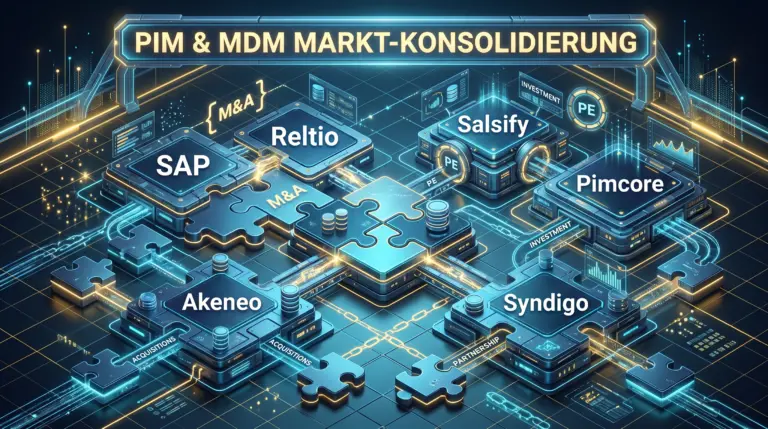
Cinven buys Salsify, Tenzing takes over Pimcore, Akeneo acquires PricingHUB: an overview of all PIM deals in 2025/2026, the three patterns behind them and what users should now look out for in their contracts.
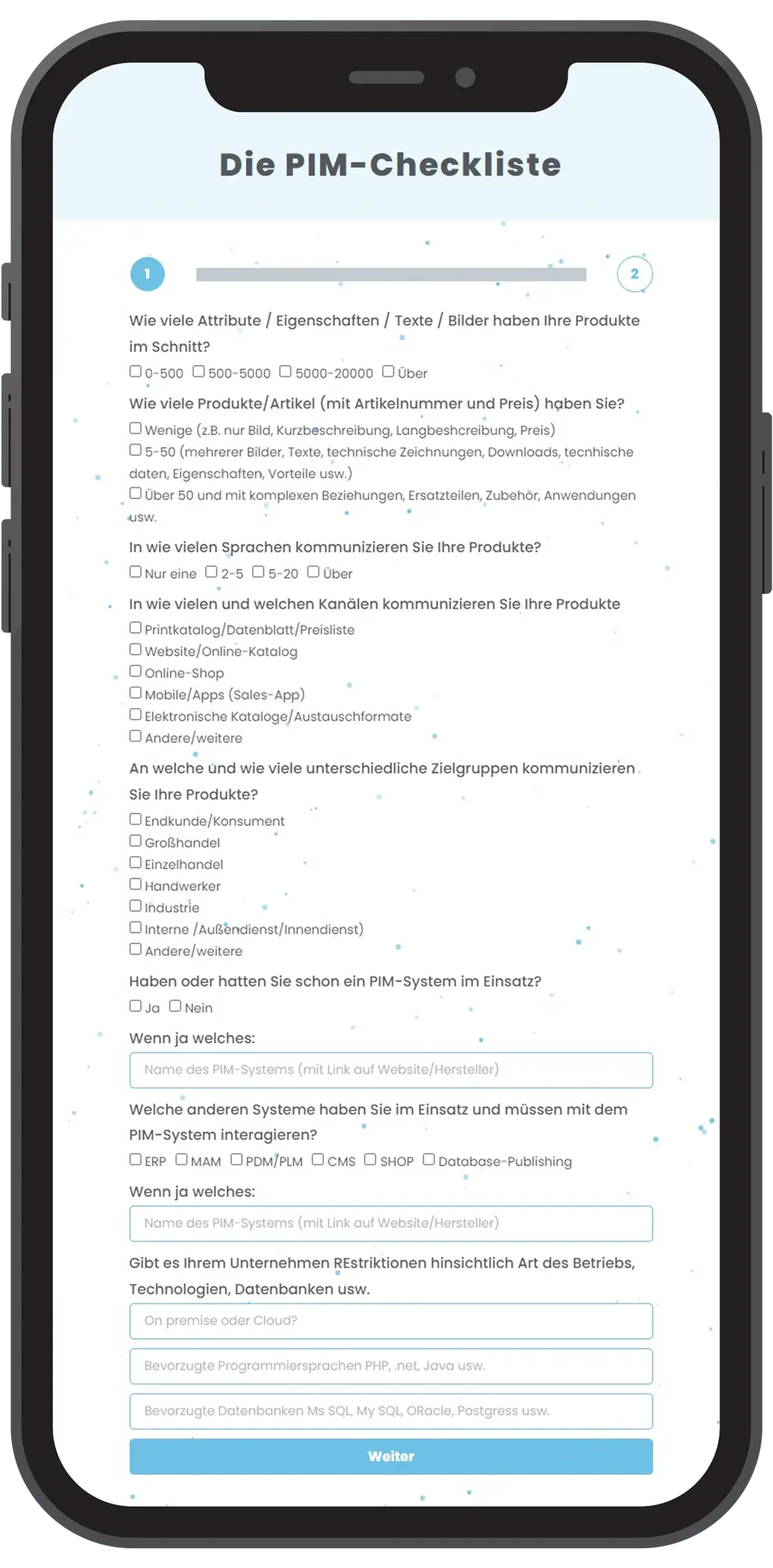
Find out in 3 minutes whether a PIM system could benefit your business and which PIM systems could be right for you!
Webdesign: Deutsche Stadtmarketing