In brief: Three anonymised selection projects show how structured PIM selection works and where it pays off: making proposals comparable, running a proof of concept with your own data and deciding whether to replace an existing system.
Case 1: Making proposals comparable
Starting point: A company with a large product range and many suppliers had shortlisted three PIM vendors. Their initial proposals were not comparable: each vendor used different assumptions for supplier access, storage and test systems.
Approach: We recalculated all proposals using the same volume assumptions and compared licences, third-party licences, customisation, services and operating costs over five years. We accounted for gaps and underestimated items with transparent upward and downward adjustments.
€0.89 millionVendor 1, total costs over 5 years
€0.97 millionVendor 3, total costs over 5 years
€1.88 millionVendor 2, total costs over 5 years
2.1 timesDifference between the lowest and highest proposals
Outcome: The difference lay less in the entry price than in the terms: one vendor charged significantly more for additional supplier access, and doubling the storage cost €50,000. Other vendors already included an unlimited number of suppliers and test instances.
Key takeaway: Compare total costs over the full term, not licence prices. Our PIM request for proposal template includes a five-year pricing sheet for this purpose.
Case 2: An automotive supplier in the aftermarket
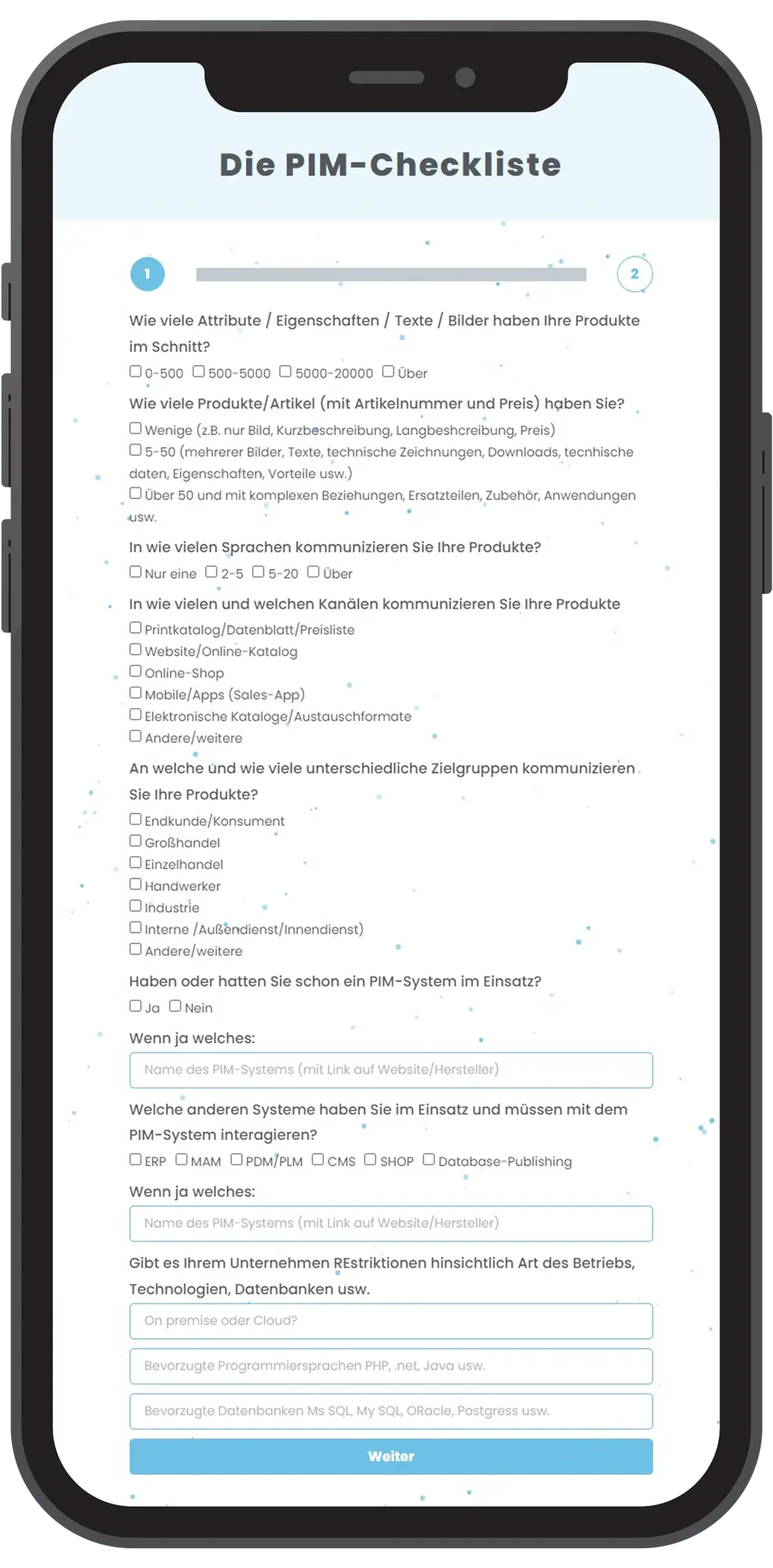
Starting point: An automotive supplier wanted to select a PIM system for its spare parts business. A requirements list was already available. Alongside PIM, the scope included workflows, AI and integration with ERP, CMS, an online catalogue, print publishing and media asset management.
Approach:
- Cross-checking the existing requirements list against our comprehensive requirements checklist and defining mandatory criteria.
- Kick-off workshop with the core team: establishing a shared understanding, prioritising using a radar chart and defining the scope.
- Requirements workshop covering use cases and criteria for the integration partner.
- A longlist of more than 20 vendors, assessed and prioritised in advance, followed by a shortlist of four vendors.
- Briefing the vendors and providing a data room so that each could demonstrate a proof of concept using real product data in a full-day workshop.
Key takeaway: An existing requirements list is a good starting point, but rarely complete. Cross-checking it against a comprehensive checklist reveals gaps before vendors are approached.
Case 3: Replacing an existing PIM
Starting point: An international medical device manufacturer was using an open-source PIM and wanted to determine whether to replace it. A longlist and shortlist were already in place.
Approach: Together with the team, we reviewed the shortlist and requirements matrix again. We deliberately separated the system decision from questions about the integrator, existing service providers and surrounding systems. A data package was prepared for the vendor workshops: basic data for all items to provide breadth, plus a selection of items with complete information to provide depth.
Key takeaway: A data package combining breadth and depth quickly reveals in a workshop how a system handles your own data model, large data volumes and special cases.
Our approach to PIM selection
All three projects follow the same process: requirements, a market review with a longlist and shortlist, vendor workshops, proposal comparison and, if required, negotiation support. Our PIM selection page explains the steps in detail. Use the PIM cost calculator to estimate your budget in advance.
Discuss your selection project
Our vendor-neutral PIM consulting supports you from defining requirements through to contract review.
- Vendor-neutral
- Over 20 years of experience
- Free initial consultation