Our definition
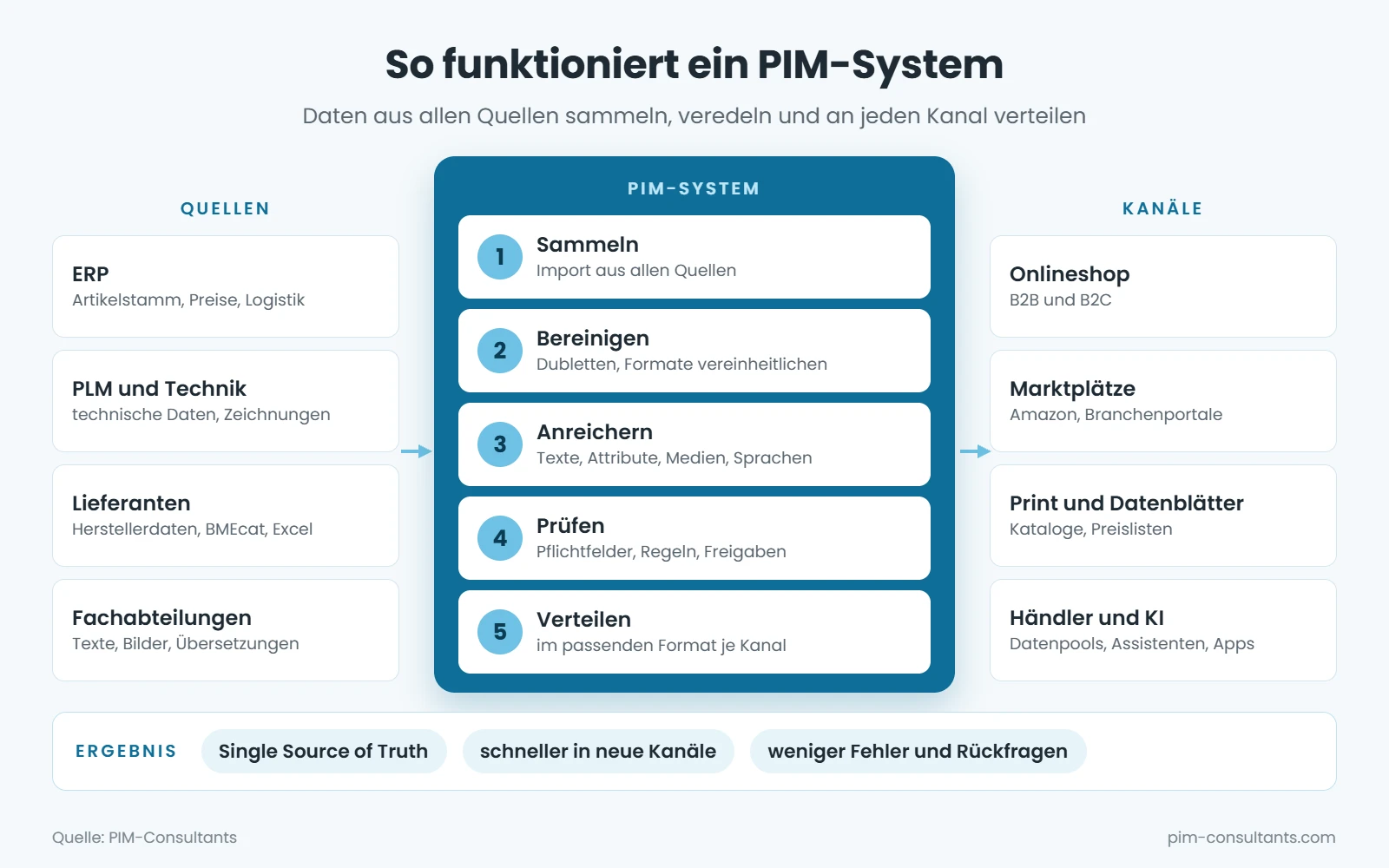
A PIM system is the central data source (single source of truth) for everything that describes a product. It gathers data from ERP, PLM, suppliers and internal departments, cleanses and enriches it, and delivers complete, up-to-date information to every channel in the right format.
Updated: October 2026 · by Matthias Kant, PIM-Consultants
The Functions and processes sections below explain these functions in more detail.

A PIM does not replace any of these systems; it complements them. What matters is which system is the master for each type of information.
| System | Purpose | Typical data | Main users |
|---|---|---|---|
| PIM | Provide complete, channel-ready product information for marketing and sales | Descriptions, attributes, classifications, relationships, translations, media references | Product management, marketing, e-commerce |
| ERP | Manage business operations. Read more in our article on PIM and ERP | Item numbers, prices, stock levels, orders, logistics data | Purchasing, sales, logistics, accounting |
| MDM | Standardise master data across multiple domains (Master Data Management). See PIM vs. MDM | Customers, suppliers, products, locations | IT, data management |
| DAM | Manage images, videos and documents (Digital Asset Management). Many PIM systems have a built-in DAM module | Product photos, videos, drawings, data sheets | Marketing, graphic design |
| PLM | Support product development and engineering before a product goes on sale (Product Lifecycle Management) | Bills of materials, CAD data, technical specifications | Product development, engineering |
Rule of thumb: the ERP knows what a product costs and where it is stored. The PIM knows how to describe and sell it.
A PIM pays off when several of these factors apply: several thousand items or many variants, numerous attributes per product, multiple languages, multiple sales channels, retailers that require data in specific formats (such as BMEcat or ETIM), and product data currently scattered across Excel spreadsheets. Our PIM benefits page explains the practical advantages.
If three or more of these points apply, it is worth taking a closer look.
Would a PIM pay off for your business?
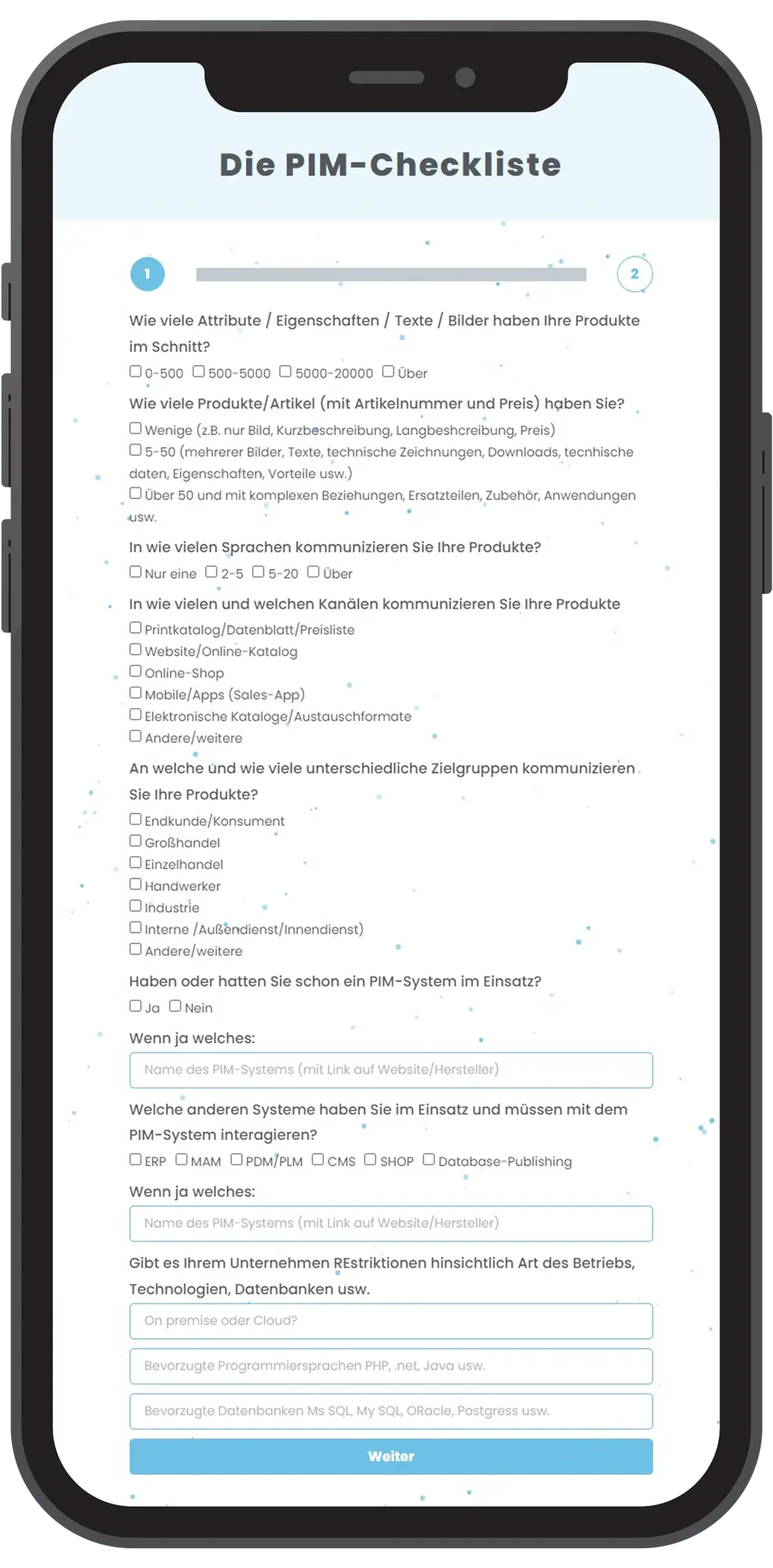
Use the PIM checklist to find out in three minutes whether a PIM system would benefit your business and which systems could be a good fit. We will email you an initial shortlist.
Take an industrial components manufacturer with a few thousand items. Before PIM, information about a product is scattered across many locations. Afterwards, a single, complete record serves every channel.
| Information | Before | With PIM |
|---|---|---|
| Item number, price, stock level | ERP | Still in ERP, visible in PIM via an interface |
| Technical attributes | Free text in an ERP field or in Excel | Structured, filterable attributes, classified using ETIM or ECLASS |
| Product descriptions | In the catalogue layout, rewritten for each channel | Short, medium and long versions, maintained centrally |
| Images and data sheets | File system, multiple versions | In DAM or PIM, linked to the product |
| Translations | Emailed to agencies, returned in Word | Translation workflow within the system |
| Accessories and successor products | In the product manager's head | Maintained as relationships, available for cross-selling |
| Approval | Via email and informal conversations | Workflow with required fields and channel-specific approvals |
There are well over a hundred PIM systems on the market. Our overview of PIM vendors covers more than 90 of them. PIM selection in six steps explains how our independent PIM consulting helps you find the right system systematically, while PIM implementation & costs outlines the costs to expect.
Most vendors now offer cloud-based SaaS solutions. On-premises or private cloud deployments are primarily chosen when internal IT requirements or specific integrations call for them.
Open-source systems save on licence fees, but not on implementation, operation or ongoing development. They are a good fit if you have a strong implementation partner.
Some systems cover PIM, DAM, MDM and syndication in a single platform. Others focus on one function and are combined with other systems.
The right option depends on your product range, channels, IT landscape and budget. Our overview of PIM vendors provides an overview of the systems available.
Compare PIM systems systematically
Use the PIM requirements checklist to assess vendors against consistent criteria. The SME version, with 46 assessment questions, is available free of charge as an Excel file.
PIM delivers benefits at three levels: strategic, tactical and operational, increasing revenue and reducing costs.
How well does your product data support every channel?
The Omnichannel Health Check reveals gaps in your data, processes and systems, and identifies where PIM can deliver the greatest value.
Its functions follow the flow of product information, known as Information Supply Chain Management (ISCM): from collecting data to distributing it across channels.
PIM can support the following business processes.
Three developments are turning structured product data from a competitive advantage into a necessity.
AI assistants are increasingly recommending and ordering products on their own. This only works with complete, machine-readable data. Find out more in our article MCP and agentic commerce.
The EU is gradually introducing the Digital Product Passport. Much of the required information belongs in PIM. See DPP and PIM systems.
Regulations such as the General Product Safety Regulation (GPSR) require additional information in every sales channel. Find out more on our PIM for e-commerce page.
Implementation: A successful PIM implementation starts with clear content rules, responsibilities and a defined vision for the channels, before the system is configured. For mid-sized businesses, the first channel typically goes live within six to twelve months. Find out more under PIM implementation.
Costs: In addition to licence or subscription fees, costs include implementation, data migration, integrations and ongoing operations. Data migration is the most frequently underestimated item. For an overview of cost drivers and total costs over five years, see PIM costs.
Would you like to discuss your situation?
Whether you are exploring your options, selecting a system or already running a project, we provide vendor-independent advice and tell you openly whether PIM is right for you and which system fits your needs.
PIM stands for Product Information Management. It refers to the software and processes a company uses to manage all its product information centrally and distribute it to its channels.
ERP manages commercial data such as item numbers, prices, stock levels and orders. PIM adds everything that describes a product and helps sell it: copy, attributes, images, documents and translations.
PIM becomes worthwhile when you manage large numbers of products, variants or languages across multiple channels and Excel or your ERP reaches its limits. Typical users are manufacturers and retailers with several thousand items or more.
For larger mid-sized businesses, software typically costs around 100.000 to 500.000 euros, depending on the system tier, with implementation costing around 150.000 to 250.000 euros. Open-source systems eliminate licence fees, but not implementation costs.
The golden record is the complete, validated master record for a product in PIM. It supplies all channels, ensuring that the same information appears everywhere.
PXM stands for Product Experience Management. The term emphasises how products are presented and experienced in each channel. Many vendors use it to describe PIM systems with additional features for channel-specific adaptation, syndication and analytics. PIM remains the foundation.
Not necessarily. Many PIM systems include a built-in DAM module that is sufficient for product images and datasheets. A separate DAM system is worthwhile if you manage large volumes of media, videos or marketing materials that are not linked to products.
For mid-sized businesses, the first channel typically goes live within six to twelve months. The biggest factors are data quality, the number of integrations and clearly defined responsibilities.
Yes, particularly for companies with an in-house IT team or a strong implementation partner. Open source eliminates licence fees, but not the costs of implementation, operations and ongoing development.
Is your product data ready for PIM and AI?
We provide a vendor-independent review of your data model, processes and systems to show you where you stand.
Or start with the PIM checklist.
PIM knowledge

Find out in 3 minutes whether a PIM system could benefit your business and which PIM systems could be right for you!
Webdesign: Deutsche Stadtmarketing