Clear priorities in three steps

Omnichannel Health Check for your product data

In brief: The Omnichannel Health Check shows how well your product data supports all your channels today, where there are gaps in your data, processes and systems, and where PIM would deliver the most value. It is based on our nine-module Omnichannel Potential Analysis, covering personas and use cases, print, websites, online catalogues, e-commerce, mobile and social, as well as processes, systems and interfaces. The check is free, with no obligation.
9 modulesfrom users and channels through to systems
150+ criteriaassessed consistently so you can compare channels
3 starting pointsthe assessment is tailored to your situation
Free of chargevendor-neutral and confidential, with an NDA on request

What you get

  • Current state and goals: a brief assessment of where your product data stands today and what needs to improve.
  • Sources and channels: an overview of which systems supply your data and which channels it supports, highlighting the biggest disconnects between them.
  • Quick wins: practical suggestions for improvements you can make in the short term, even without a new system.
  • Recommendation: the key next steps for your omnichannel strategy, whether focused on data quality, processes or a new system. Plus ideas on how to make your channels work better together.

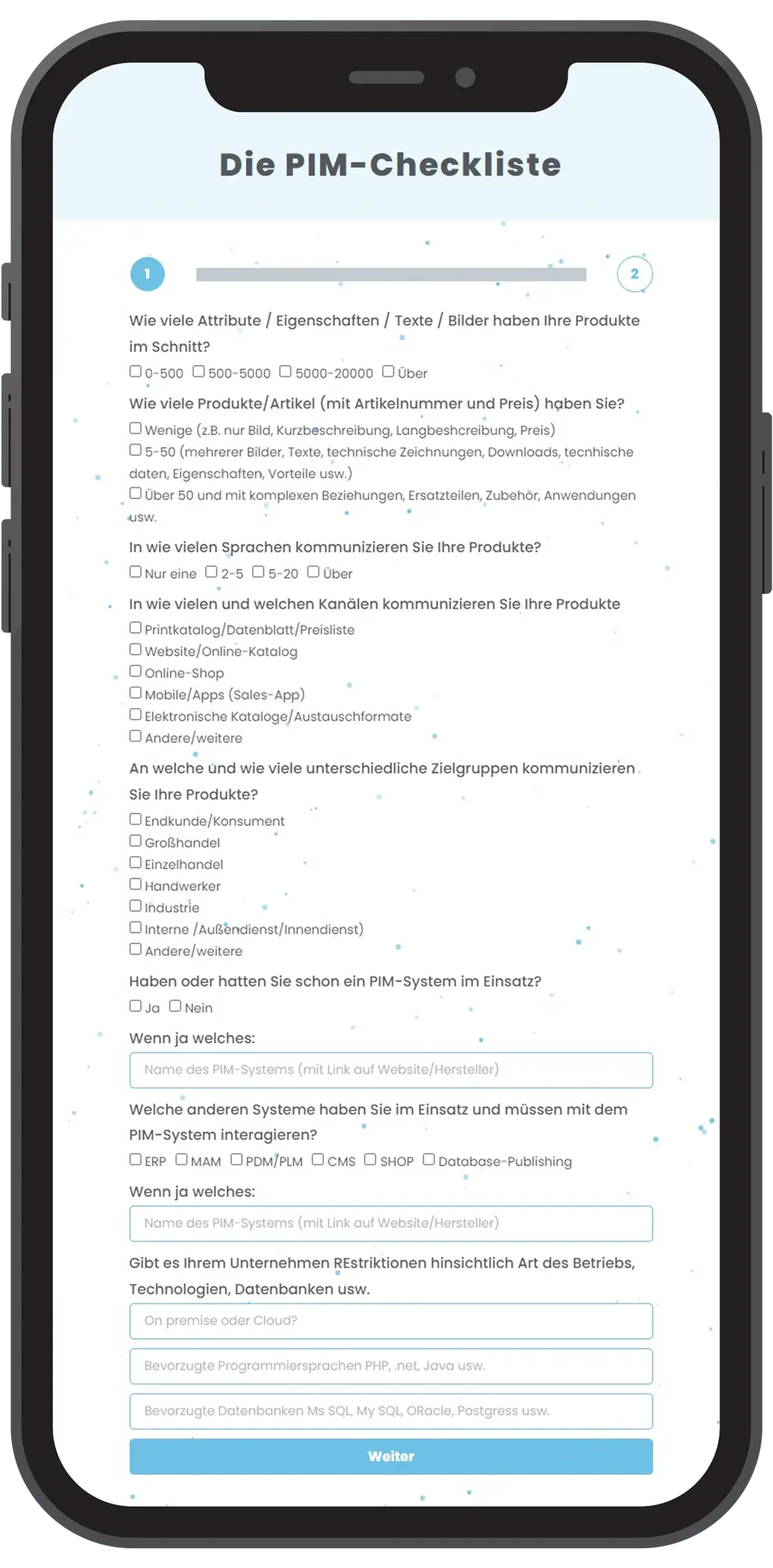
If a new system proves to be the right approach, the next step is PIM selection. For an initial self-assessment, use the PIM checklist.

Which starting point matches your situation?

To begin, you identify which of three typical starting points best describes your company. This helps us put your answers into context and focus the assessment on what you really need.

Type A: Finding direction

Today, your actions are mainly driven by external demands: customers or competitors determine what you need to do. You want to change that and develop your own strategy.

Your outcome: the big picture. What systems are available, what benefits do they offer, which do you actually need, and where should you start?

Type B: Gaining clarity

You know you need software to improve your processes and have already done some research. But instead of providing clarity, that research has raised more questions.

Your outcome: a clear view of the omnichannel systems landscape, including PIM, DAM, e-commerce and database publishing, and which options align with your goals.

Type C: Preparing for a decision

You know your channels and system requirements. But the sheer number of vendors and the difficulty of comparing systems are holding up your decision.

Your outcome: a clear weighting of the system features and capabilities that matter to you, providing a basis for selection.

Step 1

Assess your current situation and define your goals

Self-assessment, personas and use cases: Where are you today, and where do you want to be?

Step 2

Analyse all sources and channels required for PIM

Print, website, online catalogue, e-commerce, mobile, social and new channels: Which data comes from which systems?

Step 3

Develop an effective omnichannel strategy

Quick wins, priorities and a recommendation: data quality, processes or a new system.

How well does your product data support all your channels?

Request your Omnichannel Health Check. We will contact you personally to agree on which modules are relevant to you.

  • free of charge
  • vendor-neutral
  • confidential, with an NDA on request
Request a Health Check

How the Health Check works

The Health Check follows a structured process. You only complete the modules that are relevant to your channels today or in the future.

1Self-assessment
2Questionnaire for each module
3Use case discussion
4Assessment
5Results and quick wins

Self-assessment: You identify which of the three starting points best describes your situation. Questionnaire: For each module, you describe your current state and your goal: what you do today and where you want to be. Discussion: We explore personas and use cases in more depth in a one-to-one interview. Assessment: We assess your channels from an external perspective using consistent criteria and interpret your answers in the context of your goals. Results: You receive quick wins for short-term improvements and a recommendation for your next steps.

What if we cannot answer all the questions?

That is perfectly normal. Simply leave any unanswered questions blank, and we will discuss them with you. Some questions may seem probing, but they represent the minimum information we need to make well-founded recommendations. We treat all information confidentially and do not share it with third parties. We are happy to sign your non-disclosure agreement.

The nine modules at a glance

The modules follow the logic of product communication: first, who uses your product data, then the channels where it appears, and finally the design, processes and systems behind it.
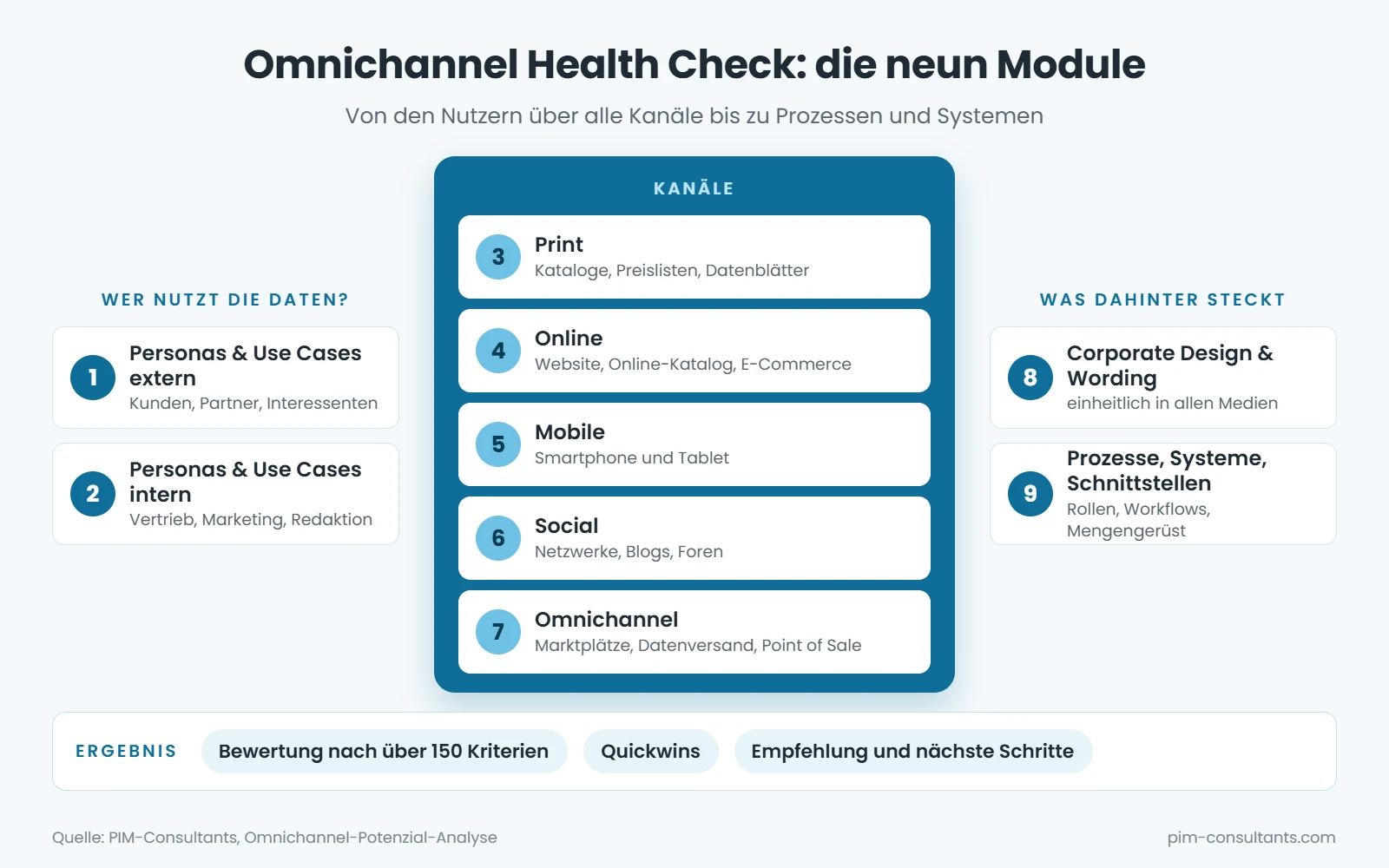
Grafik: Die neun Module des Omnichannel Health Checks: Personas und Use Cases extern und intern, die Kanäle Print, Online, Mobile, Social und Omnichannel sowie Corporate Design und Prozesse, Systeme, Schnittstellen
The nine modules of the Omnichannel Health Check
ModuleWhat it coversSample question
1. External personas & use casesCustomers, partners and prospects, and what they want to achieve with your product informationWho is looking for what information, in which channel, and for what purpose?
2. Internal personas & use casesProduct management, marketing, sales, editorial, translation and graphic designWhat information does the sales team need to support customers?
3. PrintCatalogues, price lists and data sheets: volumes, production process and data sourcesHow many rounds of corrections does a publication require?
4. OnlineCorporate website, online catalogue and e-commerce: current state and goals for eachCan customers find all the information they need to place an order without having to ask?
5. MobileProduct information on smartphones and tabletsAre key features such as search or downloads missing on mobile devices?
6. SocialSocial media activities, effort and feedbackDoes feedback from social media feed into your product communication?
7. OmnichannelMarketplaces, data delivery to retailers, point of sale, video platforms and sales supportWhich channels do you want to serve in the future?
8. Corporate design & wordingConsistent design, terminology and information across all mediaIs the same product described consistently everywhere?
9. Processes, systems and interfacesRoles, workflows, system landscape, information classes and data volumesWhich information comes from which system of record?

Personas and use cases: start with the user

The starting point is not the system, but the question of who uses your product data. A persona is a typical user with specific characteristics and usage patterns. It represents a real group: externally, this might be buyers, retailers or planners; internally, sales, product management or technical documentation teams. A use case describes what a persona wants to achieve in a particular channel and what the outcome should be.

PersonaUse caseExpected outcome
Buyer at a mechanical engineering companyknows the item number but not the current price, and checks the online cataloguehas all the information needed to place an order
Buyer at a mechanical engineering companyknows only the approximate product name and searches the online cataloguefinds the right product using search and filters
Sales representative (internal)wants to reorder products for a customercan see pricing, availability and alternatives at a glance

The use cases determine what information is needed, in how much detail and in which channel. This later forms the basis for the data model in the PIM system. We weight each persona according to its importance to your business on a scale of 1 to 5, so that our recommendations focus on where they can make the greatest impact.

The channels in detail

For each channel, we ask about your current situation and your goals. We also assess the channel from an external perspective using consistent criteria.

Print: catalogues, price lists, data sheets

The printed catalogue is often the original product communication channel and continues to play a central role in B2B. We document the scale of your publishing activities (publications per year, page count, languages, publication cycle, production time) and the production process: in-house or with a service provider, the number of revision rounds and the most frequent corrections, such as prices, text or images.

We also examine which systems supply text, technical data, images, drawings and ordering information, how much employees' specialist knowledge goes into the publications and whether you use database publishing. Our assessment covers selection guides, system overviews, how clearly products are differentiated and links to online channels via QR codes and deep links.

Corporate website

What roles does your website fulfil: building your brand image, providing company information, offering an e-catalogue for lead generation, serving as a support portal or providing pre-sales and after-sales information? Do you use your website as a sales tool, and do user analytics inform your decisions?

We assess how effectively users are guided to their goals, navigation logic, search, the media centre, internal linking, the customer journey, SEO and accessibility.

Online catalogue

Your online catalogue provides the clearest indication of how well your product data is structured. We review product pages, table structure and the depth of information, including whether data sheets, CAD files and videos are available for each product. We also look at how predecessor and successor products are handled, product finders and configurators, saved lists, download baskets and adherence to your terminology.

E-commerce and B2B online store

What drives your e-commerce activities: reducing the workload of your field sales team, selling around the clock, international expansion, customer expectations or building a dealer network? What share of revenue does e-commerce account for today, and what do you expect in future? Which languages do you sell in, and how are product information maintenance and image data management organised?

In B2B, key features depend directly on good product data: saved lists for purchasing teams, repeat orders, customer-specific pricing, configurable products, product comparisons and data sheet downloads. On the technical side, we look at the e-commerce platform, interfaces to ERP, warehouse systems, DAM and PIM, and whether you host it in your own data centre or in the cloud. Find out more on the PIM for e-commerce page.

Mobile

How well does your product communication work on smartphones and tablets? We check whether content and features are appropriately adapted or whether essential features such as search, filters or downloads are missing, and assess navigation, the customer journey and usability.

Social media

Which networks, blogs and forums do you use, how much staff time and effort do they require, and does feedback inform your decisions? We assess brand image management, social media marketing and integration with your other channels.

Omnichannel and new channels

Which channels have you already explored, and which would you like to serve in future? These include marketplaces, e-catalogues and data distribution to dealers, point of sale, digital out-of-home advertising, video platforms and sales support. We also look at whether you have in-house IT expertise or work with service providers.

Today, two additional channels make structured product data essential: AI assistants and AI search, which can only recommend products if the data is machine-readable (see MCP and Agentic Commerce), and the EU's Digital Product Passport.

Corporate design and brand language

Few things confuse customers more than a product presented with different descriptions, technical data or images across different media. We check the consistency of information, terminology, the navigation concept and the links between print, online, mobile and social media.

Want to assess your needs first?

Use the PIM checklist to find out in three minutes whether a PIM system is worthwhile for your business and which systems could be a good fit. We will email you an initial shortlist.

  • free
  • vendor-neutral
  • completed in 3 minutes
Go to the PIM checklist

The criteria we use to evaluate your channels

Every channel is assessed across the same analysis areas. This makes strengths and gaps comparable across channels and shows you where your product data is holding you back the most.

Analysis areaExample criteria
DesignFirst impression, layout, brand image, enjoyment of use
Use caseTransparency, added value, completeness of product information, cross-selling and upselling
Information presentationStructure, clarity, product pages, table structure, depth of information, predecessor and successor products
User guidanceNavigation, search, product finder, saved lists, download basket, document finder, customer journey, cross-media integration
ContentText structure, product images, alignment of images and text, terminology
TechnologyWebsite functionality, browser support, SEO, software functionality
UsabilitySelf-descriptiveness, controllability, conformity with user expectations, error tolerance, help function, accessibility

The usability criteria are based on the dialogue principles set out in DIN EN ISO 9241-110.

Example: predecessor and successor products

How does your online catalogue handle products that are no longer available? Is a successor product suggested, how does it appear in search results, and are the differences from the previous model explained? A customer searching with an old item number should not reach a dead end.

Example: depth of information

Are there data sheets, CAD files, instructions or videos for the product that offer more than the product page itself? And can users find these resources without having to go through the product page, for example via a document finder or a download basket that bundles everything into a ZIP file?

Information to help us prepare

To assess the effort involved and your system requirements, we need a rough idea of the scale. Estimates are sufficient.

InformationWhy it matters
Number of products, items and variantsdetermines the data volume and, for many PIM systems, the licensing model
Product groups and attributes per productindicates how complex the data model will be
Own or third-party products, systems and accessories, configurable productsaffects relationships, supplier data and configurators
Images, videos, PDFs and CAD dataindicates whether a DAM system is also needed
Markets and languagesdetermines translation processes and localisation
Departments and employees involvedproduct management, marketing, purchasing, production, IT, sales and trade partners
Person-days per month spent on data maintenance and publishingbasis for the business case, see PIM costs
Roles, processes and systems: practical examples

Roles: Technical documentation creates text and product tables and plans publications. The graphics team creates drawings and images. Product management maintains item data in the ERP and approves content.

Processes: When an item is created in the ERP, its properties are often stored in a single block of text. For the catalogue, these then have to be manually split into tables and text. Technical drawings are created in CAD, edited and saved in the file system at several resolutions.

Information categories: Product images, with two to three images per product in the file system, ten to twenty technical characteristics in the ERP, and short, medium and long product descriptions that often exist only in the print catalogue. These are precisely the gaps the Health Check identifies.

Typical findings and quick wins

Many weaknesses recur across companies. Some can be resolved quickly, while others are a clear indication that a PIM system is needed.

The same product is described differently in the catalogue, on the website and in the online shop

Better: one authoritative source for all channels, known as the Golden Record.

Technical data is stored as free text in an ERP field

Better: maintain characteristics as structured attributes, for example using ETIM or ECLASS. Only then can filters, comparisons and data transfers to retailers work properly.

Products that are no longer available lead to dead ends

Better: link to replacement products and explain how they differ from their predecessors.

Data sheets, CAD files and manuals are hard to find

Better: offer downloads directly on the product page and provide a central document finder as well.

The catalogue and online channels are not connected

Better: use QR codes or deep links in the catalogue that lead directly to the relevant product page.

Every catalogue requires numerous rounds of corrections

Better: use database publishing to pull prices, text and images from a central source rather than correcting them in the layout.

Product knowledge is held by individual employees

Better: gradually document this knowledge in the system as attributes, text and relationships so that all channels benefit.

What happens after the Health Check

Optimise without a new system

Quick wins in data quality, structure and processes can often make a significant difference. In that case, implement these first.

Prepare for system selection

If a PIM system makes sense, the next step is PIM selection. The PIM criteria checklist helps you compare systems.

Plan the implementation

Once the system has been selected, the focus shifts to the data model, roles and migration. Find out more under PIM implementation.

Frequently asked questions about the Omnichannel Health Check

How much does the Omnichannel Health Check cost?

The Health Check is free, with no obligation. You are not committing to anything.

Who is the Health Check for?

For manufacturers and retailers that present their products across multiple channels, such as catalogues, websites, online shops and marketplaces, and want to understand where their product data is holding them back. It is particularly popular with medium-sized B2B companies.

Do we need to have a PIM system already?

No. The Health Check is vendor-neutral and helps establish whether and where a PIM system would benefit you. Quick improvements are often possible without a new system.

How much work is involved for us?

The questionnaire is modular. You only complete the modules for channels you currently use or plan to use. Leave any questions you cannot answer blank. We will clarify them in our discussion.

Will our information be treated confidentially?

Yes. We treat all answers as confidential and do not share them with third parties. We are happy to sign your non-disclosure agreement.

How does it differ from the PIM checklist?

The PIM checklist is a three-minute self-assessment that provides an initial shortlist of suitable systems. The Health Check goes deeper: it examines all channels, processes and systems and concludes with a personalised assessment, quick wins and a recommendation.

Request your free check now

PIM KNOWLEDGE

News & Blog

Do you have any questions?

We are happy to advise you.

Wait! Have you seen our PIM checklist?

Find out in 3 minutes whether a PIM system could benefit your business and which PIM systems could be right for you!

Webdesign: Deutsche Stadtmarketing