PIM selection in 6 steps

PIM selection: How do you find the best PIM software for your business?

Our PIM selection process follows six steps: priorities, requirements analysis, market overview, software evaluation, proposal comparison and negotiation. It typically takes two to three months and concludes with a well-founded decision on a PIM system and a fair contract. Vendor-neutral, with a criteria checklist, an evaluation matrix and a proposal comparison.

Jump straight to a step in the PIM selection process:

The 6 steps of PIM selection at a glance

  1. 1PrioritiesKick-off and spider chart analysis: assess the current situation, set priorities and provide brief introductions to systems and technologies.
  2. 2Requirements analysisDevelop a requirements matrix together and weight the criteria by priority and relevance.
  3. 3Market overviewLonglist and shortlist: identify which vendors and implementation partners meet your requirements.
  4. 4Software evaluationFull-day workshops with shortlisted vendors, evaluated by your core team.
  5. 5Proposal comparisonEvaluate proposals and present them in a comparable format to support your decision.
  6. 6NegotiationCommercial support: on request, we support contract negotiations with your chosen vendor.

Step 1 of PIM selection: Priorities

Every PIM selection process starts with a shared understanding: where is your business today, and what should the new system improve? We establish priorities during the kick-off and through spider chart analysis.

(1.1) Priorities: Kick-off

(1.2) Priorities: Spider chart analysis

Spinnen-Analyse: Ist- und Soll-Werte je KriteriumBeispiel einer Spinnen-Analyse mit 28 Kriterien auf einer Skala von 0 bis 5. Die innere blaue Linie zeigt die Ist-Situation, die äußere orange Linie den Soll-Zustand.12345SucheErgebnisübersichtUsabilityEngines-TopologieDerivationVAMNeue TechnologienAusleitungTabellenansichtTexte verwaltenValidation EngineDatenqualitätReporting EngineCloud-FähigkeitÜbersetzung (TMS)Task ManagerCollaborationWorkflow-ToolBeziehungenVererbungPolyphones DatenmodellSprachenExportImportMiddlewareAPIBusiness RulesPerformanceIst (innen)Soll (außen)
Example of a spider chart analysis: for each criterion, the team rates the current and target states on a scale from 0 to 5. The wider the gap, the greater the need for action.

Objectives and outcomes of step 1:

MILESTONE 1: Your benefits

The initial action steps are defined on this basis.

Step 2 of PIM selection: Requirements analysis

The requirements matrix is the most important tool in PIM selection. You will use it later to evaluate every vendor against the same weighted criteria.

(2.1) Requirements analysis: Gathering requirements

Approach:

  1. Expand and refine the predefined requirements checklist
  2. Work with the core team to add further requirements to the requirements checklist
  3. Supplement the requirements with so-called soft factors, such as the software vendors’ strategic direction or the skills of the prospective project managers on the vendor side
  4. Develop a scoring framework, including weightings.

Downloadable template: As a starting point for your own requirements checklist, you can download our PIM criteria checklist for SMEs as an Excel file.

Auszug aus einer Anforderungscheckliste für PIM-Systeme

Show content as text
Excerpt from the requirements checklist: Chapter 8, Usability, Interfaces and Performance
No. Criterion Scoring scale
8.1 Easy management of all information relating to a product, such as categories, text, images, etc. 5: fully met / 1: not met
8.2 Data entry with suggestion lists (including suggestions based on existing text) 5: fully met / 1: not met
8.3 Copying data from similar items; linking data; sorting; editing by different users/departments 5: fully met / 1: not met
8.4 Simple, intuitive interface with the option to increase complexity or reduce it to a minimum based on roles and permissions 5: fully met / 1: not met
8.5 Freely configurable views; saving views for individual users; saving views for specific user groups; reset button 5: fully met / 1: not met
8.6 Which comparison views are available, and what functionality do they offer? 5: fully met / 1: not met
8.7 Is a dashboard (widgets) available? Start view with a summary of functions (to-do list, new products in the system, charts, statistics) 5: fully met / 1: not met
8.8 Output preview (webshop): what visualization levels are available? Example: distinction between editing and output; defining templates to visualize different outputs (flyers); template editing options (global and individual?) 5: fully met / 1: not met
8.9 Drag and drop of folder structures. Copy and paste of structures with and without objects. Drag and drop between multiple windows. Keyboard shortcuts for bulk editing 5: fully met / 1: not met
8.10 Perceived speed / system response time? Background operations? 5: no waiting time / 1: feels slow
8.11 Platform independence (Linux). All browsers (policy on previous versions), Firefox, Safari: how does the vendor handle older versions? How far back does browser support typically extend? 5: fully met / 1: not met
8.12 Editing multiple items and objects. Spreadsheet-style bulk data editing (Excel) / Excel-like filtering. Ability to apply the selected function to search results 5: fully met / 1: not met
8.13 Bulk selection for actions 5: fully met / 1: not met
8.14 Error handling: how are errors displayed? Can error displays be tailored by role? 5: fully met / 1: not met

(2.2) Requirements analysis: creating a requirements matrix

  1. The standard matrix provides a comprehensive list of requirements for each market.
  2. Depending on the project, several lists may therefore be needed (e.g. PIM + MAM).
  3. The matrix is reviewed chapter by chapter with the client team to determine whether each requirement is relevant to them.
    Additional client-specific requirements are included where necessary.
  4. The assessment criteria to be applied to individual questions are then defined with the client team.
  5. The individual chapters are then weighted (values from 1 to 5).
Aufbau einer gewichteten Anforderungsmatrix

Show content as text
Structure of the requirements matrix: weighted sections, with section 11 (Interfaces) expanded as an example
No. Criterion Source Scoring scale Weighting
1 PIM vendor profile 3
2 Integrator interpersonal skills 3
3 Integrator project expertise 3
4 PIM software strategy 3
5 Development strategy 3
6 PIM software design 3
7 PIM support 3
8 PIM usability, user interfaces & performance 3
9 PIM import 3
10 PIM export 3
11 PIM interfaces 3
11.x Bidirectional interface to ERP based on AS 400 DB2 Client
11.7 Security management across the interface: how does the interface handle differences in user access rights between system A and system B? TGOA 5: fully met … 1: not met
12 PIM search 3
13 PIM permissions management 3
14 PIM process management 3
15 PIM reporting & data quality 3
16 PIM data model 3
17 PIM inheritance 3
18 PIM bulk data editing 3
19 PIM text management 3
20 PIM relationship intelligence 3
21 PIM languages 3
22 PIM translation management 3
23 PIM output structures / templates 3
148 PIM total

Objectives/outcomes of Step 2.1 / Step 2.2 Requirements matrix:

The requirements matrix now provides the basis for 

  • compiling the longlist/shortlist,
  • preparing invitations and agendas for vendors,
  • evaluating vendors during vendor workshops. 

MILESTONE 2:

Your benefits

  • The requirements profile developed provides comprehensive coverage of your needs.
  • The entire team understands the requirements.
  • The requirements profile enables an informed initial selection of vendors using our vendor database.

Step 3 of PIM selection: Market overview

At this stage of PIM selection, we filter nearly 100 vendors in the German-speaking market to identify the systems that meet your requirements: first a longlist, then a shortlist of three to six vendors.

(3.1) Market overview: Create a longlist

Approach:

  • Create a transparent initial selection of potential vendors through a process of elimination, taking the results of milestone 1 into account.
  • Agree on the agenda for the vendor workshops
  • Brief vendors by phone on the topics to be covered so they can prepare effectively for the workshops
Beispiel einer Longlist-Bewertung von PIM-Anbietern

Show content as text
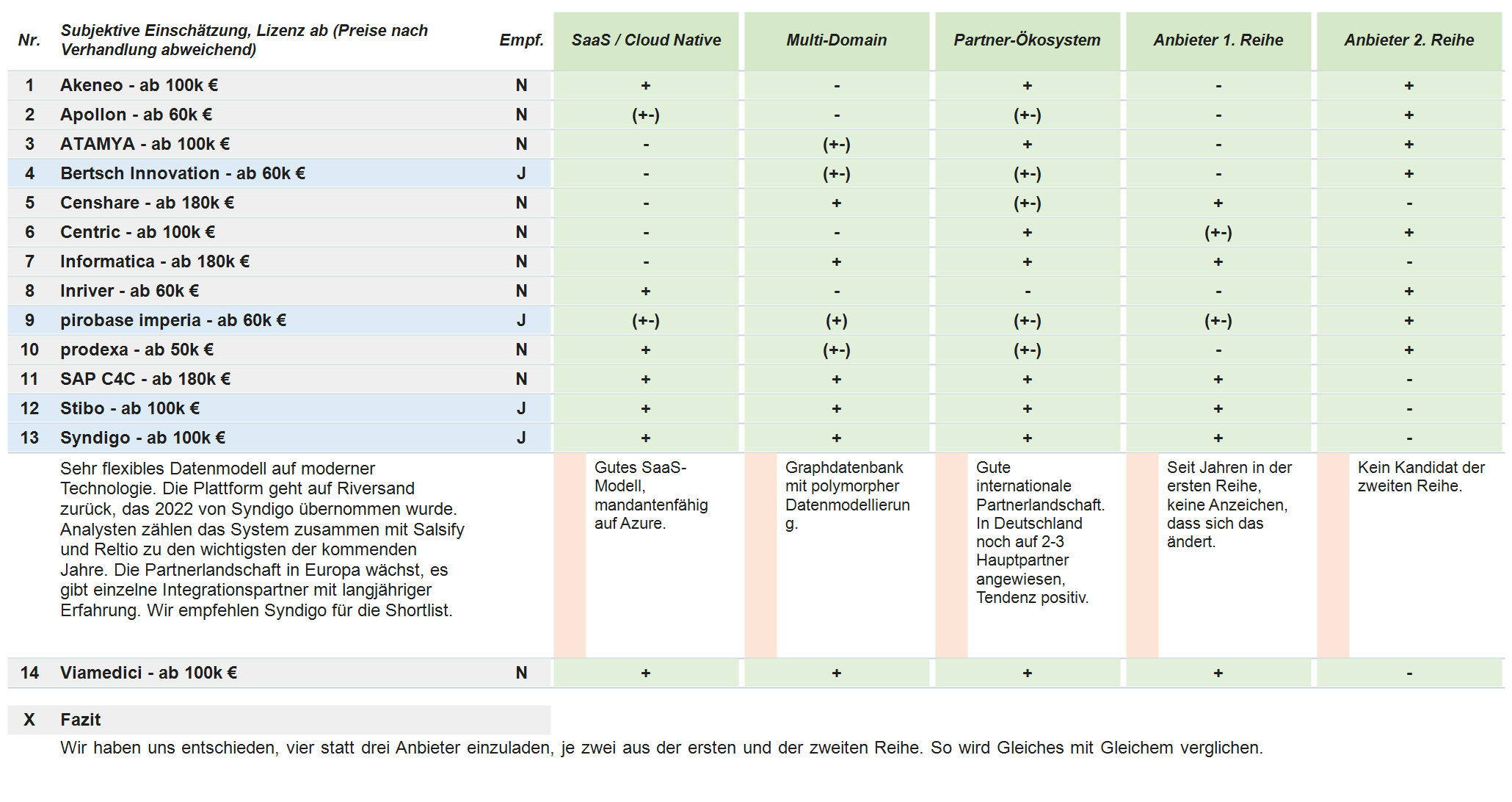
Example of a longlist evaluation from a selection project. This is a subjective assessment; prices may vary significantly following negotiations.
No. Vendor (licence starting at) Rec. SaaS / Cloud Native Multi-Domain Partner ecosystem Tier 1 vendor Tier 2 vendor
1 Akeneo from 100k € N + – + – +
2 Apollon from 60k € N (+-) – (+-) – +
3 ATAMYA from 100k € N – (+-) + – +
4 Bertsch Innovation from 60k € Y – (+-) (+-) – +
5 Censhare from 180k € N – + (+-) + –
6 Centric from 100k € N – – + (+-) +
7 Informatica from 180k € N – + + + –
8 Inriver from 60k € N + – – – +
9 pirobase imperia from 60k € Y (+-) (+) (+-) (+-) +
10 prodexa from 50k € N + (+-) (+-) – +
11 SAP C4C from 180k € N + + + + –
12 Stibo from 100k € Y + + + + –
13 Syndigo from 100k € Y + + + + –
A highly flexible data model built on modern technology. The platform originated with Riversand, which Syndigo acquired in 2022. Analysts rank the system alongside Salsify and Reltio among the most important platforms for the coming years. Its European partner network is growing, with some integration partners offering many years of experience. We recommend shortlisting Syndigo. A solid SaaS model with multi-tenant support on Azure. Graph database with polymorphic data modelling. A strong international partner network. In Germany, it still relies on two to three main partners, but the trend is positive. A leading player for years, with no sign of that changing. Not a second-tier candidate.
14 Viamedici from 100k € N + + + + –

Conclusion: We decided to invite four vendors rather than three, two from the first tier and two from the second. This ensures a like-for-like comparison.

(3.2) Market overview: vendor selection / shortlist

Approach:

  1. Suitable vendors are preselected based on the client’s weighted requirements matrix.
  2. Where appropriate, this also includes vendors the client would like to consider.
  3. A longlist is drawn up from the full vendor list.
  4. The longlist includes comments on each vendor and a decision on whether they will be shortlisted.
  5. Typically, a shortlist of 3-6 vendors is presented to the client.
  6. The shortlist is agreed with the client, after which invitations are sent to the vendors.
Beispiel einer gewichteten Bewertungsmatrix für die Shortlist

Show content as text
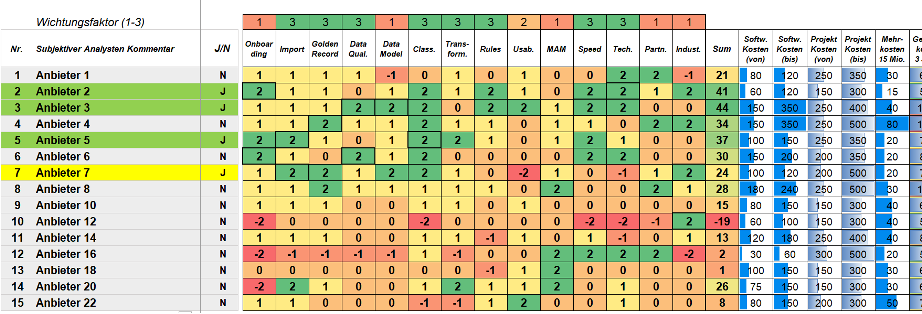
Example of a weighted evaluation matrix for the shortlist (scores from -2 to 2, weightings from 1 to 3, costs in € thousands).
No. Vendor Shortlist Onboarding Import Golden Record Data quality Data model Classification Transformation Rules Usability MAM Speed Technology Partners Industry Total Software minimum Software maximum Project minimum Project maximum Additional costs for 15 million
×1 ×3 ×3 ×3 ×1 ×3 ×3 ×3 ×2 ×1 ×3 ×3 ×1 ×1
1 Vendor 1 N 1 1 1 1 -1 0 1 0 1 0 0 2 2 -1 21 80 120 250 350 30
2 Vendor 2 Y 2 1 1 0 1 2 1 2 1 0 2 2 1 2 41 60 120 150 300 15
3 Vendor 3 Y 1 1 1 2 2 2 0 2 2 1 2 2 0 0 44 150 350 250 400 40
4 Vendor 4 N 1 1 2 1 1 2 1 1 0 1 1 0 2 2 34 150 350 250 500 80
5 Vendor 5 Y 2 2 1 0 1 2 2 1 0 1 2 1 0 0 37 100 150 250 350 20
6 Vendor 6 N 2 1 0 2 1 2 0 0 0 0 2 2 0 0 30 150 200 200 350 20
7 Vendor 7 Y 1 2 2 1 2 2 1 0 -2 1 0 -1 1 2 24 100 120 200 500 20
8 Vendor 8 N 1 1 2 1 1 1 1 1 0 2 0 0 2 1 28 180 240 250 500 30
9 Vendor 10 N 1 1 1 0 0 1 1 0 1 0 0 0 0 0 15 80 150 150 300 40
10 Vendor 12 N -2 0 0 0 0 -2 0 0 0 0 -2 -2 -1 2 -19 60 100 150 300 40
11 Vendor 14 N 1 1 1 0 0 1 1 -1 1 0 1 -1 0 1 13 120 180 250 400 40
12 Vendor 16 N -2 -1 -1 -1 -1 1 -1 0 0 2 2 2 2 -2 2 30 60 300 500 20
13 Vendor 18 N 0 0 0 0 0 0 0 -1 1 2 0 0 0 0 1 100 150 150 300 30
14 Vendor 20 N -2 2 1 0 0 1 2 1 1 2 0 1 0 0 26 75 150 150 300 30
15 Vendor 22 N 1 1 0 0 0 -1 -1 1 2 0 0 1 0 0 8 80 150 200 300 50

MILESTONE 3:

Your benefits

  • A shortlist of 3-6 final vendors is in place.
  • The vendor selection has been finalised and agreed with all decision makers.
  • The agenda for the day and the vendor invitation letters have been agreed with the core team and are ready to send.

Step 4 of PIM selection: Software evaluation

The shortlisted vendors now demonstrate their systems in full-day workshops, ideally using your own product data. Your core team evaluates each system immediately afterwards using the requirements matrix.

(4.1) Software evaluation: Invite vendors to present

Beispiel eines Einladungsschreibens zum Anbieter-Workshop

Show content as text

MUSTER vendor workshop

Project overview

Muster AG (MUSTER) intends to implement additional systems to manage its information flows. The plan is to cover PIM (including MAM) and data onboarding within information supply chain management, with a focus on PIM. Data onboarding may be presented as a connected system or a third-party system.

The new product should make a significant contribution to the success of the digital marketplace. Strong integration capabilities with existing IT architectures are essential.

Project approach: Workshops

An internal requirements profile has been developed together with independent consultant Matthias Kant from Digitize! to evaluate the software vendors.

As a team of software and solution providers, please structure your presentation around the agenda below. The vendor will facilitate the workshop and guide participants through the specified agenda. The vendor may rearrange the agenda, provided that all items are covered during the workshop.

Digitize! will attend to manage timing and ensure that all questions are addressed. The consultant on site will not conduct a separate evaluation. The evaluation will be carried out exclusively by the client team immediately after each workshop, using a structured requirements checklist.

Proposal preparation (cost estimate) following the workshops

Following the workshops, each vendor should be able to prepare a cost proposal for project delivery using the following structure:

  • Licence costs (MUSTER), base and module licences, user licences (individual, packages, etc.)
  • Licence costs (additional), if required
  • Customisation effort in person-days (PD)
  • Consulting and implementation effort in PD: blueprint, technical project management, testing, training, etc.

All effort must be specified in person-days (PD), grouped into work packages and mapped to the planned project implementation. For requirements that have not been fully detailed, effort estimates must be provided as ranges (from/to in PD).

Approach:

  • Invite vendors (the agenda should align with the requirements matrix!)
  • Schedule the vendor workshops
  • Following each vendor workshop, the vendor is asked to submit its proposal by an agreed deadline.
  • The evaluation is then carried out with the client team. 
  • From the 2nd workshop day onwards, evaluations from previous days may also be adjusted where a comparison between vendors warrants it.

(4.2) Software evaluation: Conduct the vendor workshops

Beispiel einer Agenda für einen PIM-Anbieter-Workshop

Show content as text
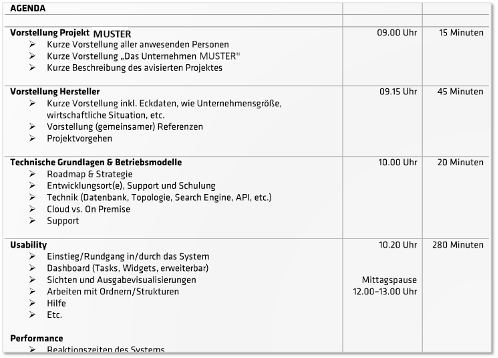
Extract from a workshop agenda (example)
Agenda item Start Duration
Introduction to the MUSTER project

  • Brief introduction of all participants
  • Brief introduction to MUSTER as a company
  • Brief description of the planned project
09:00 15 minutes
Vendor introduction

  • Brief introduction including key facts such as company size, financial position, etc.
  • Presentation of (joint) client references
  • Project approach
09:15 45 minutes
Technical foundations and deployment models

  • Roadmap and strategy
  • Development location(s), support and training
  • Technology (database, topology, search engine, API, etc.)
  • Cloud vs. on-premises
  • Support
10:00 20 minutes
Usability

  • Getting started and system walkthrough
  • Dashboard (tasks, widgets, extensibility)
  • Views and output visualisations
  • Working with folders/structures
  • Help
10:20 (lunch break 12:00 to 13:00) 280 minutes
Performance

  • System response times

Approach:

  • Invite vendors (the agenda should align with the requirements matrix!)
  • Schedule the vendor workshops
  • Following each vendor workshop, the vendor is asked to submit its proposal by an agreed deadline.
  • The evaluation is then carried out with the client team. 
  • From the 2nd workshop day onwards, evaluations from previous days may also be adjusted where a comparison between vendors warrants it.

Step 4.1 / 4.2: Vendor evaluation

Approach:

  • Facilitate each workshop presentation (one per day)
  • Support the core team in its subsequent evaluation of vendors and solutions against the requirements profile.
  • Document the workshops in the comments sections of the requirements checklist and record open issues for follow-up.
Beispiel für emotionales und funktionales Ranking der Anbieter

Show content as text
Subjective ranking

  1. Vendor A
  2. Vendor D
  3. Vendor B
  4. Vendor C
Functional ranking

  1. Vendor C (428 points)
  2. Vendor B (419 points)
  3. Vendor D (367 points)
  4. Vendor A (359 points)

MILESTONE 4:

Your benefits

  • The core team’s functional evaluation of each vendor is documented in the Digitize! requirements matrix.
  • Each team member’s subjective assessment of the vendors is transparently documented.
  • The core team has jointly agreed on a ranking of vendors based on functional fit.

Step 5 of PIM selection: Proposal comparison

A sound PIM selection requires more than a comparison of licence fees. We compare proposals across licensing, implementation, operations and additional costs over three to five years.

Beispiel einer Entscheidungsmatrix mit Kostenbudget

Show content as text
Functional decision matrix (scores from 1 to 5, weighted by priority)
Software vendor Import
×5
Export
×4
Golden Record
×5
Data quality
×5
Data model
×4
Classification
×5
Reports
×3
Search
×5
MAM
×5
Technology
×3
Project
×5
Industry
×2
Total
Vendor 1 5 5 5 5 5 5 3 5 4 4 5 5 266
Vendor 2 3 3 4 4 4 4 5 4 2 5 4 3 209
Vendor 3 4 4 3 3 4 4 4 3 4 2 4 3 196
Cost budget in € thousands
Vendor Software minimum Software maximum Project minimum Project maximum Additional costs for 15 million Total cost over 3 years
Vendor 1 90 135 80 230 30 890
Vendor 2 200 250 320 575 150 1.875
Vendor 3 104 140 135 300 50 965

Approach:

  • Evaluate the proposals prepared by the vendors based on the requirements and the workshop.
  • Create a decision matrix to compare solutions, with a transparent breakdown of licensing, customisation and consulting

MILESTONE 5:

Your benefits

  • You have a transparent cost breakdown for each vendor and an overall comparison covering licences, third-party licences, customisation, other professional services and operating costs (maintenance and update agreements).
  • Any gaps or miscalculations in the proposals have been addressed through clearly documented upward or downward adjustments to prevent “tactical” pricing.
  • The functional decision matrix and commercial evaluation provide a transparent, fully traceable basis for choosing a solution.

Step 6 of PIM selection: Negotiation

PIM selection ends with the contract. We work with you to define your negotiation objectives and support the discussions so that both parties start the partnership with a fair outcome.

Beispiel eines kaufmännischen Vergleichs der Finalisten

Show content as text
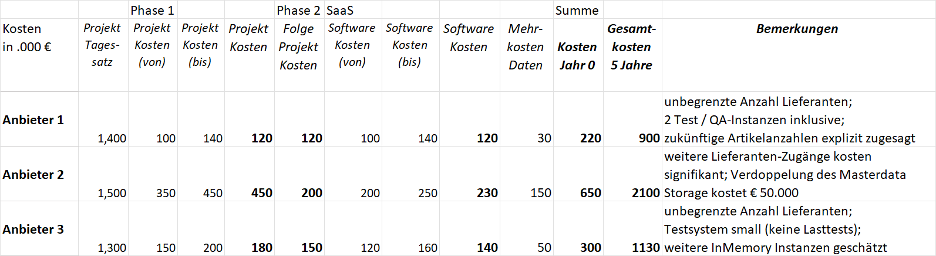
Commercial comparison of the finalists (costs in € thousands, daily rate in €)
Vendor Daily rate Phase 1 Phase 2 SaaS Additional data costs Year 0 costs Total cost over 5 years Notes
Project minimum Project maximum Project Follow-up project Software minimum Software maximum Software
Vendor 1 1.400 100 140 120 120 100 140 120 30 220 900 Unlimited suppliers; 2 test/QA instances included; future item volumes explicitly guaranteed
Vendor 2 1.500 350 450 450 200 200 250 230 150 650 2.100 Significant charges for additional supplier access; doubling master data storage costs €50.000
Vendor 3 1.300 150 200 180 150 120 160 140 50 300 1.130 Unlimited suppliers; small test system (no load testing); costs for additional in-memory instances estimated

Approach:

  • The core team selects vendors and invites them to negotiations based on functional, emotional and financial criteria
  • Prepare negotiation objectives based on the proposal comparison matrix
  • Agree on negotiation objectives and tactics with the client’s negotiating team
  • Provide on-site support for contract negotiations

MILESTONE 6:

Benefits for the client AND the vendor

  • A fair commercial outcome as the foundation for a long and successful partnership

Frequently asked questions about PIM selection

How long does PIM selection take?

Typically two to three months, from kick-off to contract negotiations. The actual timeline depends mainly on how quickly meetings with the core team and vendors can be arranged.

How much does support with PIM selection cost?

Depending on the model you choose, between approximately 2.000 and 20.000 euros. The cost depends on whether we support you at individual stages or throughout the selection process.

How many vendors should be on the shortlist?

Typically three to six. This keeps vendor workshops manageable while still allowing you to compare the systems effectively.

What criteria should the requirements list include?

Alongside capabilities such as data modelling, import, export, data quality and workflows, include softer factors such as the vendor’s strategic direction and the experience of its project team. As a starting point, you can download our PIM criteria checklist for SMEs.

Do I need a consultant for PIM selection?

Not necessarily. However, a vendor-neutral consultant knows the market, the common pitfalls and where there is room to negotiate. Find out more in our article PIM consulting: essential or unnecessary?

PIM knowledge

News & Blog

Do you have any questions?

We’re happy to help.

Wait! Have you seen our PIM checklist?

Find out in 3 minutes whether a PIM system could benefit your business and which PIM systems could be right for you!

Webdesign: Deutsche Stadtmarketing