Take control of your data
For manufacturers, suppliers and retailers, complete, validated product information is the foundation of marketing and sales. PIM is particularly valuable for companies that
When attributes, images or translations are missing, customers cannot find the product through filters and search, do not buy it or return it. Retailers reject incomplete data, while internal teams maintain the same data separately in Excel, ERP and the online store. Every correction then takes time in multiple places.
All product information is held in one system. The PIM connects to ERP, inventory management, CRM and e-commerce systems. Transactional data such as stock levels and orders stays in the ERP, while the PIM combines product data with marketing content and distributes it to all channels.
Workflows, bulk editing, inheritance and automated checks reduce manual work. New products and product ranges are ready to sell sooner.
Online stores, marketplaces, catalogues and field sales teams all use the same up-to-date data. This builds trust among customers and retail partners.
Specific copy, images and product ranges can be syndicated to each target audience and channel, without maintaining duplicate data.
Complete attributes improve filtering, search and comparison. Product relationships create cross-selling and upselling opportunities. Good data also improves visibility in search engines and AI assistants.
Customers who find all the relevant information before buying order the right product. Accurate dimensions, materials and compatibility information reduce return rates.
Customers and retailers who can rely on your data come back. A PIM also makes it easier to meet regulatory requirements such as the Digital Product Passport or the PPWR.
Define a small set of KPIs before the project and measure your baseline:
Our PIM ROI article provides a sample calculation. Our ROOT method, used in the Agentic Readiness Assessment, measures whether your processes and data are ready for automation in the first place.
A PIM brings all product information together in one place, speeds up maintenance, ensures consistent data across all channels and reduces errors and returns. New products and channels go live faster.
A small set of KPIs has proven effective: time from initial product creation to publication, product data completeness by channel, maintenance effort per product, error and return rates, and online store conversion rate. Measure these before the project begins.
That depends on your product range, the number of channels and languages, and your current maintenance effort. You can find a sample calculation in our PIM ROI article.
How much value is hidden in your product data?
We provide an independent assessment of your data model, governance, processes and systems, and quantify what the gaps are costing you today.
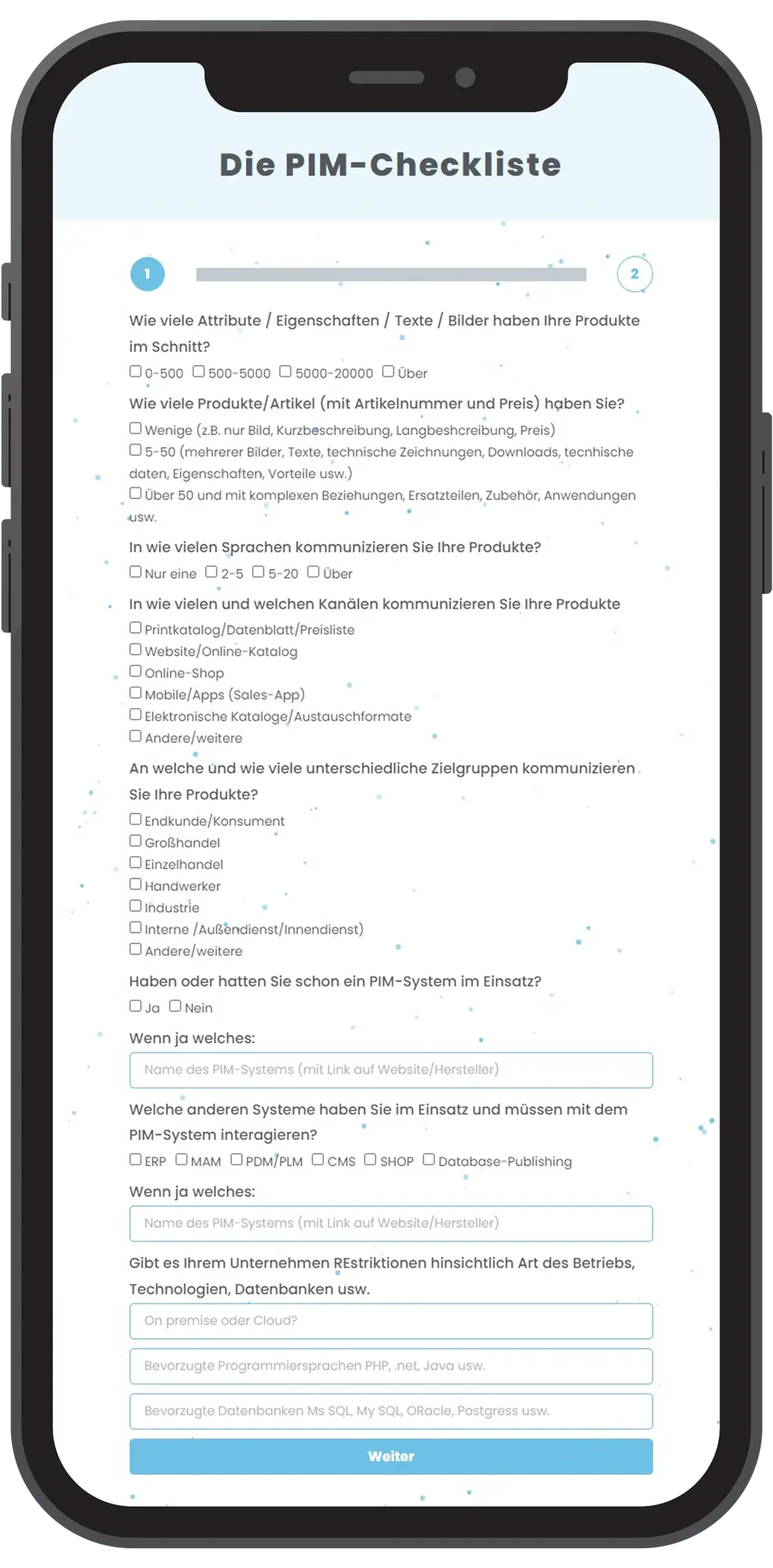
Or start by completing the PIM checklist.
PIM KNOWLEDGE

Find out in 3 minutes whether a PIM system could benefit your business and which PIM systems could be right for you!
Webdesign: Deutsche Stadtmarketing