PIM for ecommerce
Customers cannot touch products in an online store. They make decisions based on data: product names, descriptions, technical specifications, variants, images, videos, data sheets and accessories. If information is missing, they leave or return the goods. Store filters and search only work when attributes are complete and consistently maintained.
All mandatory attributes for each category, in every language. Products missing from filters will not be found.
Consistent units, spellings and values so filters work and products can be compared.
Tailored copy, titles and image formats for online stores, marketplaces and print, all derived from the same core data.
Accessories, spare parts and alternatives linked through relationships to support cross-selling and reduce incorrect purchases.
Reviews, prices and availability usually come from the online store and ERP, but are part of the complete page experience.
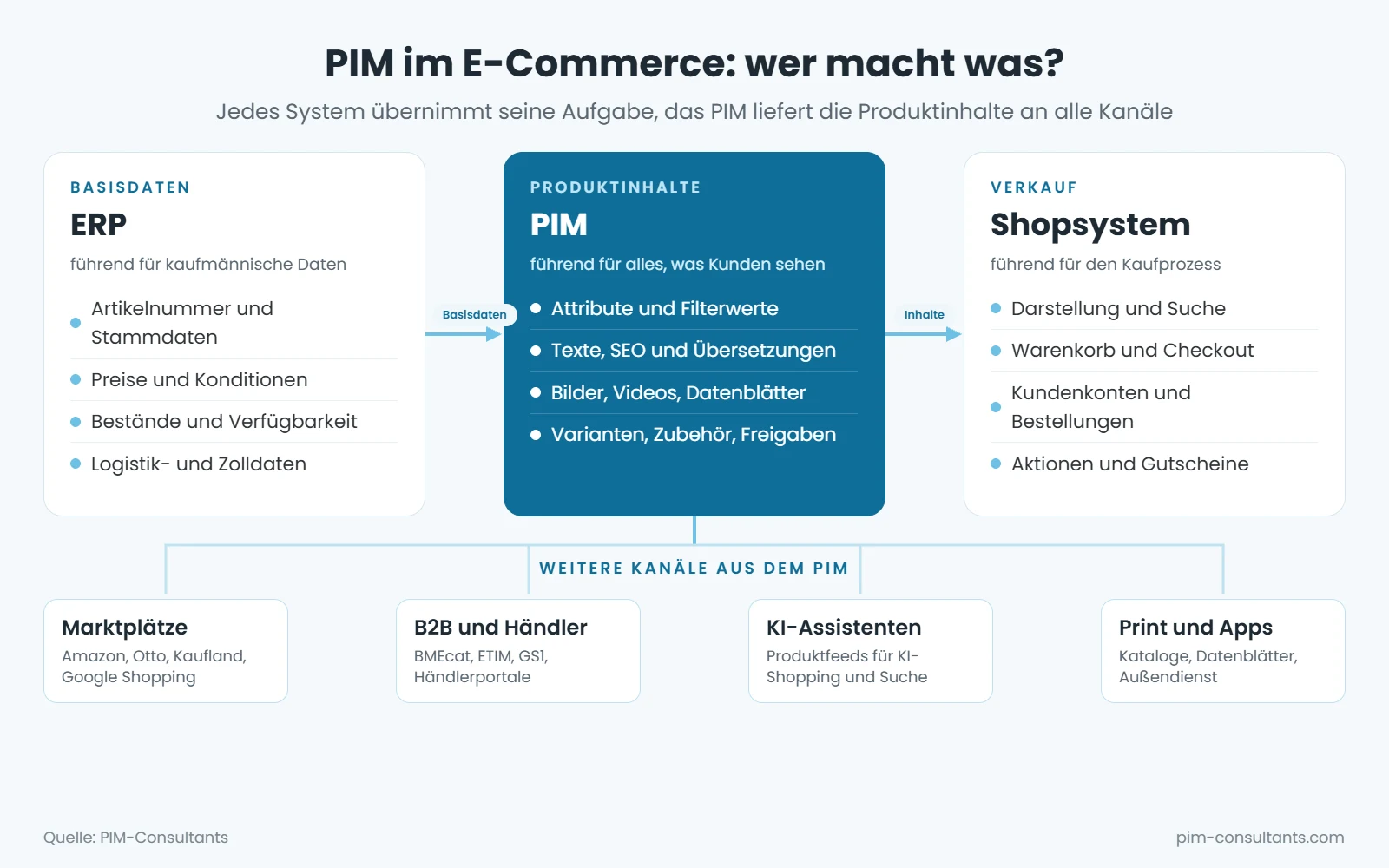
The e-commerce platform handles sales and presentation: shopping cart, checkout, prices and customer accounts. The PIM maintains product content, combines it with core data from the ERP and passes it to the online store. This means data is maintained once and syndicated consistently everywhere.

In practice, there are four approaches, which can also be combined:
In every case, it is important to define which system is the source of truth for each data element. Maintaining the same data in both the PIM and the store backend is the most common cause of conflicting information.
Is a PIM worth it for your online store?
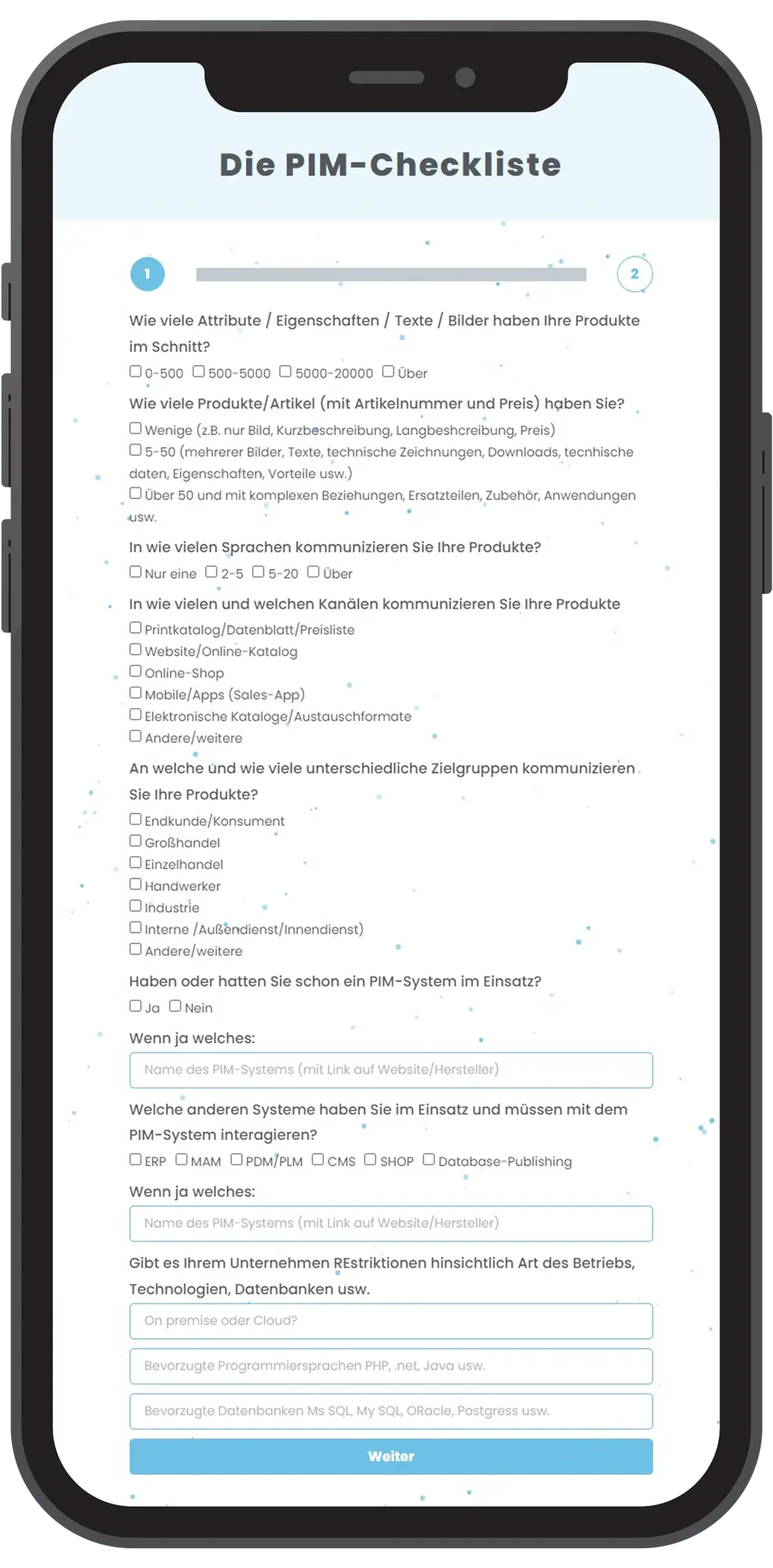
Use the PIM checklist to find out in three minutes whether a PIM system is worthwhile for your business and which systems could be a good fit. We will email you an initial shortlist.
Marketplaces such as Amazon, Otto, Kaufland or Google Shopping require their own formats, categories and mandatory fields. A PIM maps these requirements for each channel and exports the data automatically. In B2B, exchange formats such as BMEcat, ETIM and GS1 also come into play. Find out more in the article PIM and marketplaces.
In the PIM, these differences are maintained as channel-specific mappings: the core data stays the same, while categories, titles and mandatory fields are derived for each marketplace. Rejected records highlight gaps in the data.
Wholesalers and procurement platforms expect product data in standardised formats. BMEcat is a widely used exchange format for electronic catalogues, while ETIM and ECLASS provide classification with predefined attributes. GS1 standards and GDSN support data exchange, primarily in the consumer goods sector. A PIM maintains the classification once and uses it to generate the required exports.
Alongside selling points, EU rules require additional information on product pages. The most reliable approach is to maintain this information as dedicated attributes in the PIM and automatically transfer it to your online store and marketplaces.
Since 13 December 2024, online listings must include, among other things, the manufacturer's name and address, an EU-based responsible person for manufacturers outside the EU, product identification details, and warnings and safety information. Marketplaces such as Amazon now explicitly request these fields. Maintaining them for each product in the PIM eliminates the need to add them separately in every channel.
Since 28 June 2025, consumer-facing online stores must be accessible, from search through to payment; microenterprises providing services are exempt. For product data, this primarily means that images need meaningful alt text and product information should be easy to understand. Alt text can be maintained and translated in the PIM or DAM as a dedicated field for each image.
The Ecodesign Regulation is introducing digital product passports in stages, starting with batteries from February 2027. Information on materials, origin and recycling will therefore become part of product data. Find out more in our article on the digital product passport.
Note: this overview is not a substitute for legal advice.
Structured core data is essential for generating copy automatically: descriptions for each channel and variant, SEO copy and translations. Without clean data, AI generates copy faster, but it also generates errors faster. Our article PIM meets AI provides a practical example.
Customers are increasingly using AI assistants to recommend and compare products. These assistants draw on structured product feeds and website markup. With its Agentic Commerce Protocol, for example, OpenAI describes how retailers can provide ChatGPT with a regularly updated product feed containing identifiers, descriptions, prices, availability, media and shipping options; direct purchases in chat are currently available to approved partners.
For retailers, this means that maintaining complete, unambiguous and approved product data in the PIM also enables them to serve these new channels. For more background, see our article MCP and Agentic Commerce.
Images, videos, 3D models and AR views should be linked directly to the product. A PIM with a DAM module or an integrated DAM provides each channel with the right media in the right format, complete with usage rights, display order and alt text.
Establish your baseline before implementing the PIM. This will allow you to demonstrate its value later.
| KPI | What it measures |
|---|---|
| Completeness by channel | Percentage of mandatory attributes populated for each category, language and channel |
| Time-to-market | Days from item creation in the ERP to going live in the online store and on marketplaces |
| Product page conversion | Percentage of product page visits that lead to a purchase, before and after data improvements |
| Returns due to product data | Returns for reasons such as “not as described” or “wrong size” |
| Marketplace rejections | Listings rejected or suppressed due to missing or incorrect data |
| Search and filters | Searches with no results and filter usage in the online store |
These are common signs we see in our projects. If three or more apply, it is worth taking a closer look:
Product data is stored in Excel spreadsheets, the store backend and emails, and no one knows exactly which version is correct.
Weeks pass between item creation and going live because copy, images and attributes are collected one after another.
Customers cannot find products because attributes are missing or maintained inconsistently.
Data is adapted and added separately for every marketplace, language and retailer.
Our overview of PIM vendors provides a market overview, PIM selection explains our approach to choosing a system, and the PIM implementation page shows how an implementation works.
Not necessarily. But with several thousand products, many variants, multiple languages or channels, managing product data in the shop or in Excel becomes prone to errors. At that point, a PIM system is worth considering as a single source of truth.
The e-commerce platform handles sales: shopping cart, checkout, prices and customer accounts. The PIM system manages product content and supplies it to the shop and other channels, such as marketplaces, retailers and print.
Popular platforms such as Shopware, Shopify, Adobe Commerce, Salesforce Commerce Cloud or SAP Commerce. Many PIM vendors provide ready-made connectors. Otherwise, the connection is established via an API or an integration platform.
It prepares the same product data in the format required by each marketplace, with marketplace-specific categories, titles and mandatory fields, and automatically keeps it up to date.
No. Orders, customers, promotions and presentation are still managed in the shop backend. Product content, however, is managed in the PIM system instead and passed from there to the shop.
Many PIM systems now offer AI capabilities for copywriting, translation and classification. Good results require complete product attributes, clear guidelines for each channel and an approval workflow.
In addition to licence or subscription fees, there are costs for setup, shop integration, data migration and ongoing internal maintenance. For an overview, see PIM implementation & costs.
Is your product data ready for your shop, marketplaces and AI agents?
We provide an independent assessment of how well your data model, processes and systems serve your channels today.
Learn more about our e-commerce consulting, start by completing the free PIM checklist or contact us directly.
PIM KNOWLEDGE

Find out in 3 minutes whether a PIM system could benefit your business and which PIM systems could be right for you!
Webdesign: Deutsche Stadtmarketing