
PIM evaluation checklist: compare PIM software systematically

Download the free SME version with 46 evaluation questions, plus the full list of around 400 criteria for your selection project.

Download the free SME version (Excel)

In brief: The PIM evaluation checklist helps you assess PIM vendors in a structured, consistent way. Download the SME version with 46 evaluation questions in 14 criteria groups as a free Excel file. The full evaluation checklist used in our selection projects provides a baseline of around 400 criteria in around 30 groups for PIM and DAM, with a scoring scale, weighting and analysis through to a ranked list of preferred vendors.
46 evaluation questionsin the free SME version
around 400criteria in the full list
around 30 groupsfrom vendor profile to DAM
1–5 scoring scalewith weighting and a score for each vendor

Two versions for different projects

1

SME version

A concise starting point for small and medium-sized enterprises: the key questions to ask vendors, with weighting and automated scoring.

46 evaluation questions, 14 groups, Excel
Free, with a download link sent by email after a brief review

Download the SME version

2

Full evaluation checklist

The requirements matrix from our PIM and DAM selection projects for mid-sized and larger companies, aligned with your own requirements.

A baseline of around 400 criteria in around 30 groups
With a scoring scale of 1 to 5, a source for each criterion and weighting for each group

More about the full list

What's included in the SME version

Many selection projects compare features alone. Equally important are the vendor's long-term viability, how the system can be operated and extended, and how well it can handle your data. The list therefore covers four areas:

1

Vendor and strategy

Vendor capabilities, risk mitigation, software strategy and development strategy.

15 evaluation questions, for example on the roadmap, documentation and safeguards if developers become unavailable
2

Technology and operations

Software design, support and deployment model, whether in the cloud or in your own data centre.

8 evaluation questions, for example on configuration rather than coding, and the maintenance agreement
3

Data exchange

Import, export, interfaces, validation and data quality.

12 evaluation questions, for example on mapping, export formats, e-commerce and ERP integration
4

Data model

Data model flexibility, inheritance and translations.
11 evaluation questions, for example on data types, units, multilingual capabilities and multi-level inheritance
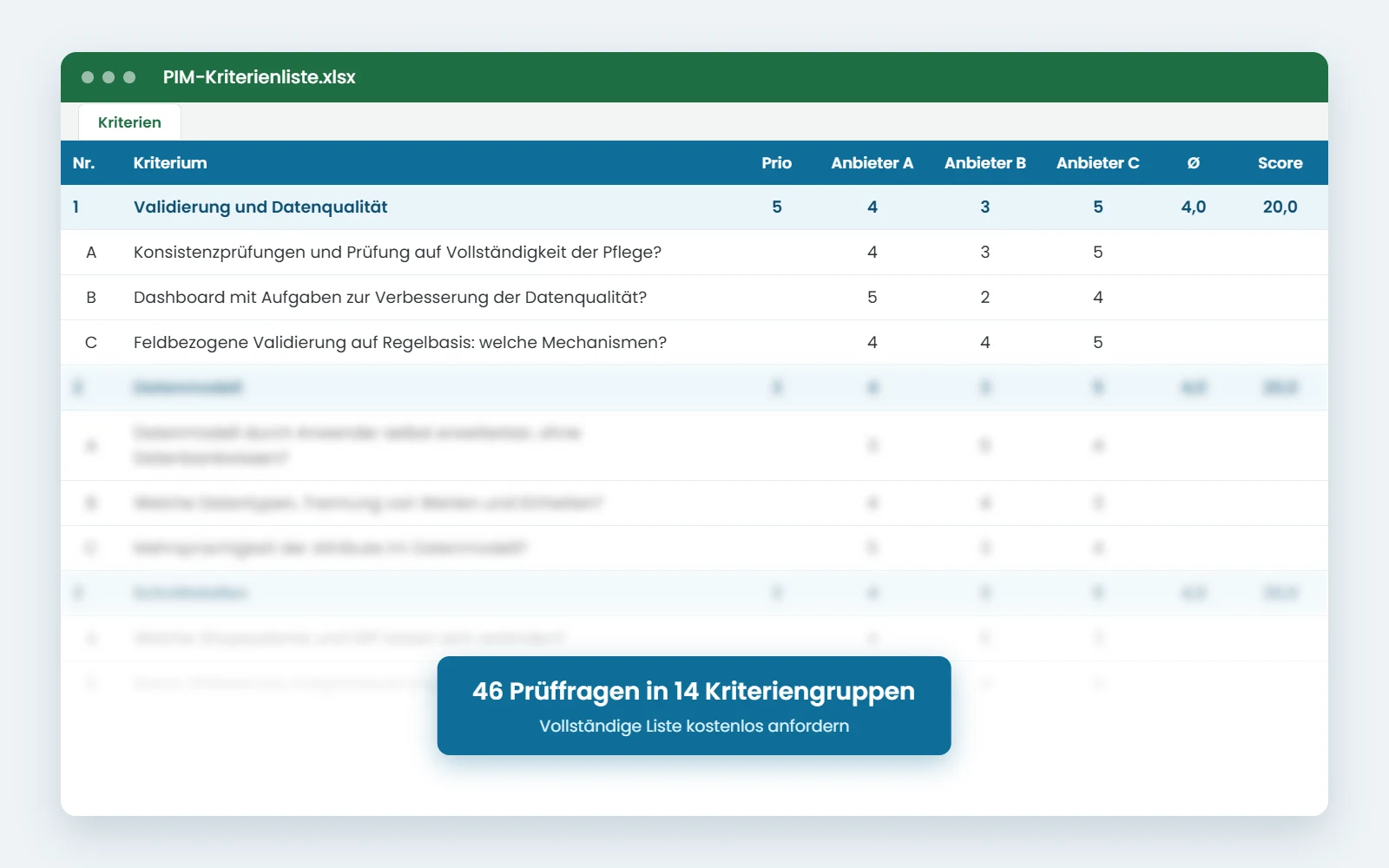
Vorschau der PIM-Kriterienliste als Excel: Kriteriengruppen mit Priorität, Bewertung je Anbieter, Durchschnitt und gewichtetem Score
List structure: weighting for each criteria group, rating for each vendor and weighted score (example values).

Preview: 12 of the 46 evaluation questions in the SME version

This sample shows how specific the questions are. You can send them directly to vendors or ask them during a demo.

Criteria groupExample question
Vendor capabilitiesHow many customers use the software, and how many developers work on the standard product?
Risk mitigationWhat safeguards ensure that you can continue using the software if developers at the vendor or partner become unavailable?
Software strategyIs there a development roadmap, and how are updates made available to all customers?
Development strategyIs the software developed in Switzerland, Germany or the EU?
Software designAre adaptations made through configuration or coding?
OperationsIs a cloud option available, and can the software also run in your own data centre?
SupportWhat support and further development are included in the maintenance agreement?
ImportCan fields from supplier files be freely mapped to attributes in the PIM system?
ExportWhich formats are supported, such as XML, XLS, CSV or JSON?
InterfacesWhich e-commerce platforms and ERP systems can be integrated, and how?
Data modelCan users create new attributes, categories and rules without database knowledge?
TranslationsCan translation memory systems and translation tools be integrated?

Plus 34 more questions, covering topics such as data quality and validation rules, multi-level inheritance, export configuration, the process engine and the approach to releases. Download the free SME version.

How to use the evaluation checklist

1Set weightingsAssign each criteria group a priority from 1 to 5 to reflect your project.
2Ask vendorsSend the questions to your longlisted vendors or discuss them in demos.
3Evaluate responsesRate each vendor; the list calculates the average and weighted score.
4Create a shortlistCompare the top two to three vendors in demos using your own data.
Example: how weighting changes the result

Suppose data quality is critical to you (priority 5), while the deployment model is less important (priority 2). A vendor with an average data quality rating of 4 out of 5 receives a weighted score of 20 in that area, while a vendor scoring 5 for operations receives only 10. This ensures that your priorities directly shape the comparison, rather than giving every feature equal weight.

Set the weightings before the first vendor responses arrive. Otherwise, you may unconsciously adjust them to favour your preferred vendor.

Download the SME version for free

46 assessment questions, weighting and scoring in one Excel file, ideal for getting started. Enter your name and email address. After a brief review, we will email you the download link.

  • free
  • vendor-neutral
  • Excel template
Request now

The complete criteria list: around 400 criteria

For larger selection projects, a questionnaire is not enough. We use a requirements matrix with a baseline of around 400 criteria, matched against the requirements of your departments. Each criterion has a source (the standard catalogue or your own requirement), a rating scale from 5, “fully met”, to 1, “not met”, and belongs to a weighted criteria group.

Vendors and partners

Vendor profile, interpersonal skills and the integrator’s project delivery capabilities.

Strategy and technology

Software and development strategy, software design, support, SaaS or cloud deployment.

Functionality

Usability and performance, search, import, export, supplier onboarding, data transformation and golden record, interfaces, bulk data maintenance, workflows and rules, data quality, reporting, access rights management.

Data model and content

Data model, classifications, inheritance, versions and variants, relationships, text management, languages, translation management, output structures and templates.

There are also criteria groups for DAM or MAM: maintenance structure, data handling, derivatives and distribution. Examples of individual criteria include the bidirectional ERP interface and security management across interfaces: how are a user’s access rights transferred from system A to system B?

From criteria catalogue to decision

The complete list is not a box-ticking exercise. It is a tool used throughout the selection project:
1Gather requirementsWorkshops with all departments, a requirements mind map, initial areas for action
2Requirements matrixMatch a baseline of around 400 criteria against your requirements and assign weights
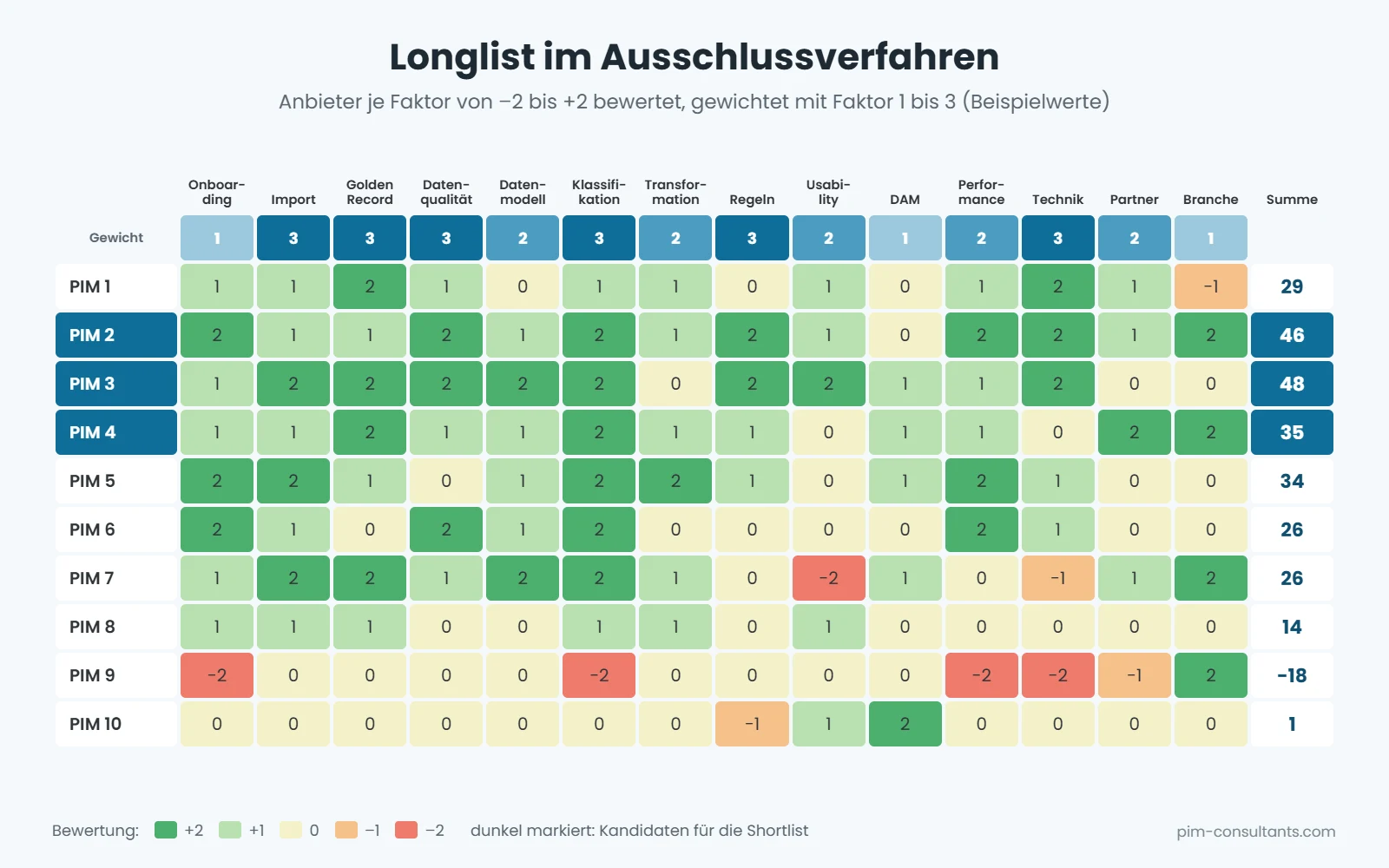
3LonglistTransparent initial selection through elimination
4Vendor workshopsInvitations and agendas drawn directly from the matrix, demos using your data
5Preferred vendorsCore team assessment and an agreed ranking of preferred vendors
Beispiel einer Longlist-Bewertung: zehn PIM-Anbieter je Faktor von minus 2 bis plus 2 bewertet und mit Faktor 1 bis 3 gewichtet, die drei besten kommen auf die Shortlist
Longlisting through elimination: each vendor is assessed against each factor, with weightings reflecting your priorities (illustrative values).
Example: the final assessment of three preferred vendors

At the end, the core team scores the shortlisted vendors in each criteria group on a scale from 1 to 5. The most revealing groups are those where vendors differ. Where all perform equally well, the group does not influence the decision.

Criteria groupPriorityPIM APIM BPIM CInterpretation
Integrator’s project delivery capabilities5354Focus: project delivery
Import5354Focus: import
Data transformation and golden record5453Focus: golden record
Classifications5354Focus: classification
Software strategy4444all equal
Languages2454not decisive

Excerpt with illustrative values. In addition to the requirements-based assessment, each team member records their own assessment of the vendors individually.

Request the complete criteria list for your project

We walk you through the complete list of around 400 criteria and match it against your requirements. If needed, it can serve as the basis for longlisting, vendor workshops and assessment.

  • vendor-neutral
  • for PIM and DAM
  • free initial consultation
Request the list

What matters when assessing vendors

A criteria list is only as good as the answers you receive. In our experience, these points make the difference:

Ask for evidence, not just ticked boxes

Almost every vendor answers “Can you do this?” with a yes. So ask how: through configuration or coding, as standard functionality or a custom project, and with how much effort. Ask them to demonstrate the answer in the demo.

Demos with your own data, not standard presentations

Give shortlisted vendors a sample of your actual product data and two to three typical workflows, such as creating a new item with translation and approval. This lets you see how the system handles your structures, rather than just a prepared sample database.

Assess vendors and partners as thoroughly as the software

A good system is of little use if the implementation partner lacks experience in your industry or the vendor stops developing it. The list therefore also asks about customer numbers, development capacity, the roadmap and safeguards. Reference calls with comparable customers round out the picture.

Include total cost in the comparison

The score shows how well the solution meets your requirements. Alongside it, consider total costs over five years: licensing, implementation, interfaces, operation and internal effort. You will find an overview under PIM Implementation & Costs.

Add your own criteria

The list is deliberately industry-neutral. Add what matters most to you, such as industry standards like ETIM, ECLASS or BMEcat, AI features for text and translation, data for the digital product passport, print output or your marketplaces’ requirements.

PIM checklist, criteria list or expert support?

The right tool depends on where you are in the selection process:

PIM checklistSME versionFull list with our support
PurposeInitial guidance: Is a PIM worthwhile, and which systems are suitable?Detailed comparison of multiple vendorsAround 400 criteria, matched to your requirements, to guide your decision
Time and effort3 minutes onlineA few days with your project teamTailored to your project
OutcomeInitial shortlist by emailWeighted score for each vendorAn informed system decision, demos using your data
Next stepGo to the PIM checklistDownload the SME versionRequest the list · PIM selection

Explore more than 180 systems in our PIM vendor overview.

Frequently asked questions about the PIM criteria list

How much does the PIM criteria list cost?

The SME version is free. Enter your name and email address, and after a brief review we will email you the download link for the Excel file. We use the full list in selection projects. Contact us to find out more.

What is the difference between the SME version and the full list?

The SME version contains 46 assessment questions in 14 groups for a focused vendor comparison. The full list provides a foundation of around 400 criteria in around 30 groups for PIM and DAM, with a scoring scale of 1 to 5, a source for each criterion and weighting. It is matched to your specific requirements.

What format does the list come in?

An Excel file (.xlsx). You can adapt and extend the criteria, weighting and vendor columns as needed.

How many vendors should I compare?

A longlist of five to ten vendors has proven effective. The top two or three make the shortlist and take part in workshops using your own data.

Does the criteria list replace consulting?

It structures the comparison and helps you ask the right questions. Evaluation, workshops and negotiations remain the project team's responsibility. If you would like support, we offer vendor-neutral guidance throughout the selection process.

Ready for a structured vendor comparison?

Start with the free SME version or contact us about the full criteria list for your selection project.

Request the full list

Download the SME version · More about PIM selection

PIM knowledge

News & Blog

Any questions?

We are happy to advise you.

Wait! Have you seen our PIM checklist?

Find out in 3 minutes whether a PIM system could benefit your business and which PIM systems could be right for you!

Webdesign: Deutsche Stadtmarketing