- General
PIM Training via E-Learning: How TRUMPF Brings Viamedici Courses into Its Own Learning Platform via SCORM
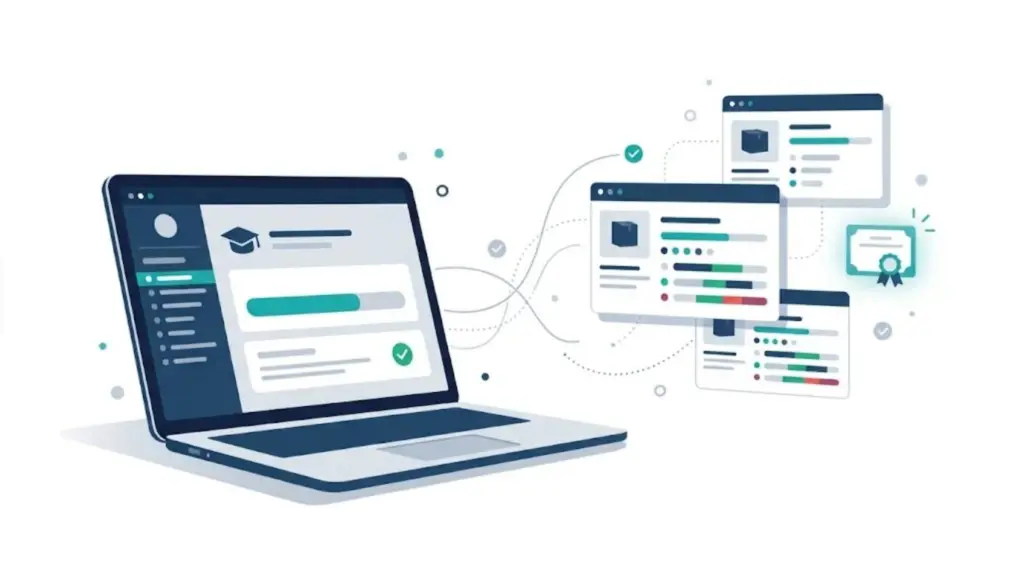
TRUMPF no longer trains new PIM users in face-to-face sessions, but through e-learning in its own learning platform. The training is based on Viamedici’s standard “Data Steward Essentials” course, which TRUMPF shortened to around 90 minutes and imported into Workday Learning as SCORM files. The course is an integral part of the ServiceNow process for new PIM access requests: user accounts are only created once the e-learning is complete. With 20 to 40 new users per year, TRUMPF says the purchase of the course files paid for itself within a year at most. This was reported by Ali Cin and Johannes Wenserit from TRUMPF in the Viamedici webinar “Rethink Your Trainings”, which is available as a recording. We reviewed the roughly 41-minute session and assess what other PIM users can take away from it.
Key takeaways
- TRUMPF uses Viamedici EPIM 4 and EPIM 5 in parallel, depending on the product area. New PIM users join on an ongoing basis, rather than in scheduled onboarding groups. Face-to-face training required too much effort, particularly for users with read-only access.
- TRUMPF selected the relevant chapters from Viamedici’s “Data Steward Essentials” course. Viamedici supplied a SCORM file for each chapter, which TRUMPF uploaded directly to its Workday Learning platform.
- The e-learning is a mandatory step in the ServiceNow PIM access request process. A user account is only created once the learning platform reports completion. Key users then continue to provide process-specific knowledge.
- One drawback: the quiz questions could not be imported directly. With help from a working student, TRUMPF recreated the tests in its own system. Viamedici includes the questions with the purchase and offers to integrate them into the e-learning modules.
- Viamedici offers two courses, “Data Steward Essentials” and “Data Steward Advanced”, each in German and English. They run either on Viamedici’s own Moodle platform or as purchased SCORM files in the customer’s learning platform. Viamedici provides pricing on request only.
- Our assessment: in many PIM projects, the impact of user training on costs and user adoption is underestimated. Anyone selecting a PIM system should scrutinise the vendor’s training offering just as closely as its functionality and licence pricing.
The webinar at a glance
| Key point | Details |
|---|---|
| Title | “Trainings neu denken” (English title: “Rethink Your Trainings”), Viamedici Insight |
| Published | 27 July 2026, available as a recording (around 41 minutes, in German) |
| Speakers | Ali Cin (Service Owner PIM and MAM, IT) and Johannes Wenserit (Business Process Manager PIM and MAM), both TRUMPF; Linda Scharinger (Training, Viamedici); hosted by Sebastian Bold (Viamedici) |
| Systems at TRUMPF | Viamedici EPIM 4 and EPIM 5, Workday Learning as the learning platform, ServiceNow for user account requests, Confluence for operational processes |
| Course | Viamedici “Data Steward Essentials”, shortened by TRUMPF to 9 learning units and around 90 minutes, with mandatory and optional sections |
| Format | One SCORM file per chapter, with a quiz after each chapter |
| Payback period | According to TRUMPF, no more than one year, with 20 to 40 new users per year |
As of 19 November 2026. All information about TRUMPF is taken from the presentation given by TRUMPF employees in the webinar.
Why TRUMPF changed its approach to PIM training
Johannes Wenserit described the starting point candidly. TRUMPF sees considerable turnover among PIM users, with new users joining all the time. The existing training was not enough to give them a solid foundation. Because new users did not arrive in onboarding groups, but individually and at any time, conventional face-to-face training was neither efficient nor scalable. The mismatch was particularly pronounced for users with read-only access: the training effort was out of proportion to what these users actually do in the system.
Facing a PIM selection yourself?
Answer 14 questions in our PIM checklist and receive a personally reviewed shortlist with reasons. Free and vendor-neutral.
The aim was therefore to introduce self-paced e-learning that would ensure consistent basic training with minimal effort. Ali Cin highlighted that all users now gain the same foundational knowledge, regardless of location, timing or trainer. New users no longer have to wait for scheduled sessions and become productive sooner. Key users and trainers spend less time delivering basic training. The solution was so well received internally that other service and application owners at TRUMPF adopted the approach for their own applications.
How TRUMPF approached it
- Review the course: TRUMPF was given access to the standard “Data Steward Essentials” course on Viamedici’s learning platform (Moodle) and worked through it independently.
- Select the content: The course introduces all product editing functions. TRUMPF removed anything not needed internally, depending, for example, on whether users work with the data matrix or with assets.
- Define the learning structure: TRUMPF specified the chapters, time allocations and relevant learning units from the standard course, then sent this structure to Viamedici (see table below).
- Receive the SCORM files: Viamedici supplied one SCORM file per chapter. TRUMPF uploaded them directly to Workday Learning. The team described this step as quick and straightforward.
- Recreate the quizzes: The quiz questions from Viamedici’s learning platform could not be integrated directly. TRUMPF recreated them in its own system as a one-off task.
The learning structure TRUMPF presented in the webinar:
| Chapter | Time | Learning units from the Viamedici course |
|---|---|---|
| Introduction | 5 min. | Get Started |
| Initial overview | 5 min. | System introduction |
| Search | 5 min. | Search, with quiz |
| Product editing basics | 35 min. | Data creation, relationships, data attributes, data types, data matrix, data quality index, references, with quiz |
| Working with dictionaries | 10 min. | Dictionary, dictionary entries, with quiz |
| Collaboration and individual work | 10 min. | Dashboard, My Profile, with quiz |
Source: TRUMPF slide from the webinar. Learning units total 70 minutes, or around 90 minutes including quizzes.
In the Workday Learning catalogue, the course is listed as self-paced e-learning with 9 learning units and a duration of around 90 minutes, including mandatory and optional sections. It is available to all TRUMPF employees. Searching for “PIM” brings it up.
Training as part of granting access
Its integration into the access management process is particularly relevant to other PIM operators. At TRUMPF, all PIM-related operational processes, from data model changes and bulk data handling to imports and exports, run through ServiceNow. They are documented in Confluence, and each department has key users. Requests for PIM access follow this process:
| Step | What happens |
|---|---|
| 1. Request | The user submits a request in ServiceNow, specifying the instance (production, development or test), the required role (user, key user or read-only), the request type (new or change) and any training already completed. |
| 2. Review | An approver checks whether the request is justified and the role is appropriate. According to TRUMPF, around 90% are approved directly; the remainder require follow-up questions. |
| 3. E-learning | New users and users switching from read-only to editing permissions receive a link to the e-learning course. The team tells read-only users which chapters are sufficient for their needs. Simple extensions of permissions do not require e-learning. |
| 4. Completion | The learning system confirms that the course has been completed. |
| 5. User account creation | Only then is the user account created in the PIM system. |
| 6. Role-based training | Depending on the role, key users then provide training specific to the application and processes. |
The final step is important. TRUMPF itself emphasised that the Viamedici course is standard e-learning that does not cover its own processes and specific requirements. E-learning therefore does not replace key users; it frees them from repeatedly delivering the same basic training.
Training and operations belong in PIM selection
Whether a PIM system works in day-to-day operations ultimately depends on its users. That is why our vendor-neutral PIM selection process also assesses vendors’ training options, role models and operational requirements.
What SCORM is and what it does
In the second part, Linda Scharinger, who manages the learning platform at Viamedici, explained the technical fundamentals. SCORM stands for “Sharable Content Object Reference Model” and is a widely used standard for e-learning content. It is maintained by the Advanced Distributed Learning Initiative (ADL). The key points from the presentation:
- A SCORM file is a ZIP package. It contains learning content such as text, images, videos, simulations and tests, along with technical information. It is usually created using an authoring tool.
- The learning platform and the package exchange data. The package reports completion status, learning progress, test results and time spent to the learning platform. Learners can pause and later pick up where they left off.
- Without a learning platform, there is no tracking. You can unzip the package and open it in a browser, but you will not know whether someone has worked through the course or how far they have progressed.
- Reporting for those responsible: In Moodle, trainers and managers can view and export all learners’ attempts and grades. This is particularly important for mandatory training with deadlines.
Viamedici also acknowledged the limitations: personal interaction is not the same as in classroom training. Viamedici says it compensates for this with support via Microsoft Teams, optional onboarding sessions, a chat in Moodle and dedicated contacts.
Additional context: SCORM comes in several versions, primarily SCORM 1.2 and SCORM 2004. ADL now recommends the successor standards xAPI and cmi5 for new projects, but notes that SCORM remains widely used. The webinar did not specify which SCORM version Viamedici supplies. Prospective customers should check compatibility with their own learning platform in advance.
Viamedici’s training offering
Viamedici currently offers two courses, with more planned according to the webinar:
- Data Steward Essentials: the basics of working with data and assets in EPIM, aimed at new users with no prior knowledge. According to the Viamedici website, the course takes around ten hours, completed at the learner’s own pace over one to two weeks, and includes exercises in a training environment and a certificate of participation.
- Data Steward Advanced: for experienced users, covering data import, data structuring, configuration via the user interface, monitoring and export.
Both courses are available in German and English. They can be used in three ways: on Viamedici’s own Moodle platform, as purchased SCORM files in the customer’s learning platform, or in a tailored version with selected topic modules removed or files adapted to the customer’s needs. Viamedici supplies quiz questions and accompanying PDFs with the SCORM files. Live sessions lasting two to four hours are also available online or on site.
Viamedici provided only general information about costs during the webinar, stating that pricing is individual. Training may already be included in migrations or larger projects, and volume discounts are available for large numbers of participants on the Viamedici platform. For smaller-scale needs, Viamedici recommends its own platform; beyond a certain scale, it recommends using the customer’s own learning platform.
Two polls during the webinar show where participants stand: 43% said they already used a learning platform (LMS or LXP), the same proportion said they did not, and 14% did not know. 75% were interested in the SCORM files. The number of respondents was not disclosed, and the moderator noted that fewer participants voted in the second poll.
Our assessment
This account of practical experience is useful because it addresses an issue that is often tackled too late in PIM projects. In larger companies, a PIM system can easily have dozens or hundreds of users, many of whom use it only occasionally or have read-only access. Training every user individually ties up key users on an ongoing basis. Providing no training at all leads to poor data quality and frustration in business departments.
We believe three points apply regardless of the PIM vendor:
- Link training to access permissions. The “learn first, then get access” approach is simple and effective. It requires the learning platform to reliably report course completion back to the access request process.
- Separate standard training from company-specific content. Vendor training covers how to use the system, not your data model or approval processes. This second layer remains the responsibility of key users or needs to be covered in a separate course.
- Plan for ongoing maintenance. TRUMPF runs EPIM 4 and EPIM 5 in parallel and has courses for both versions. Every new version and every interface change can make course content outdated. The webinar did not address how often the provider updates its content or whether you automatically receive updated SCORM files. These points should be covered in the contract.
The claim of a payback period of no more than one year comes from the customer, not from a substantiated calculation, as no prices were disclosed. It is nevertheless plausible: even with 20 to 40 new users per year, in-person sessions, travel time and key user involvement quickly add up. Whether buying course files is worthwhile for you depends primarily on the number of new users, staff turnover and whether you already have a learning platform in place. According to the webinar poll, fewer than half of the participants could confirm that they did.
For PIM selection, this gives us specific questions to ask every vendor:
- What training is available for each role, and in which languages?
- Is the content available as SCORM, xAPI or cmi5 for use in your own learning platform, and in which version?
- Are tests and certificates included in the packages, or are they only available on the provider’s platform?
- How are courses updated for new releases, and what does this cost?
- Is training included in the implementation project or charged per participant?
We factor these points into our assessment of operating costs. Our PIM cost calculator lets you include training as a separate cost item, and our PIM RFP template helps you put these questions to vendors in a structured way. Find out more about Viamedici in the vendor profile and in our article on EPIM 5 Update 5.
Are you planning to implement or expand a PIM system?
We provide vendor-neutral support to help you consider roles, your training approach and operational processes from the outset. The initial 30-minute consultation is free.
Frequently asked questions
What is SCORM?
SCORM (Sharable Content Object Reference Model) is a standard for e-learning content. A SCORM package is a ZIP file containing learning content and technical information that is uploaded to a learning platform. The package reports progress, test results and time spent to the learning platform.
What is the difference between an LMS and an LXP?
An LMS (Learning Management System) delivers courses and manages participants and learning progress. An LXP (Learning Experience Platform) is the newer term and places greater emphasis on the learning experience and content discovery. TRUMPF uses Workday Learning, while Viamedici uses Moodle.
How does TRUMPF train new PIM users?
Through an e-learning course of around 90 minutes in Workday Learning, based on Viamedici’s “Data Steward Essentials” course. Completing the course is a mandatory step in the ServiceNow request process for PIM access. Depending on the user’s role, this is followed by process-specific training delivered by key users.
What training does Viamedici offer for EPIM?
Currently, “Data Steward Essentials” for beginners and “Data Steward Advanced” for experienced users, both in German and English. Live sessions are also available online or on site. According to Viamedici, further courses are planned.
Can you use Viamedici courses in your own learning platform?
Yes. Viamedici sells the courses as SCORM files, shortened or customised on request. Quiz questions and supporting PDFs are included. If you do not have your own learning platform, the courses run on Viamedici’s Moodle platform.
How much does Viamedici training cost?
Viamedici does not publish prices. Self-paced courses are charged per participant or seat, while live sessions are quoted individually. Training may be included in migrations or larger projects, and volume discounts are available for larger numbers of participants.
Can vendor e-learning replace internal PIM training?
No. A standard course teaches users how to operate the system, not your data model, roles or approval processes. This is why TRUMPF also supplements e-learning with role-specific training delivered by key users.
Sources
- Viamedici: Rethinking Training, webinar recording with slides (27.07.2026), reviewed in full by our team
- Viamedici: Rethink Your Trainings (English version)
- Viamedici: Role-based MDM & PIM training for data stewards and teams
- Viamedici: Case Studies, including TRUMPF
- ADL Initiative: SCORM
Request vendor-neutral advice
Looking to rethink training and operations for your PIM system? Send us a brief message outlining how many users you have and their roles.
We will get back to you with a vendor-neutral assessment.
PIM Market Update Newsletter
Acquisitions, new vendors, practical tips: by email every six to eight weeks
Concise and vendor-neutral: developments in the PIM market and what they mean for your selection process. Unsubscribe at any time.
More PIM insights
News & Blog

PIM Costs 2027: What a PIM System Really Costs
List prices from 15 vendors, nine real quotes and total costs over three years: what a PIM system costs in 2027 and what drives the price. Includes PDF.
AI Visibility of PIM Vendors 2027: Who ChatGPT and Google Recommend
Analysis of 60 AI responses: which PIM systems Google AI Mode and ChatGPT recommend, which sources they rely on and what this means for PIM selection.
DACH PIM Market Report 2027: 150 PIM Vendors in Figures
150 PIM vendors and 150 integrators compared: location, SaaS and on-premises, pricing, modules, AI features and acquisitions. Includes a downloadable PDF.
Migrating from Pimcore 11 to OpenDXP: process, effort and risks
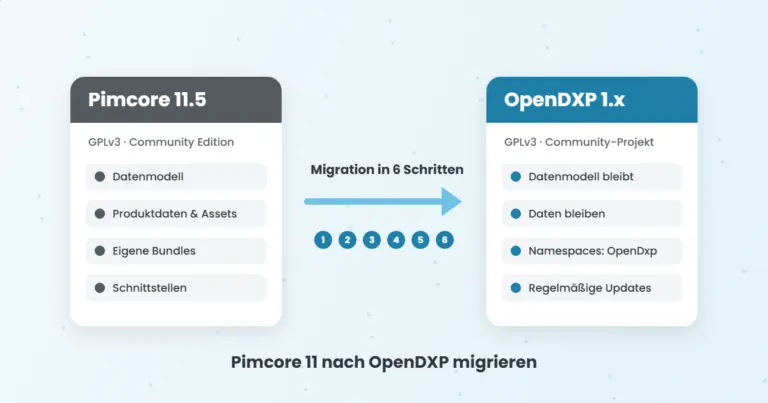
Migrating from Pimcore 11 to OpenDXP: requirements, a six-step process, changes, factors affecting effort, risks and agencies. Includes a free platform review.
AI agents for product data: what works in real projects
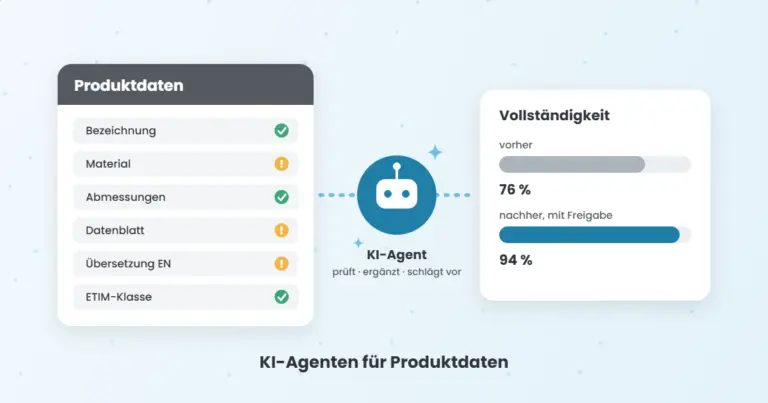
In two projects, AI agents increased product data completeness from 76 to 94% and from 42 to 86%. What works, what it costs and where the limits lie.
GS1 Sunrise 2027: QR Codes Instead of Barcodes, What Your Product Data Needs to Deliver
By the end of 2027, checkouts worldwide should be able to read 2D codes. What Sunrise 2027 and GS1 Digital Link mean for manufacturers, which product data a QR code needs and what your PIM must provide.