Migrating from Pimcore 11 to OpenDXP: process, effort and risks

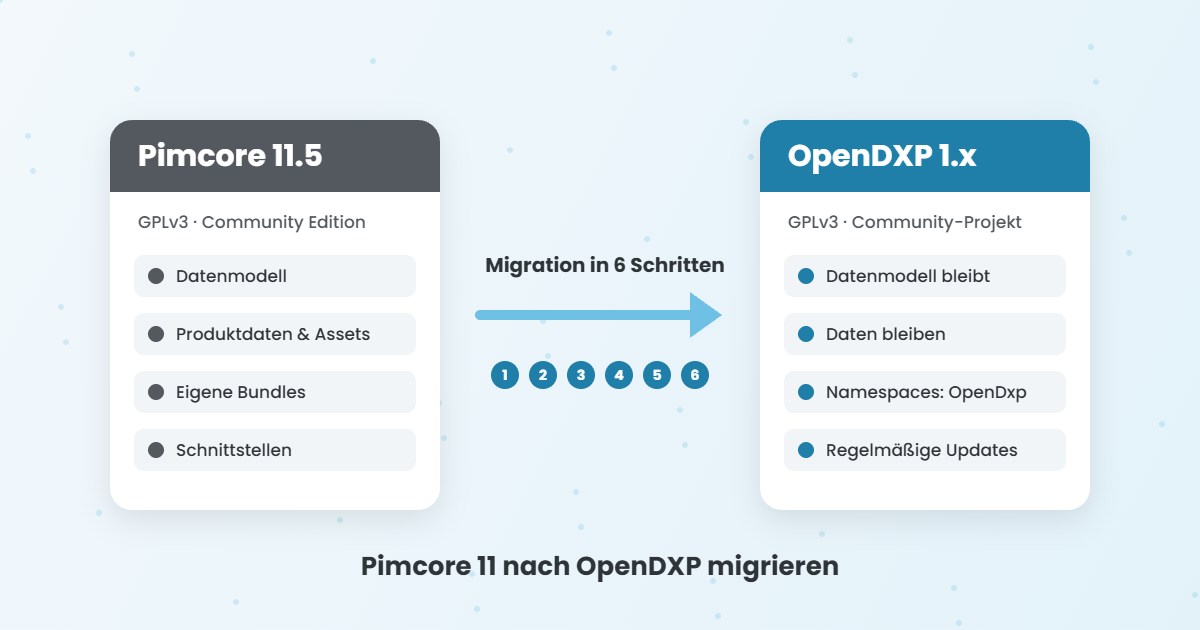
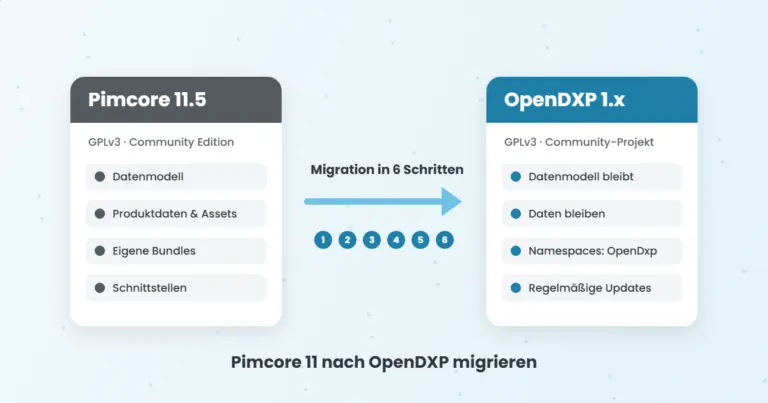
Migrate Pimcore 11 to OpenDXP: retain your data model and data in a six-step migration

Migrating from Pimcore 11 to OpenDXP: process, effort and risks

As of 27 November 2026 · OpenDXP 1.5.6

Community Edition support for Pimcore 11 ended in autumn 2025, and paid long-term support for platform version 2024.4 expires in December 2026. If you are still running Pimcore 11, you need a plan now. One option is to move to OpenDXP, the GPLv3 fork of Pimcore 11.5.13.

This page explains who the migration suits, which steps the OpenDXP documentation specifies and where the risks lie. For an introduction to OpenDXP, see our article OpenDXP: the open-source PIM following Pimcore’s licensing change.

Is the migration worthwhile for you?

OpenDXP is a good fit if most of the following apply:

  • You run Pimcore 11 yourself or with a hosting provider and have annual revenue above €5 million, so upgrading to Pimcore 2025/2026 would require a paid licence.
  • Your data model and processes work well, and you want to keep them.
  • You use few or no commercial Pimcore Enterprise bundles.
  • You have an in-house development team or an agency to handle operations and updates.

OpenDXP is less suitable if you need contractually guaranteed vendor support, want to use Pimcore’s new AI features or have requirements that have changed significantly since implementation. We compare the three options in Pimcore vs. OpenDXP.

Requirements

  • Pimcore 11.5.x: The OpenDXP documentation requires you to update to the latest Pimcore 11.5 release first.
  • PHP and Symfony: OpenDXP 1.5.6 requires PHP 8.3, 8.4 or 8.5 and Symfony 7.4. Older PHP environments must be upgraded first.
  • Inventory: List all bundles, custom extensions, integrations and cron jobs in use. Check whether an OpenDXP version is available for each bundle.
  • Test environment: A copy of the database and assets on which to rehearse the entire migration.

The process in six steps

  1. Assess and decide: Review bundles, custom code, integrations and hosting. The result is a list of what needs to be replaced or adapted.
  2. Update to Pimcore 11.5.x: If you have not already done so, including the PHP version.
  3. Adapt the code: Switch packages to OpenDXP using Composer and change namespaces from Pimcore to OpenDxp (for example, in bin/console; the script can be taken from the OpenDXP skeleton). PIMCORE_ constants become OPENDXP_, pimcore: console commands become opendxp:, and pimcore_ Twig functions become opendxp_.
  4. Adjust the configuration: The config/pimcore folder becomes config/opendxp, and configuration blocks such as pimcore_admin become opendxp_admin.
  5. Adapt the database: Rename the BUNDLE_INSTALLED__Pimcore entry in settings_store, replace class references in documents_editables and properties (according to the documentation, this is also safe in serialised data), remove old Pimcore migrations from migration_versions and migrate document, asset and object versions according to the instructions.
  6. Test, go live and maintain: Run functional tests with business users and check integrations, exports and permissions. Plan regular updates after go-live, as each minor version is only supported until the next one is released.

These steps follow the official Migrating to OpenDXP guide. Always refer to the latest version of that guide.

What changes when you migrate

AreaChange in OpenDXPWhat to check
LoginHard-coded password salt removed; a setting keeps existing logins workingLogin for all users after migration
EditorTinyMCE WYSIWYG editor replaces QuillFormatted text and templates
TemplatesTwig only; some controller classes changedCustom controllers and templates
PDF generationChromium support removed; Gotenberg recommendedDatasheets and print output
MigrationsOld Pimcore migrations removedmigration_versions table
BundlesCommercial Pimcore bundles not includedReplacement or custom solution

What determines the effort involved

For a lean installation with standard bundles, migration mainly involves code changes and testing. The effort increases with:

  • Numerous custom bundles and extensions containing Pimcore references,
  • Enterprise bundles in use for which there is no direct replacement,
  • An older starting version that first needs to be updated to 11.5,
  • Numerous integrations with ERP, e-commerce, DAM or print systems that need testing,
  • Print and PDF output based on Chromium.

A reliable estimate is only possible after an assessment of your current setup. That is exactly what our free platform review is designed for.

Operational risks

  • No vendor: no SLAs; you and your agency are responsible for operations and security updates.
  • No LTS: updates in line with minor releases are an integral part of ongoing operations.
  • Early-stage project: a small core team centred on DACHCOM, with a community that is still growing.
  • Separate paths: new Pimcore features, for example in AI, will not make their way into OpenDXP. Switching back to Pimcore later becomes more complex with each version.

OpenDXP agencies for your migration

Our directory lists OpenDXP agencies and partners from Germany, Austria and Switzerland, including DACHCOM, instride, INFOLOX, aufwind, viucom, PRinguin, Klickpark and sparcode. If you choose to upgrade Pimcore, Pimcore agencies and partners are available to help.

Free platform review for Pimcore 11 users (30 minutes)
We provide vendor-neutral guidance on whether upgrading Pimcore, migrating to OpenDXP or selecting a new system makes sense for you, what this means for licensing and effort, and which agencies could be a good fit.

Book a platform review

Frequently asked questions

Can I migrate directly from Pimcore 10 or 11.2 to OpenDXP?
No. The OpenDXP documentation requires Pimcore 11.5.x. Older installations must first be updated to the latest 11.5 release before migrating.

Will my product data be preserved during the migration?
Yes. OpenDXP is based on Pimcore 11.5.13, so your data model and data are preserved. Changes are made to class references in individual tables, such as documents_editables and properties, and to entries in settings_store and migration_versions.

Do commercial Pimcore bundles work with OpenDXP?
Pimcore’s Enterprise bundles are not part of OpenDXP. For each bundle in use, you need to establish whether a community alternative is available or a custom solution is required.

How much does OpenDXP cost?
The software is free under the GPLv3. Costs arise from migration, testing and ongoing operations, including regular updates.

OpenDXP: The New Open-Source Alternative

Discover how current licensing changes are affecting the PIM market and why OpenDXP is considered a strategic alternative in 2026.

Please leave your contact details to receive the white paper.
We will be happy to provide further information afterwards.

Share this post

More PIM insights

News & Blog

Any questions?

We are happy to advise you.

Wait! Have you seen our PIM checklist?

Find out in about 10 minutes whether a PIM system could benefit your business and which PIM systems could be right for you.

Webdesign: Deutsche Stadtmarketing