- PIM comparisons
PIM for Fashion and Textiles: Providers Compared for 2026
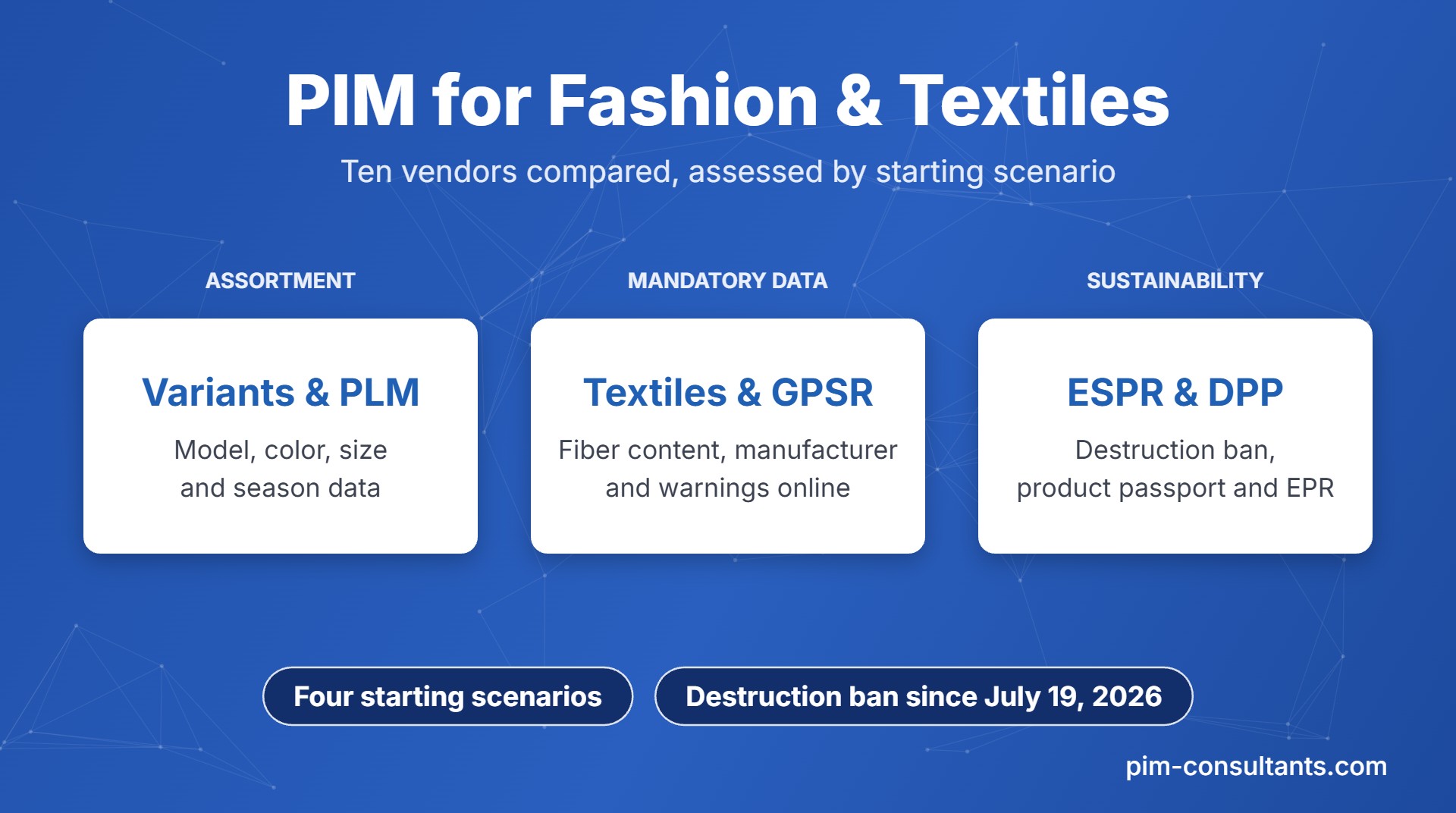
In short: In fashion, footwear and textiles, your starting point determines the right PIM, not the provider’s name. Every collection brings hundreds to thousands of style, colour and size variants that need to reach retail partners, marketplaces and your own online store early in the season. New obligations also arrive between 2026 and 2028: the ban on destroying unsold clothing and footwear, stricter rules on environmental claims, extended producer responsibility for textiles and the Digital Product Passport. We assessed ten providers against seven requirements: variants and sizes, seasons and PLM, mandatory information, images and media, marketplaces and retail partners, sustainability and supporting evidence, and localisation. This gives us four typical starting scenarios: brands with wholesale operations and their own online store; fashion retailers with many brands and suppliers; brands focused on marketplaces; and international brands operating across many countries and languages. Our assessment following the comparison shows which solution fits which scenario.
What a PIM for fashion and textiles needs to do
- Variants and sizes: A style has several colours, each colour has a size range, and each size has its own EAN. The PIM must support this hierarchy, inherit attributes at the right level and manage sizing systems, fits and size charts for each country. Multi-brand retailers also have thousands of colour variants per collection to manage.
- Seasons, collections and PLM: Styles, materials and suppliers originate in PLM, often months before launch. Retail partners need the data early for order books, line sheets and B2B platforms such as NuORDER or JOOR, while your own online store needs it later, with all images included. The PIM needs reliable PLM integration, season management and the ability to carry over continuing lines.
- Mandatory information: Under the Textile Labelling Regulation (EU) 1007/2011, fibre composition must be clearly visible before purchase, including in online stores. Since December 2024, the General Product Safety Regulation (GPSR) has required every online listing to include the manufacturer’s postal and email addresses, product identification details with an image, and any applicable warnings. In practice, care instructions are also essential.
- Images and media: Images sell fashion: multiple views per colour, model shots, close-ups and videos, plus channel-specific formats and backgrounds. The PIM needs its own DAM or close integration with one, with automatic assignment of images to variants.
- Marketplaces and retail partners: Zalando, Amazon, About You and retail partners’ online stores each require their own attributes, size codes and image specifications. Ready-to-use formats, maintained mappings and feedback on which items were rejected and why are crucial.
- Sustainability and supporting evidence: Since 27 September 2026, generic environmental claims such as “environmentally friendly” have only been permitted in Germany with supporting evidence, and sustainability labels only with a recognised certification scheme. Extended producer responsibility and disclosure of destroyed goods require weight and material data for each item. The Digital Product Passport will require further information on origin, materials and repair. The PIM should maintain material composition, certificates and supporting evidence for each item.
- Localisation: International brands manage copy, sizes and prices for many countries. They need translation workflows with machine pre-translation and review, country-specific assortments and clear responsibilities for each market.
Deadlines affecting product data in fashion and textiles
Several rules take effect between 2026 and 2030. Many require information that is currently often held only in ERP systems or spreadsheets: weight, material composition, quantities and supporting evidence for each item.
| Date | Regulation | What it means for product data |
|---|---|---|
| since 8 May 2012 | Textile Labelling Regulation (EU) 1007/2011 | Fibre composition must be clearly visible before purchase, including when buying electronically (Article 16); non-textile parts of animal origin must be indicated. |
| since 13 December 2024 | General Product Safety Regulation (EU) 2023/988 (GPSR) | Every online listing must identify the manufacturer or importer with postal and email addresses, provide product identification details with an image, and include any applicable warnings and safety information (Article 19). |
| 2026 | Ecodesign for Sustainable Products Regulation (EU) 2024/1781 (ESPR), disclosure | Large companies disclose the number and weight of destroyed unsold consumer products for the first time for the 2025 financial year, including the reasons and disposal methods. |
| 19 July 2026 | ESPR, ban on destruction | Large companies may no longer destroy unsold clothing, clothing accessories and footwear. Exceptions are governed by Delegated Regulation (EU) 2026/296; supporting records must be retained for five years. |
| 27.09.2026 | Amendment to the German Act Against Unfair Competition (UWG) implementing Directive (EU) 2024/825 | Generic environmental claims require evidence; sustainability labels require certification or approval by a public authority. |
| 02.03.2027 | Implementing Regulation (EU) 2026/2 under the ESPR | Standardised format for disclosing destroyed goods. |
| Q4 2027 (planned) | ESPR, delegated act on textiles | Ecodesign requirements and Digital Product Passport for clothing and textiles; the obligations apply only after a transition period. |
| 17.04.2028 | Waste Framework Directive, amended by (EU) 2025/1892 | Extended producer responsibility schemes for textiles and footwear in all Member States; producers must register in each country and report the quantities placed on the market annually, including by weight. Applies to microenterprises from 17.04.2029. |
| 19.07.2030 | ESPR, ban on destruction | The ban on destruction and disclosure requirements also apply to medium-sized companies. |
There is some relief for leather: since 18 September 2026, cattle hides and leather have no longer been covered by the Deforestation Regulation (Delegated Regulation (EU) 2026/2102). A subsequent review of the regulation will determine whether leather remains permanently exempt.
PIM vendors for fashion and textiles compared
Vendors are listed alphabetically, not ranked. We have included only vendors with publicly documented customer references in fashion, footwear or textiles. Features are based on vendor information; customer references are included only where publicly verified.
| Vendor | Focus | Strengths in fashion and textiles | Customer references (publicly verified) | Best suited to |
|---|---|---|---|---|
| Akeneo (Nantes, Düsseldorf office) | SaaS PIM focused on channels and product experience | Fashion industry page covering product ranges, sizes, variants, Digital Product Passport and resale; at Kurt Geiger, over 60,000 products and around 700,000 SKUs for 21 online shops and around 20 retail partners; at N Brown, materials, care instructions, measurements and international size charts for three brands | Kurt Geiger, N Brown (Simply Be, Jacamo, JD Williams), Fossil, Zadig&Voltaire | Brands and retailers with many shops and partners that prefer SaaS |
| Bluestone PIM (Oslo) | SaaS PIM built on MACH architecture | At Zeeman, a central data hub connecting PLM, online shop, search and catalogue; around 40,000 SKUs for over 1,300 stores; AI-assisted localisation reduced from six weeks to around one week | Zeeman (textile discounter, Netherlands) | Retailers with headless commerce and multiple languages |
| Centric PXM by Centric Software (formerly Contentserv) | PIM and DAM from the company behind Centric PLM | At DANIELS, two collections a year, each with around 3,200 colour variants from over 200 brands, managed without separate spreadsheets; the vendor also covers product development with Centric PLM | DANIELS (fashion retailer, Bornheim) | Multi-brand retailers and brands seeking PLM and PIM from a single vendor |
| inriver (Malmö) | PIM focused on product experience and syndication | At Carhartt, data consolidated from SAP ERP and PLM, publication time halved (partner: Valtech); at Fjällräven, over 2,000 products with Bynder DAM and a translation service; at Varner, eleven brands in eight countries | Carhartt, Fjällräven, Varner, New Balance | Brands with wholesale operations, their own online shop and multiple channels |
| Pimcore (Salzburg) | Open-source platform for PIM, DAM and commerce | At deuter, one PIM for over 20 country-specific online shops in up to five languages, with a shared framework for the outdoor brands of the Schwan-Stabilo Group; at Macron, time to market reduced by 60% and data maintenance effort by 30%, with channel-specific image editing | deuter, Macron, La Redoute, POLO Motorrad | Brands with in-house IT or an IT partner that want to combine PIM, DAM and online shop flexibly |
| Plytix (Málaga) | SaaS PIM with DAM and brand portals for mid-sized businesses | At Baldinini, ten channels supplied automatically, content in four languages, brand portals instead of file transfers; at Twisted X, retailer-specific feeds and new products created twice as fast | Baldinini, Twisted X, Otter Distribution | Mid-sized brands with many retailers and limited budgets |
| Sales Layer (Valencia) | SaaS PIM with many connectors | At namuk, over 3,500 SKUs and 8,000 images for eleven channels, integrated with Shopify and NuORDER; at Bobux, distribution to over 40 countries with Magento, JOOR and Amazon | namuk (children’s clothing, Switzerland), Bobux, Ysabel Mora | Brands selling wholesale through B2B platforms and through their own online store |
| Salsify (Boston) | Product experience platform with PIM, DAM and syndication | At ASICS, a global data model for over 500,000 products, 67 channels and 1.26 million assets across four regions; at Samsonite, enhanced content in around 15 minutes rather than weeks | ASICS, Samsonite | International brands with many retailers and marketplaces |
| Stibo Systems (Aarhus) | Multi-domain MDM with PIM | At Mason Companies, over one million SKUs from more than 1,000 suppliers onboarded in three years, covering ten brands; at Tiger of Sweden and Peak Performance, centralised product data for wholesale, stores, franchises and online stores | Mason Companies (footwear), Tiger of Sweden, Peak Performance | Large retailers and brand groups with many suppliers and channels |
| Tradebyte (Ansbach, Zalando Group) | Platform for marketplace and retailer integration | Preferred integrator for Zalando, mapping data to retail platform formats; at Marc O’Polo, 20 integrations in twelve countries in nine months; at Protest Sportswear, marketplace orders up 37% | Marc O’Polo, Protest Sportswear | Brands whose growth is driven by Zalando and other marketplaces, usually alongside a PIM |
Other vendors with fashion and textile references: Pimberly (Cotton Traders with 140,000 products and 92,000 assets), Kontainer (Les Deux, Pandora), JasperX (Filson, Tumi, Samsonite) and THRON (focus on fashion brands).
Our assessment: which solution fits which starting point
We assessed the ten vendors against the seven requirements in the first section, wherever public evidence was available. No vendor is equally strong across all seven: some start with brands and channels, others with retail, platforms or master data management. We therefore distinguish between four starting points.
Starting point 1: brands with wholesale operations and their own online store
Here, the journey from PLM through the ordering phase to the online store is what matters. inriver has a documented case at Carhartt: data from SAP ERP and PLM comes together in the PIM, cutting publishing time in half. Sales Layer connects B2B platforms such as NuORDER and JOOR at namuk and Bobux, while Plytix provides retailer-specific feeds and brand portals at Baldinini and Twisted X. Akeneo has a dedicated industry page covering sizes, variants and the Digital Product Passport. Check at what point in the seasonal cycle the PIM starts supplying data to ordering platforms and how carry-over products are handled.
Starting point 2: fashion retailers with many brands and suppliers
Multi-brand retailers take in data from hundreds of suppliers and need fast enrichment. Centric PXM has a documented case at DANIELS with over 200 brands and around 3,200 colour variants per collection, as does Stibo Systems at Mason Companies with over one million SKUs from more than 1,000 suppliers. At Zeeman, Bluestone PIM connects PLM, the online store and the catalogue for over 1,300 stores, while inriver supplies data for eleven brands across eight countries at Varner. Check supplier onboarding, validation rules and the import of size and colour codes.
Starting point 3: brands focused on marketplaces
When a large share of revenue comes through Zalando, Amazon or About You, formats and mappings are critical. Tradebyte is positioned as Zalando’s preferred integrator and implemented 20 integrations in twelve countries in nine months at Marc O’Polo; Protest Sportswear reports a 37% increase in marketplace orders. Tradebyte generally complements a PIM rather than replacing it. At ASICS, Salsify serves 67 channels from a single data model. Check who maintains the mappings when a marketplace changes its requirements.
Starting point 4: international brands operating across many countries and languages
Global brands need a shared data model with regional flexibility. Salsify has a proven deployment at ASICS with over 500,000 products across four regions, while Akeneo supports around 700,000 SKUs for 21 online stores at Kurt Geiger. Pimcore powers more than 20 country-specific stores in up to five languages for deuter. As an open-source platform, it offers extensive flexibility but requires a strong implementation partner. Stibo Systems is a good fit when product data forms part of a multi-domain strategy that includes supplier and location data. Assess translation workflows, country-specific product ranges and access permissions for each market.
Whatever your starting point, the ban on destroying unsold goods, producer responsibility and the Digital Product Passport require weight, material proportions and supporting documentation for each item. If you currently keep this information only in your ERP or spreadsheets, factor it into your PIM selection. Find out more in our article on the Digital Product Passport.
Questions to ask every vendor
- How do you model styles, colours and sizes, including an EAN for each size, inheritance and country-specific sizing systems?
- Which PLM systems do you integrate with, and at what stage in the season can the PIM start supplying data to ordering platforms and retail partners?
- How is fibre composition maintained as structured data and published across all channels before purchase, including details of non-textile parts of animal origin?
- Which formats for Zalando, Amazon, About You and B2B platforms are available out of the box, and who maintains the mappings when requirements change?
- How do you manage environmental claims, certification labels and supporting documentation for each item, and how do you prevent unsupported claims in product copy?
- Can you provide item-level weight and material proportions for producer responsibility and disclosure requirements under the Ecodesign Regulation?
- How are you preparing for the Digital Product Passport for textiles, for example through unique identifiers and GS1 Digital Link?
- Which customers in fashion, footwear or textiles in Germany, Austria or Switzerland can we speak to as references?
Frequently asked questions
Which PIM is suitable for fashion companies?
That depends on your starting point. Brands with wholesale operations and their own online store can find relevant customer references at inriver, Akeneo, Sales Layer and Plytix. Multi-brand retailers with many suppliers often choose Centric PXM, Stibo Systems or Bluestone PIM. Businesses selling primarily through Zalando and other marketplaces often complement their PIM with Tradebyte, while international brands operating across many regions use solutions such as Salsify, Akeneo or Pimcore.
Does fibre composition have to be displayed in the online store?
Yes. Under Article 16 of the Textile Labelling Regulation, fibre composition must be clearly visible before purchase, including when purchases are made electronically. According to case law from Germany’s Federal Court of Justice, this applies as soon as the goods can be ordered directly. The PIM should maintain this information as structured data and publish it across all channels.
What does the ban on destroying unsold goods mean for product data?
Since 19 July 2026, large companies have been prohibited from destroying unsold clothing, clothing accessories and footwear. The ban applies to medium-sized companies from 19 July 2030. Exceptions, such as safety defects, must be documented. Large companies must also disclose the number and weight of goods destroyed. This requires item-level categories, weights and quantities, usually drawn from both ERP and PIM.
When will the Digital Product Passport for textiles arrive?
The European Commission plans to adopt the delegated act for textiles in the fourth quarter of 2027. The obligations will only apply after a transition period. It already makes sense to maintain structured data on material proportions, origin, care and repair instructions, and unique identifiers for each item.
Do I need both PLM and PIM?
In most fashion companies, yes. PLM manages development, materials, suppliers and samples, while PIM prepares the data for retailers, marketplaces and the online store. The integration is crucial: at Zeeman and Carhartt, PLM supplies the raw data to PIM. Centric Software offers both systems from a single vendor.
Your next step
A brand platform, a retailer PIM or marketplace integration? We provide a vendor-neutral comparison based on your collections, channels and system landscape. The initial consultation is free: book an appointment. Our PIM selection page explains the structured selection process, while the PIM-Finder helps you build an initial shortlist.
Last updated: November 2026. Information on features, formats and interfaces is based on vendor statements and should be verified during your project. This article does not constitute legal advice. Please consult your legal advisers on labelling requirements.
Sources
- Omsels: Textile labelling in online retail (Art. 16, BGH I ZR 7/15)
- IHK Köln: General Product Safety Regulation (GPSR)
- Umweltbundesamt: Ban on destruction and transparency obligations
- IHK Karlsruhe: Environmental claims, amendment to the UWG
- WKO: Amendment to the Waste Framework Directive (EU) 2025/1892
- European Commission: Digital Product Passport for textiles
- IHK Lüneburg-Wolfsburg: EUDR product scope revised
- Akeneo: PIM for Fashion
- Akeneo: Kurt Geiger case study
- FashionUnited: N Brown and Akeneo
- Bluestone PIM: Zeeman
- Digital Terminal: DANIELS with Centric PIM and DAM
- inriver: Carhartt
- inriver: Fjällräven
- inriver: Varner
- Pimcore: deuter
- Pimcore: Macron
- Plytix: Baldinini
- Plytix: Twisted X
- Sales Layer: namuk
- Sales Layer: Bobux
- Salsify: ASICS
- Salsify: Samsonite
- Stibo Systems: Mason Companies
- Stibo Systems: Tiger of Sweden
- Tradebyte: Zalando’s preferred integrator
- Tradebyte: Marc O’Polo
- Tradebyte: Protest Sportswear
- Pimberly: Cotton Traders
More PIM insights
News & Blog
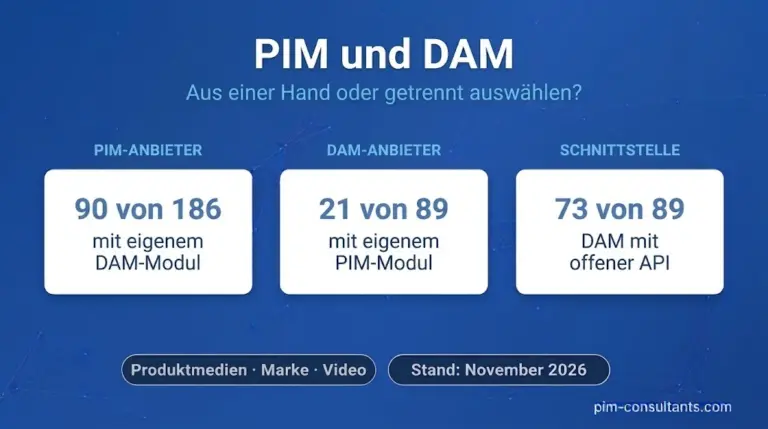
PIM and DAM: choose one vendor or separate systems?
Product images, data sheets, certificates and videos are all part of a product’s information. That is why many PIM vendors offer their own DAM module,
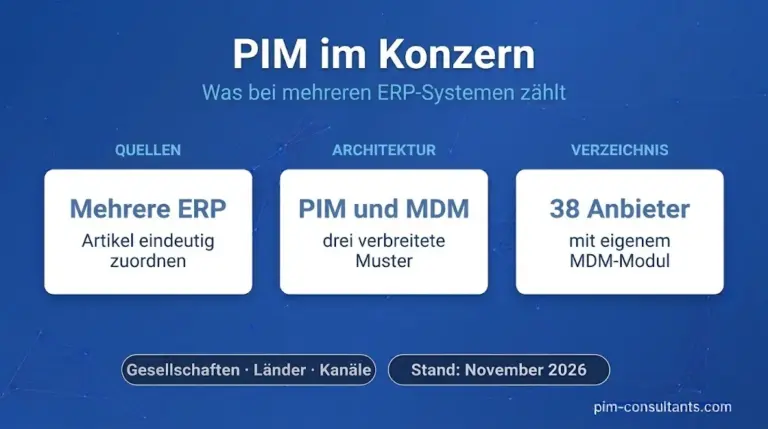
PIM in Corporate Groups: What Matters with Multiple ERP Systems
In large enterprises, product data rarely comes from a single ERP system. Acquisitions, national subsidiaries and production sites bring their own systems, often with different
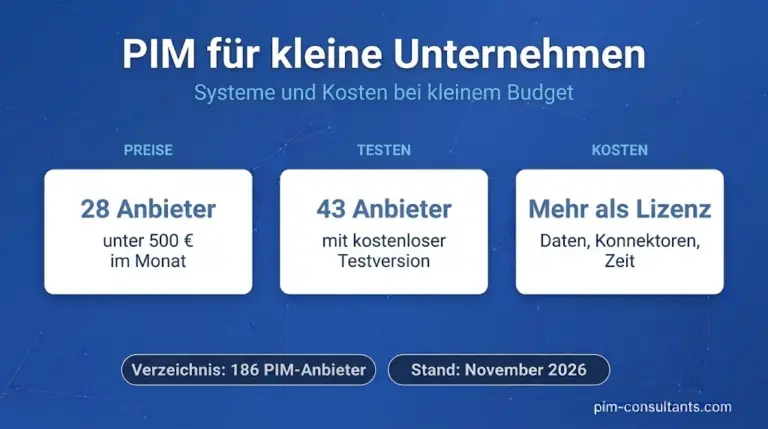
PIM for Small Businesses: Systems and Costs on a Tight Budget
Small businesses rarely need an enterprise PIM, but often need more than a spreadsheet and their online store’s product management features. Once the same product