PIM in Corporate Groups: What Matters with Multiple ERP Systems

PIM for corporate groups: what matters when you have multiple ERP systems

In large enterprises, product data rarely comes from a single ERP system. Acquisitions, national subsidiaries and production sites bring their own systems, often with different item numbers, units of measure and product groups. A PIM system is expected to turn this into consistent product information for every channel. The right system depends less on the product name than on its architecture and how it handles multiple sources.

Key takeaways

  • With multiple ERP systems, the first step is to establish which system is the system of record for each field and how item numbers from the different ERP systems are mapped to one another.
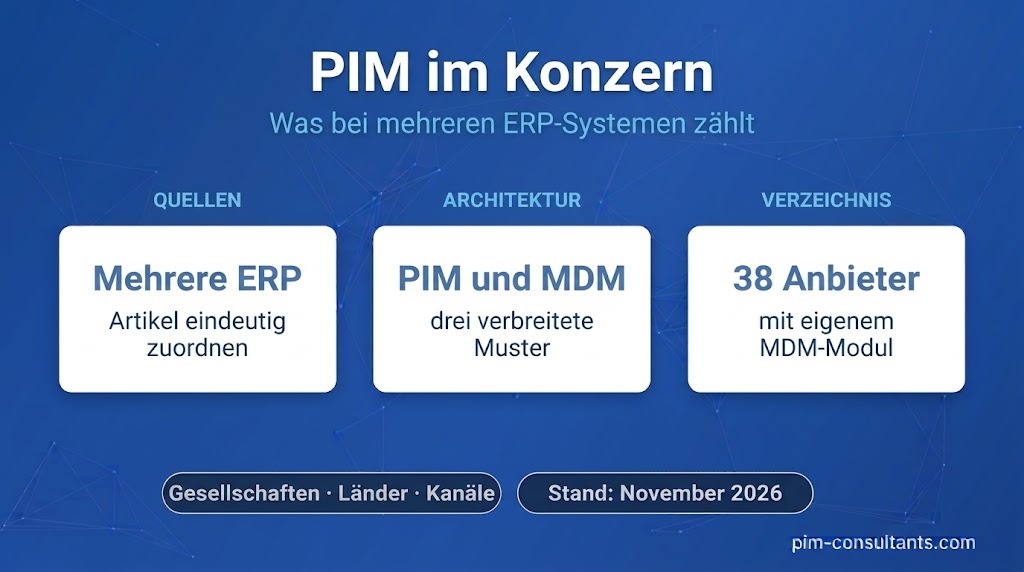
  • Three architectures are common: a PIM with an integration layer, an MDM upstream of the PIM, or a shared platform for MDM and PIM.
  • According to the PIM-Consultants directory, 38 of 186 PIM vendors offer their own MDM module; 33 of these target companies with revenue of more than €50 million (as of November 2026).
  • Of the 18 systems in our overview, seven are listed as having an MDM module: ATAMYA, Informatica, novomind iPIM, Pimcore, Stibo Systems, Syndigo and Viamedici.
  • More important than any list is a test using your own data: mapping items across multiple ERP systems, company and country contexts, interfaces, and performance at your data volume.

Why multiple ERP systems change PIM selection

  • The same item has a different number, description or unit of measure in each ERP system.
  • Product groups and classifications differ between companies.
  • Prices, stock levels and availability remain in the ERP systems, but channels need them alongside product information.
  • National subsidiaries maintain their own copy, certificates and product ranges.
  • ERP migrations, for example to SAP S/4HANA, often take years. The PIM must support both old and new systems in parallel throughout this period.

Three architectures compared

ArchitectureHow it worksSuitable whenWhat to consider
PIM with an integration layerThe ERP systems send items to a central PIM via an integration platform. There, items are mapped, enriched and syndicated to the channels.The focus is primarily on product data; customer and supplier data remain in the ERP systems.Article number mapping tables, error handling, interface operation
MDM before PIMAn MDM system creates a Golden Record for each item from the ERP data. The PIM system imports it and adds marketing and technical content.Material, supplier or customer data also need to be cleansed across the group; data governance is a goal in its own right.Two systems and two projects; clear rules on which system owns each field
One platform for MDM and PIMOne vendor covers master data and product information in a single system and data model.You want fewer interfaces and a shared data foundation.Check whether both components are equally mature; dependence on a single vendor

The wiki entry PIM, MDM or PXM explains the differences between these system categories.

What a PIM system needs to support in a corporate group

  • Data model with contexts: legal entity, country, language and channel; central values that can be supplemented or overridden locally.
  • Mapping multiple article numbers: cross-references between numbers in the ERP systems and duplicate checks.
  • Rules for each source: define which system is allowed to supply each field and what happens when values conflict.
  • Roles, permissions and workflows for each legal entity: local maintenance, central approval for shared data.
  • Interfaces: documented API, change events, bulk imports and ready-made connectors for your ERP systems.
  • Performance: import and response times at your data volumes, verified in tests using real data.
  • Traceability: a change log for each field, so it remains clear who changed what and which source the change came from.

Which systems to consider

According to the PIM-Consultants directory, as of November 2026:

  • 123 of the 186 vendors name companies with revenue of over €50 million as target customers.
  • 38 vendors have their own MDM module, 33 of them for customers with revenue of over €50 million.
  • 62 vendors offer an API with real-time events.
  • Among the 18 systems in our overview, censhare, Informatica, Salsify, SAP Commerce Cloud, Stibo Systems and Syndigo primarily target large enterprises. ATAMYA, Informatica, novomind iPIM, Pimcore, Stibo Systems, Syndigo and Viamedici are listed as offering an MDM module.
  • The directory also includes platforms for master data across multiple domains, such as Ataccama ONE, Profisee, Reltio, SAP Master Data Governance and Semarchy.

This list is not a recommendation. A test using your data and ERP interfaces determines which two or three systems make the shortlist. Useful resources include the direct comparisons SAP MDG or Stibo Systems and Stibo Systems or Informatica, as well as the article PIM and SAP.

Questions to ask vendors

  1. How does the system match items across multiple ERP systems? Demonstrate this using our data.
  2. Which ready-made ERP connectors are available, and who maintains them when new ERP versions are released?
  3. How are legal entities, countries and local product ranges represented in the data model?
  4. What happens when two sources provide different values for the same field?
  5. Which customers use the system with multiple ERP systems, and can we speak to them?
  6. What does the system cost for our number of legal entities, users, languages and items?

Frequently asked questions

Which PIM systems are suitable for corporate groups with multiple ERP systems?

No single system suits every corporate group. Suitable systems can match items across multiple ERP systems, represent entity-specific and country-specific contexts, and integrate through APIs and events. According to the PIM-Consultants directory, 38 of 186 PIM vendors also offer an MDM module. Testing with your own data is essential.

Do I need MDM if I have multiple ERP systems?

Not necessarily. If you only need to manage product data, a PIM with a well-designed integration layer is often sufficient. MDM is worth considering if materials, suppliers or customers also need to be reconciled across the group.

Which is the leading system, ERP or PIM?

The ERP usually remains the system of record for commercial data such as item numbers, prices and stock levels, while the PIM leads on marketing and technical product information. What matters is a clear rule for each field that all legal entities follow.

Can a PIM help with an ERP migration?

Yes. A PIM can maintain a reliable supply of product data to your channels while ERP systems are gradually replaced. This requires interfaces to both the old and new ERP systems, running in parallel for a period of time.

Sources

Last updated: November 2026

Request vendor-neutral advice

Do you have multiple ERP systems and legal entities and need the right PIM architecture? Send us a brief overview of the systems you use and the channels you supply.

We will get back to you with an initial assessment.

PIM Market Update newsletter

Acquisitions, new vendors and practical tips, delivered by email every six to eight weeks

Concise and vendor-neutral: developments in the PIM market and what they mean for your selection process. Unsubscribe at any time.

Share this article

More PIM insights

News & Blog

Any questions?

We would be happy to advise you.

Wait! Have you seen our PIM checklist?

Find out in 3 minutes whether a PIM system could benefit your business and which PIM systems could be right for you!

Webdesign: Deutsche Stadtmarketing