Small businesses rarely need an enterprise PIM, but often need more than a spreadsheet and their online store’s product management features. Once the same product data is needed across multiple channels, languages or retailer formats, maintaining it in several places takes more time than using a simple PIM system. This article explores the options for tight budgets, what they cost and how to assess whether a system can grow with your business.
At a glance
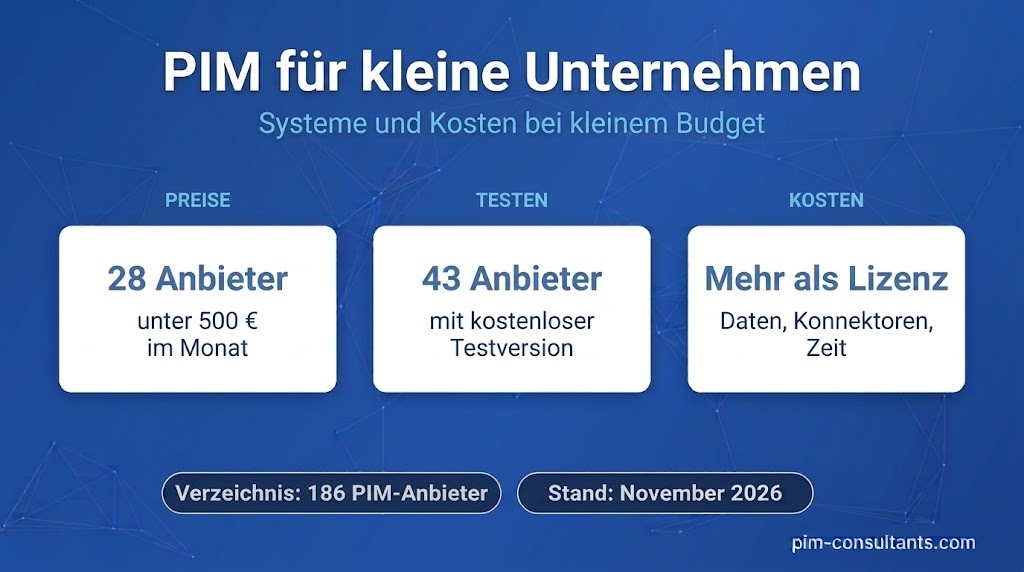
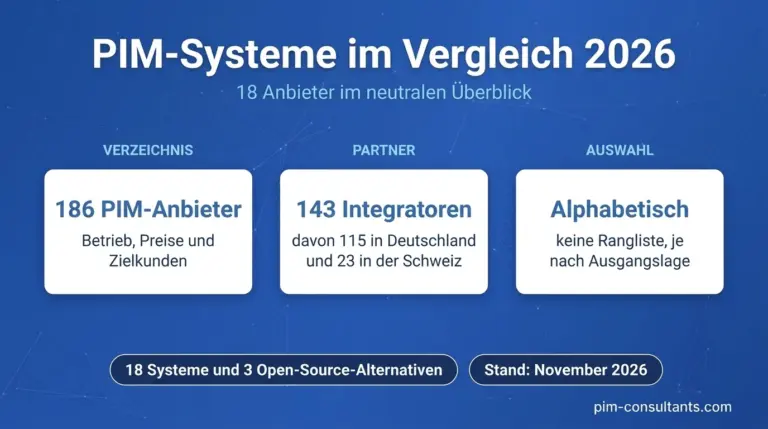
- According to the PIM-Consultants directory, 28 of 186 PIM vendors list starting prices below €500 per month. 43 offer a free trial, and 6 are listed as open source or as offering a free edition (as of November 2026).
- 135 of the 186 vendors provide pricing only on request. On a tight budget, publicly available prices help you build a reliable cost estimate faster.
- Examples with public pricing: Plytix is free for up to 100 products, AtroPIM is free when hosted in your own data centre, and Pimcore Community Edition is free for companies with annual revenue below €5 million.
- The licence is only part of the cost. You also need to account for data migration, data modelling, integrations with your online store and ERP, and your team’s time.
- The key questions are whether the system can grow with your product range, channels and languages, and whether a ready-made connector is available for your e-commerce platform.
When PIM becomes worthwhile for small businesses
There is no fixed threshold based on product count. An online store with 300 products in three languages across four channels benefits more from PIM than a store with 3,000 products in one language and one channel. Typical signs include:
- Product data is maintained in multiple places, such as spreadsheets, your online store, your ERP and marketplaces.
- You supply more than one channel, for example your online store, Amazon or retailers that require data in their own formats.
- You sell in multiple languages.
- New products are slow to go online because descriptions, images and attributes have to be gathered from different sources.
- Retailers or regulations require structured information, such as manufacturer details under the GPSR or attributes based on ETIM and ECLASS.
If you run just one online store in one language with only a few product attributes, your e-commerce platform’s product management features will often be sufficient.
Four options for a tight budget
| Option | Typical costs | Suitable when | Limitations |
|---|
| Product management in your e-commerce or ERP system | Included in your existing licence | One channel, one language, few attributes | Multiple channels, retailer formats, approvals and translations quickly become cumbersome |
| SaaS PIM with a public starting price | From €0 for very small product ranges to a few hundred euros per month | You want to get started quickly without running your own IT infrastructure, and use a widely adopted e-commerce platform | Prices usually increase with products, users or channels; data models and workflows may have limitations |
| Open source or free edition | No licence costs, but hosting, setup and maintenance costs apply | You have an in-house IT team or an agency and specific data model requirements | You are responsible for operations and updates; check the licence terms carefully |
| Feed and marketplace tools | Monthly fee, often based on channels or products | Your main goal is to supply data to marketplaces and price comparison sites | No central product data model for all channels |
Examples with public pricing
The following selection is not a recommendation. It highlights systems in our directory whose pricing or terms of use are publicly available.
| System | Entry-level option | Pricing factors |
|---|
| Plytix | Standard plan free for up to 100 products; Pro from €149, Enterprise from €699 per month | Product count and plan |
| AtroPIM | Free when hosted in your own data centre; cloud from €190 per month plus support | Cloud resources, support level |
| Pimcore Community Edition | Free for companies with annual revenue below €5 million | Above that threshold, a paid Professional or Enterprise edition is required |
| Sales Layer | Pricing on request, 30-day free trial | Users, products and languages |
The PIM vendor overview with the “under €500 per month” filter lists all 28 vendors with starting prices below €500 per month. To find all systems offering a free trial, use the “Free trial” filter. Read more about open-source and free editions in the open-source PIM comparison.
Costs beyond the licence
- Data migration: Cleaning up Excel spreadsheets, standardising attributes and matching images. This often accounts for the largest share of the work in small projects.
- Data model: Attributes, variants and categories need to be clearly defined at the outset.
- Connectors: Check whether integration with Shopify, Shopware, WooCommerce or Amazon is included in the plan or costs extra.
- Your own time: Someone needs to maintain the data and add new products.
- Growth: Calculate the cost for your product range in two to three years, not just today.
For indicative costs for mid-sized projects, see the article PIM implementation and costs.
Six questions to ask before you commit
- What does the system cost for your current number of items, and for twice that number?
- Is there a ready-made connector for your online store and ERP, and who maintains it?
- Can variants, attributes and languages be structured to meet your channels’ requirements?
- Can you export all your data in full at any time if you decide to switch later?
- Where is the data stored, and is a data processing agreement available?
- Who helps with setup: the vendor, a partner or your own team?
When a basic system is no longer enough
- You operate across multiple legal entities or countries with different product ranges.
- Customers require classifications such as ETIM or ECLASS, or data via GS1 data pools.
- Approvals involve several departments and require workflows with roles and permissions.
- You create print catalogues or data sheets directly from product data.
In these cases, it is worth exploring the PIM systems overview and taking a structured approach to PIM selection.
Frequently asked questions
Which PIM systems are suitable for small businesses on a tight budget?
The main options for small businesses are SaaS systems with published starting prices and ready-made online store connectors, as well as open-source or free editions. According to the PIM-Consultants directory, 28 of 186 PIM vendors list starting prices below €500 per month. The right system depends on your product range, channels and languages.
Is there a free PIM system?
Yes. Plytix is free for up to 100 items on its Standard plan, AtroPIM is free when hosted in your own data centre, and the Pimcore Community Edition is free for companies with annual revenue below €5 million. Hosting, setup and maintenance still cost money or time.
How much does a PIM system cost for small businesses?
SaaS plans for small product ranges often cost less than €500 per month. There are also one-off costs for data migration and setup, plus connectors where applicable. Base your calculations on your expected number of items in two to three years, as many plans become more expensive as your product range grows.
How many items do you need before a PIM is worthwhile?
There is no fixed threshold. Channels, languages and attributes are the deciding factors: a small product range across multiple languages and channels often benefits more than a large range in a single online store and language.
Sources
As of November 2026. Prices are based on vendor information and are subject to change.