Munich-based growth investor Nordwind Growth is selling its majority stake in Pimcore to London-based private equity investor Tenzing. Pimcore announced the sale on 27 August 2026. Completion remains subject to antitrust approval, and the parties have not disclosed a purchase price. For customers, this is the second major change in just over eighteen months: since version 12 (platform version 2025.1), Pimcore has no longer been available under an open-source license. This article explains who Tenzing is, what Pimcore has promised, what remains unclear, and what customers and partners should clarify now. For other acquisitions in the market, see our overview of PIM consolidation in 2026.
At a glance
- Nordwind Growth and other shareholders are selling a majority stake in Pimcore to Tenzing. Nordwind led the $12 million Series B round in 2022 and subsequently held around 73%.
- Founder Dietmar Rietsch and Co-CEO Matthias Blauth will continue to lead the company. Completion is subject to antitrust approval.
- Pimcore promises that the core code will remain available to view, cloud, self-hosting and PaaS options will remain available, and Pimcore will retain control of the roadmap.
- The announcement says nothing about pricing, editions or the Community Edition.
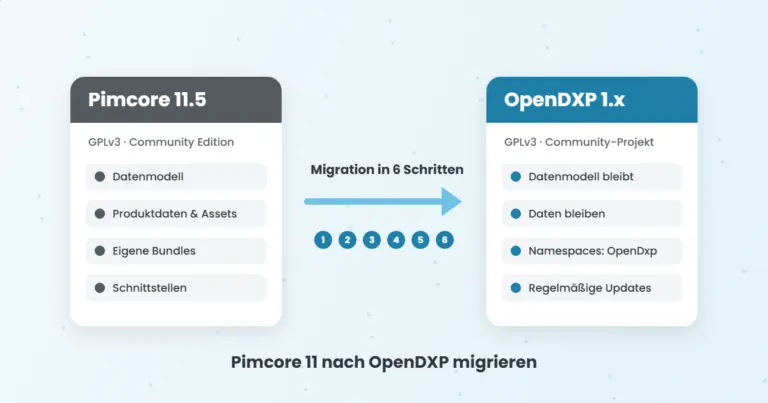
- The Pimcore Open Core License (POCL) has applied since version 12. The Community Edition is now free only for companies with annual revenue of up to €5 million. Those wishing to stay with the GPL must remain on version 11 or switch to the OpenDXP fork.
Who is Tenzing?
Tenzing is a London-based private equity firm with offices in Munich and Stockholm. According to its own figures, it manages around £1.7 billion and holds stakes in about 20 companies, primarily European B2B software and IT service providers with enterprise values between £50 million and £300 million. The Pimcore investment comes from its third fund, worth around £900 million, which has been investing since 2023. This is its second investment in the German-speaking market, following IT service provider Mahr. Tenzing supports its portfolio companies with an in-house growth team and programmes covering areas such as AI adoption.
Both parties cite the platform’s international growth as a goal, both organically and, according to Tenzing, through acquisitions. Tenzing’s rationale for the investment is that Pimcore manages product, customer and media data on a single platform, while many competitors cover only individual areas, and that AI projects require clean, validated data.
What Pimcore promises and what remains unclear
| Topic | Pimcore’s statement | What you should clarify |
|---|
| Management | Dietmar Rietsch and Matthias Blauth will stay on | Who will be responsible for your account and your partner after completion? |
| Deployment | Cloud, self-hosting and PaaS options will remain available | Does this also apply to future versions and new modules? |
| Code and licensing | The core code will remain available to view and extend | Will the POCL, revenue threshold and editions remain unchanged? |
| Roadmap | Pimcore retains control, with further development of Data Spine and AI | Which features will be available only in Enterprise or as add-on modules? |
| Partners | More investment in training, certification and joint sales | Will partner tiers, commissions or certification requirements change? |
| Pricing | No statement | Specify price guarantees, annual adjustments and contract terms in writing |
| Community Edition | No statement | For how long, and under what conditions, will it continue to be maintained? |
The licensing change: Open Core instead of GPL
Up to version 11 (platform version 2024.4), Pimcore was licensed under GPLv3 and free for everyone. With version 12 (2025.1), Pimcore switched to its own Pimcore Open Core License. The code remains available to view, but is no longer open source in the strict sense. Companies with annual revenue of €5 million or more need a commercial edition; those running Pimcore as a SaaS offering for third parties need an OEM license. In response, Swiss agency DACHCOM launched OpenDXP, a fork of Pimcore 11 that remains under GPLv3. For a direct comparison, see Pimcore vs. OpenDXP.
| Edition | Price (excluding VAT) | Who it is for |
|---|
| Community Edition | Free | Companies with annual revenue of up to €5 million |
| Professional | €8,400 per year | Commercial license with all core modules |
| Enterprise | €25,200 per year | Additional enterprise modules, Long Term Support, 24/7 support |
| PaaS | On request | Hosting and support by Pimcore |
Pimcore cites the transition as a driver of strong growth: recurring revenue has reportedly increased more than fivefold since October 2022, and the company says it is operationally profitable. These claims have not been independently verified. For customers, this means that the licence is usually not the largest cost item with Pimcore. Implementation, extensions and ongoing operations through a partner typically account for more. Read more in our Pimcore profile.
Our assessment: a second private equity investor, the same direction
With Tenzing following Nordwind, another private equity investor is taking over. Such investors typically hold stakes for several years and aim to increase revenue and earnings significantly during that time. At software vendors, this usually involves expanding sales, making acquisitions, introducing new paid modules and adjusting prices. Whether Pimcore will follow this path remains to be seen. However, the 2025 licence change shows that the company is already generating more revenue from its user base.
Pimcore thus joins a wave of ownership changes in the PIM market. One example from the German-speaking market is Main Capital’s acquisition of 4ALLPORTAL. For Pimcore customers, the situation is relatively stable: the management team is staying, edition pricing is public, and OpenDXP provides a free alternative for version 11. Those selecting a new system should still compare Pimcore with other systems, for example in Akeneo vs. Pimcore or our overview of Pimcore alternatives.
What Pimcore customers and partners should clarify now
- Contract: Have prices, annual price adjustments and the contract term set out in writing, and check what happens in the event of a change of ownership.
- Edition: Check whether you are still using the Community Edition despite annual revenue exceeding €5 million. If so, you will need a commercial edition from version 12 onwards.
- Version: If you are still running version 11, you need a plan: upgrade to the current platform, purchase Long Term Support from Pimcore or switch to OpenDXP. Partners report that security updates for 2024.4 will be available until the end of 2026.
- Roadmap: Ask which announced features, such as AI agents and Data Spine, are included in your edition.
- Partner: Clarify with your integrator whether partner tiers or certifications are changing and whether they will support your project over the long term.
If you would like an independent review of your Pimcore contract or a proposal, we can help with our PIM contract and vendor review.
Frequently asked questions
Who has acquired Pimcore?
London-based private equity firm Tenzing is acquiring a majority stake in Pimcore from Nordwind Growth and other shareholders. The sale was announced on 27 August 2026 and is subject to competition clearance.
How much did Tenzing pay for Pimcore?
Pimcore, Tenzing and Nordwind have not disclosed a purchase price. Tenzing says it invests in companies valued at between £50 million and £300 million.
Will Pimcore’s pricing or licensing change?
Pimcore has pledged that its core source code will remain openly accessible and that cloud, self-hosted and PaaS options will remain available. The announcement says nothing about pricing, editions or the Community Edition. Make sure prices and contract terms are therefore set out in your contract.
Is Pimcore still open source?
Not in the strict sense. Since version 12, Pimcore has been governed by the Pimcore Open Core License. The Community Edition is free only for companies with annual revenue of up to €5 million. Pimcore 11 is the last version released under GPLv3; its free continuation is called OpenDXP.
Will Pimcore’s management team stay?
Yes. Founder Dietmar Rietsch and co-CEO Matthias Blauth will continue to lead Pimcore after the sale.
Sources
As of 7 November 2026. Information based on press releases and vendor statements; prices exclude VAT.