PIM Project

PIM Implementation & Costs

In brief: For larger mid-sized businesses, PIM software costs around 100.000 to 250.000 euros depending on the tier, while enterprise systems cost around 500.000 euros. Implementation typically adds 150.000 to 250.000 euros. The biggest cost differences come not from licences, but from data quality, integrations and the work required from your own team.
100–500 thousand €Software by system tier for larger mid-sized businesses
150–250 thousand €for implementation in mid-sized businesses
6–12 monthsuntil the first channel goes live
5 yearsa useful timeframe for comparing costs

What does a PIM implementation involve?

Half of a PIM project is organisational work. The software is quick to install; the real work lies in the data model, data migration and responsibilities. These are the typical steps:

  1. Define goals and requirements: Which channels, languages and product data should the PIM support, and what measurable improvements should it deliver?
  2. Select a system: Market overview, longlist, demos using your own data and proposal comparison. Our guide to PIM selection in six steps shows you how.
  3. Build the data model: Categories, attributes, classifications and relationships. This is where most of the business-side work is required. See data modelling.
  4. Implement integrations: Connect ERP, online stores, marketplaces, DAM and print systems.
  5. Migrate data: Cleanse, migrate and enrich legacy data. This step is almost always underestimated.
  6. Clarify processes and roles: Who maintains which data, who approves it, and which quality rules apply?
  7. Training and operations: Documentation, training, change management and a clear plan for the period after go-live.

Our article Service partner or in-house team explores whether to implement with an integration partner or your own team.

For a detailed guide with a timeline, roles and common mistakes, see PIM implementation in four steps.

How long does each phase take?
PhaseTypical timeframe for mid-sized businesses
Analysis and target state4 to 8 weeks
System selection2 to 3 months
Solution design1 to 2 months
Implementation and data migration3 to 6 months
Pilot and rollout1 to 2 months

Timelines depend primarily on data quality and the number of integrations and languages. Every month of the project uses up partner budget and internal team capacity, so a clearly defined scope for the first phase has a direct impact on costs.

What does a PIM system cost?

The following indicative figures apply to larger mid-sized businesses. They show software costs by system tier, excluding implementation.

TierExamplesIndicative software cost
Open sourceAkeneo, Pimcore, OpenDXP, AtroPIMCommunity version with no licence fee, enterprise versions by subscription
Entry-levelPlytix, Base.com, nextPIM, Ergonode, xmediaaround 100.000 euros
Professionalinriver, Centric PXM (formerly Contentserv), prodexa, Viamedici, pirobasearound 250.000 euros
EnterpriseStibo Systems, Informatica (Salesforce), Syndigo, Salsifyaround 500.000 euros

Implementation is additional, typically costing 150.000 to 250.000 euros for mid-sized businesses. You can find all systems, including their pricing models, licensing models and target audiences, in our PIM vendor overview.

What sets the system tiers apart
  • Open source: Full control over the code and data model, with no licence fees for the community version. In return, you are responsible for hosting, updates and further development, either in-house or through a partner.
  • Entry-level: Quick to get started, often offered as SaaS with fixed packages. Well suited to manageable product ranges and a small number of channels, with limitations for complex data models and workflows.
  • Professional: Flexible data models, workflows, classifications and print integration. Typical for mid-sized businesses with technical products, many attributes and multiple channels.
  • Enterprise: Designed for large data volumes, many countries and multiple domains, extending to MDM, with correspondingly greater implementation and operational effort.

What makes up the costs

  • Licence or SaaS subscription: Depends on the number of users, products, channels and modules.
  • Implementation: Solution design, data model, configuration and project management by the integration partner.
  • Integrations: Each connection to an ERP, online store, marketplace or DAM is a subproject in its own right.
  • Data migration: Cleansing, migration and enrichment of legacy data.
  • Operations: Hosting, maintenance, updates and support, usually included in the subscription for SaaS.
  • Internal effort: Product management, marketing and IT contribute to the project. This item never appears in a vendor quote.
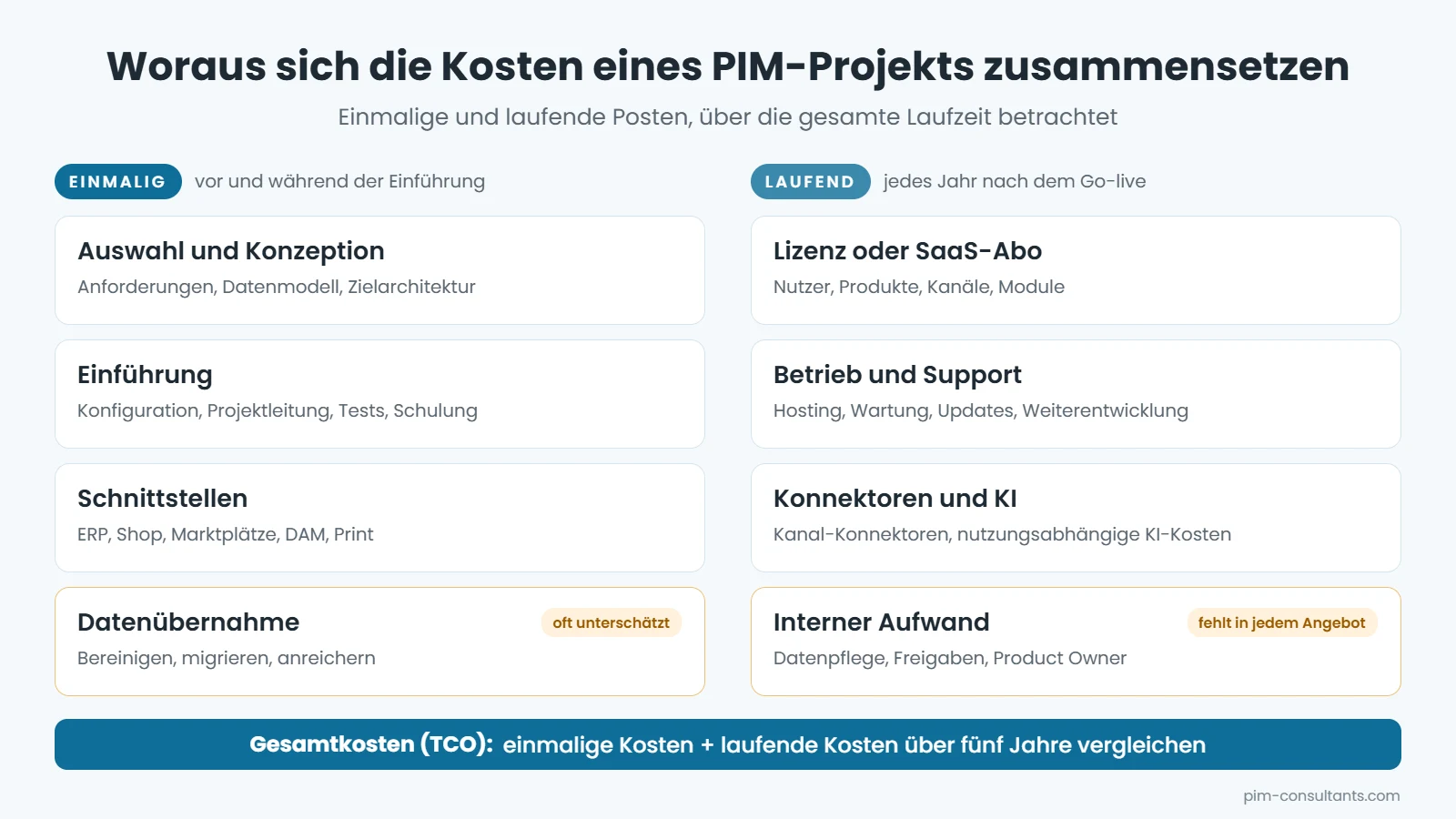
Grafik Kostenbestandteile eines PIM-Projekts: einmalig Auswahl und Konzeption, Einführung, Schnittstellen, Datenübernahme; laufend Lizenz oder SaaS-Abo, Betrieb und Support, Konnektoren und KI, interner Aufwand
One-off and recurring costs: Always compare total costs over the full term.
Costs often missing from proposals
  • Internal time: Product management, marketing and IT contribute to the project for months, with the Product Owner often dedicating a large share of their time.
  • Data cleansing and enrichment: Missing attributes, text, images and translations must first be created.
  • Additional connectors: Each additional marketplace, retailer or data pool may incur its own licensing and setup costs.
  • Growth: Pricing tiers based on users, products, channels or languages can lead to sharp cost increases as you grow.
  • AI usage: Some vendors charge for AI features based on usage or as a separate module.
  • Contract renewal: Price adjustments after the initial term, something we have already seen in projects.
  • Upgrades and exit: Version upgrades for on-premises systems and data exports if you later switch vendors.

Which system category is right for you?

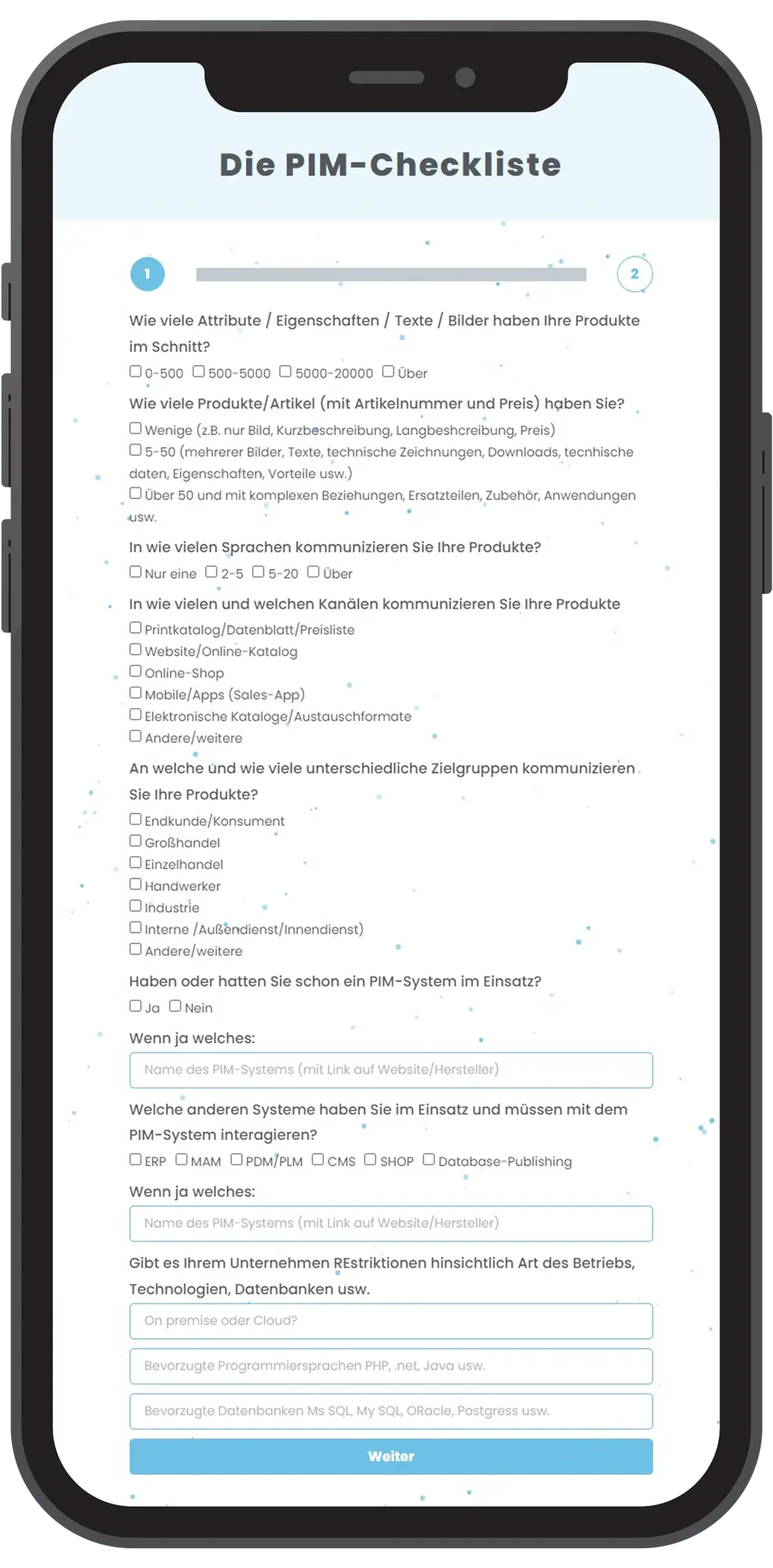
Use the PIM checklist to assess which system category and vendors match your requirements in just three minutes. We will email you an initial shortlist.

  • free
  • vendor-neutral
  • completed in 3 minutes
Go to the PIM checklist

What drives costs?

The main factors that increase PIM project costs are large numbers of products and variants, many attributes per category, multiple languages, numerous output channels, complex product relationships and poor source data. Use the PIM checklist to assess which system category is right for you in just three minutes. Our article on PIM ROI explains how to calculate the return on your investment.

Cost drivers and how to manage them
Cost driverWhy it increases costsHow to keep costs under control
Many products and variantsHigher data volumes, more complex variant logic, higher pricing tierModel variants clearly and remove obsolete products before migration
Many attributes per categoryLarger data model, more maintenance effortAlign attributes with channel requirements and use classification standards
Multiple languagesTranslation, approvals and checks for each languagePlan a translation process with a glossary and AI support
Many output channelsEach integration is a separate subprojectStart with the most important channels and prioritise standard connectors
Complex relationshipsAccessories, spare parts and configurations increase modelling and testing effortDefine relationship types early and test them using examples
Poor source dataCleansing and enrichment take time and budgetMeasure data quality before selection and budget realistically for the work involved

Compare total costs over five years

Licence prices alone tell you little. A low-cost subscription can work out more expensive over time than a higher one-off licence fee, while an open-source system with no licence fee still incurs operating and development costs. Compare total costs over five years, using the same assumptions for all vendors.

ItemOne-offRecurring annual costs
SoftwareLicence purchaseSubscription or maintenance
ImplementationSolution design, configuration, project management, testingOngoing development and change requests
InterfacesIntegration with ERP, online store, marketplaces, DAMConnector licences, maintenance following changes
DataCleansing, migration, enrichmentTranslations, new content, AI usage
OperationsEnvironment setupHosting, support, updates
Internal resourcesProject participation by business departmentsData maintenance, approvals, product owner
How to make proposals comparable
  • Give all vendors the same volume assumptions: number of users, products, variants, languages, channels and media assets.
  • Use the same implementation specification, ideally with sample data and the key workflows.
  • Request transparent pricing tiers: What will it cost if your product range, user base or channel count grows?
  • Check contract terms: Contract duration, price adjustments on renewal, termination, data export.
  • Ask about additional costs: Connectors, AI features, test environments, support tiers.

Our PIM criteria list provides a structured template for your comparison.

Plan your budget without cutting the wrong corners

1

Start in phases

One product group, one channel, the most important languages. This reduces the initial budget and shows early on whether the data model and processes work.

2

Prioritise standard functionality over custom development

Adapt your processes to the system's proven workflows wherever business requirements allow. Every custom development adds costs during implementation and with every update.

3

Address data early

Measure data quality and clean up critical attributes before your implementation partner starts billing. This preparatory work offers the greatest leverage.

4

Allocate internal capacity from the outset

A product owner with sufficient time and decision-making authority saves more money than any discount by shortening coordination and approval cycles.

Also include a contingency budget, particularly for data migration and interfaces.

How the investment pays off

The budget delivers measurable benefits: getting new products online faster, less maintenance effort per item, fewer queries and returns caused by incorrect information, and new channels without additional staff. Establish these baseline metrics before the project so you can demonstrate the benefits later. Our article on PIM ROI explains how to calculate these benefits.

Frequently asked questions about PIM costs

How much does a PIM system cost for a mid-sized business?

For larger mid-sized businesses, software costs range from around 100.000 euros (entry-level) to 250.000 euros (professional), depending on the category, with enterprise systems costing around 500.000 euros. Implementation typically adds another 150.000 to 250.000 euros.

How long does a PIM implementation take?

Selection usually takes two to three months. For mid-sized businesses, implementation through to the first live channel often takes six to twelve months, depending on data quality and the number of interfaces and languages.

Is open-source PIM free?

The community editions of Akeneo or Pimcore have no licence fees. Implementation, hosting, maintenance and ongoing development still incur costs and account for the largest share of expenditure.

SaaS or on-premises: which costs less?

SaaS spreads costs across an annual subscription and reduces the work involved in operations and updates. On-premises has higher upfront costs but can pay off over a longer period if you run your own IT operations. The key is to compare total costs over five years.

What costs arise after go-live?

Recurring costs include subscriptions or maintenance, hosting and support, connector licences and ongoing development. There is also internal work involved in data maintenance and approvals, which increases as your product range and channels grow.

How much internal effort should we plan for?

More than most expect. During implementation, you need a product owner with substantial time and decision-making authority, along with key users from the business departments. After go-live, data maintenance becomes an ongoing responsibility.

How do I compare PIM proposals properly?

Use consistent volume assumptions, a common specification and a comparison of total costs over five years. The PIM criteria list provides a template.

Where does your PIM project stand?

Before you approve the budget: we provide a vendor-independent assessment of whether your data model, processes and systems are ready for your project, and quantify the gap.

Request an assessment

Or go straight to PIM selection, the PIM criteria list or the free PIM checklist.

PIM KNOWLEDGE

News & Blog

Have any questions?

We are happy to advise you.

Wait! Have you seen our PIM checklist?

Find out in 3 minutes whether a PIM system could benefit your business and which PIM systems could be right for you!

Webdesign: Deutsche Stadtmarketing