
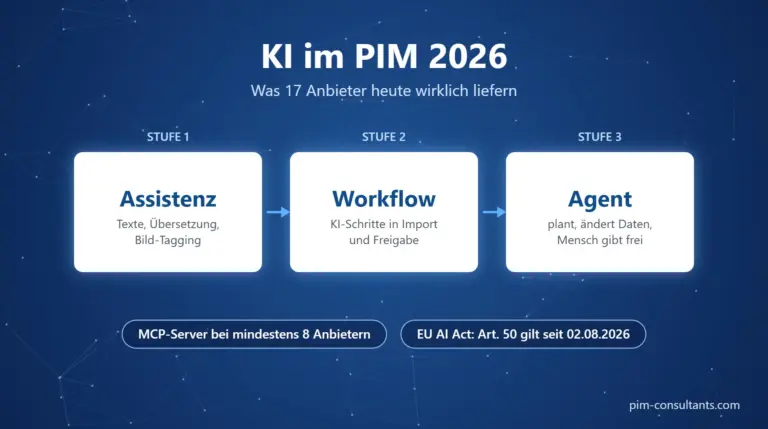
AI in PIM 2026: What vendors actually deliver today
Which AI capabilities PIM vendors actually deliver in 2026: an overview of agents, MCP servers, custom AI models and pricing across 17 vendors, plus obligations under the EU AI Act.
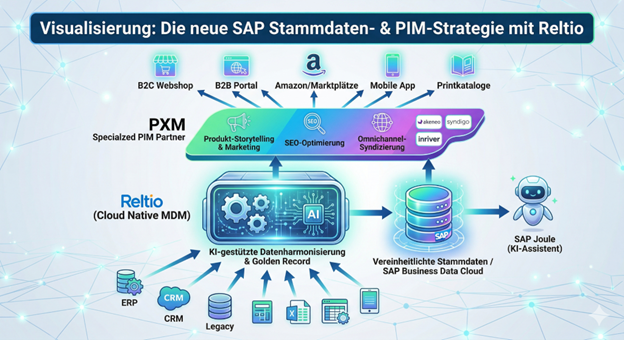
SAP SE’s acquisition of cloud-native Master Data Management (MDM) provider Reltio, officially announced in March 2026, marks a fundamental turning point in data management and systems architecture for global enterprises. With estimated annual recurring revenue (ARR) of over US$185 million, year-on-year growth of 40% and a customer base of more than 200 large enterprises, Reltio fills a significant technology gap in SAP’s portfolio. However, this acquisition should not primarily be seen as a direct challenge to the established Product Information Management (PIM) market, but rather as a far-reaching architectural decision to strengthen SAP Business Data Cloud (BDC). The primary objective of this investment is to create a fully trusted, cross-domain data foundation, an essential prerequisite for implementing enterprise-wide agentic artificial intelligence (agentic AI).
SAP’s historical PIM strategy, which for over a decade relied heavily on the Product Content Management (PCM) module integrated into SAP Commerce Cloud (formerly Hybris), has increasingly proved inadequate and an obstacle to innovation in today’s world of omnichannel commerce, fast-moving marketplaces and composable architectures. At the same time, a detailed analysis reveals Reltio’s specific architectural and functional weaknesses in product-centric data enrichment, Product Experience Management (PXM) and marketplace syndication. These limitations clearly demonstrate that the Reltio acquisition in no way eliminates the need for dedicated PIM solutions. On the contrary, it creates an entirely new best-of-breed paradigm for SAP customers and IT decision makers. In this new architecture, Reltio acts as the central, cross-domain master data hub (MDM), ensuring data integrity, while highly specialised PIM partners such as Akeneo, inriver and Syndigo remain essential to successfully deliver the “last mile” of the product data experience, emotionally engaging marketing enrichment and global sales channel syndication.
Fully understanding the strategic necessity and urgency of the Reltio acquisition requires a detailed analysis of SAP’s track record in product data management. In 2013, SAP acquired the rising e-commerce company Hybris to establish a dominant, undisputed position in the booming digital commerce market. Hybris brought an integrated module called Product Content Management (PCM) into the SAP ecosystem, which SAP subsequently positioned and marketed as its primary solution for managing product data for enterprise customers. This strategic decision rested on the assumption at the time that product data was primarily needed to populate a company’s own online shop.
While Hybris enjoyed tremendous commercial success as a monolithic e-commerce engine in the late 2010s and became deeply integrated into the IT landscapes of global enterprises, the product data market was moving in an entirely different, far more complex direction. Consumer and B2B buyer requirements rapidly shifted from simply populating an online shop to highly complex omnichannel strategies. These modern strategies require seamless, simultaneous delivery of consistent yet channel-specific data to print catalogues, mobile apps, global marketplaces such as Amazon, specialist B2B dealer portals and even IoT devices. SAP’s response to these seismic market shifts was primarily cosmetic and infrastructure-focused: renaming Hybris as SAP Commerce Cloud and migrating the underlying architecture to the Microsoft Azure public cloud (known as CCv2), complemented by a new frontend called Spartacus. However, the underlying PCM module remained architecturally tied to the narrow use case of traditional e-commerce and did not evolve into a true, independent enterprise PIM solution.
With the officially announced end of life (EOL) for the on-premise versions of SAP Commerce (Hybris) set for 31 July 2026, hundreds of global enterprises now face the pressing need to fundamentally modernise their critical systems landscapes. Continuing to run this legacy software poses unpredictable risks to business continuity, including major security vulnerabilities caused by missing patches, the complete withdrawal of vendor support, a lack of compatibility with modern cloud infrastructure and exponentially growing technical debt that stifles all agility in digital commerce. In this context, industry analyses by Nucleus Research show that modern cloud deployments deliver four times the return on investment (ROI) of outdated on-premise applications, primarily by eliminating hidden infrastructure costs and IT overheads.
| Architectural and functional criterion | SAP Commerce Cloud PCM (Legacy) | Modern enterprise PIM (best-of-breed / MACH) |
| Core architectural focus | Tightly coupled web storefront / e-commerce backend. | Platform-agnostic omnichannel single source of truth. |
| Data modelling & flexibility | Very rigid, difficult to extend for complex B2B hierarchies and qualified attributes. | Highly flexible, dynamic relationships, full multidomain capabilities. |
| Governance & data quality rules | Hard-coded, often requiring IT releases and system downtime. | Visually configurable by business users (low-code/no-code interfaces). |
| Syndication & industry standards | Severely limited, dependent on expensive point-to-point integrations. | Out-of-the-box API channels, native support for BMEcat, GS1 GDSN and ETIM. |
| Operational time-to-market | Extremely slow (documented 6-10 months in complex enterprise environments). | Highly agile, accelerated by AI-generated content and automation. |
| Evaluation criterion (Forrester Wave Q2 2025) | Score achieved (Reltio) | In-depth analysis of platform capabilities |
| Customer 360 Domain | 5.00 | A clear industry leader in the error-free consolidation and linking of customer data from highly fragmented global IT landscapes. |
| Multidomain MDM Capabilities | 5.00 | Excellent native capabilities for managing customer, product, supplier and location data simultaneously and at high performance within a single, unified architecture. |
| Matching, linking, and entity resolution | 5.00 | Outstanding AI-powered, self-learning algorithms for accurately identifying and merging duplicates and semantically related records. |
| Data Enrichment and Integration | 5.00 | Deep, preconfigured integrations with external third-party data providers (such as Dun & Bradstreet) for automatic, near-real-time profile enrichment. |
| Data Privacy and Security Architecture | 5.00 | A highly robust, granular permissions framework, native encryption and comprehensive audit trails make Reltio ideally suited to strictly regulated sectors (defence, pharmaceuticals and finance). |
| Scalability and Performance | 5.00 | Architecturally proven, limitless scalability for extremely high bidirectional transaction volumes in global real-time scenarios (B2B/B2C). |
| Product 360 Domain (PIM Focus) | 3.00 | A significant functional gap compared directly with the other domains, revealing the clear conceptual limitations of a purely technology-focused MDM system. |
The SAP Executive Board’s decision to acquire a thriving business with $185 million in ARR, effectively making Reltio an IPO-ready candidate in the software market, at a substantial premium is driven by an existential strategic imperative that goes far beyond traditional, reactive master data management. At the heart of this landmark acquisition is an uncompromising commitment to executing SAP’s global “AI-First and Suite-First” strategy.
Modern artificial intelligence, particularly Generative AI (GenAI) and complex large language models (LLMs), is inevitably subject to the unforgiving IT principle of “garbage in, garbage out”. When the underlying enterprise data is severely fragmented, redundant, outdated and semantically inconsistent across hundreds of different systems, from legacy SAP ERP instances and Salesforce CRM to external, unstructured supplier databases, even the most advanced AI systems will inevitably produce flawed analyses, dangerous hallucinations and recommendations that harm the business.
Muhammad Alam, member of the Executive Board of SAP SE responsible for Product & Engineering, articulated this fundamental problem with unflinching precision when the acquisition was announced: “Artificial intelligence cannot reach its full potential when data is scattered across business units, platforms and domains, without connections or the necessary context”.
Once the transaction formally closes (scheduled for Q2 or Q3 2026), Reltio will not continue as an isolated ancillary product. Instead, it will be deeply integrated into SAP Business Data Cloud (BDC) as a central core component. BDC, which SAP has significantly advanced through a high-profile alliance with data lake pioneer Databricks, aims to become the universal, interoperable data platform for the entire enterprise of the future. Reltio provides the missing, mission-critical “System of Context”. It harmonises, deduplicates and cleanses data not only from internal SAP systems but, in a decisive paradigm shift, explicitly from third-party, non-SAP systems as well. This proactive source-agnostic approach was a decisive strategic reason for the acquisition: the SAP Executive Board recognises that large enterprise customers invariably operate highly heterogeneous IT landscapes that have evolved over time and cannot be forced into an SAP-only framework.
The next, imminent evolutionary step in global enterprise software is the establishment of “Agentic AI” (agent-based, autonomous artificial intelligence). While today’s AI assistants, such as the first generation of SAP’s own copilot Joule, primarily serve as reactive chatbots answering user questions, highly specialised AI agents are expected to execute highly complex business processes autonomously, flawlessly and without human intervention in the near future. Examples include global supplier risk assessments during geopolitical crises, fully automated placement of orders worth millions, and legally compliant resolution of escalated customer service disputes.
For autonomous actions with such far-reaching implications and potentially massive financial consequences, AI agents need absolute certainty and access to authoritative, verified data (“Golden Records”) within milliseconds. Reltio’s native, deeply integrated support for the revolutionary Model Context Protocol (MCP), combined with the extremely low latency of the Google Cloud Spanner platform, enables precisely this: an AI-powered procurement agent can access the globally consolidated, fully trusted supplier master record in Reltio in real time, simultaneously incorporate volatile external risk data extracted from unstructured news PDFs or ESG reports, and autonomously make an informed business decision within seconds.
Independent IT analysts and market observers stress that this multibillion-dollar acquisition secures the essential data foundation SAP has lacked until now, enabling it to deliver on its ambitious, at times grandiose AI promises to enterprise customers and financial markets in the demanding reality of day-to-day operations. This strategic move decisively elevates Master Data Management from a neglected administrative back-office discipline to a business-critical, board-level enabler of all modern AI strategies.
Despite its outstanding, undisputed capabilities in Master Data Management and the strategic brilliance of the acquisition for SAP Business Data Cloud and the AI portfolio, a deeper, unvarnished analysis reveals significant functional weaknesses in Reltio when it comes to specialised, sales-oriented Product Information Management (PIM). These shortcomings are already substantiated quantitatively and objectively by its significantly lower score of 3.00 (in stark contrast to perfect scores of 5.00 in other categories) in Forrester’s “Product 360 Domain” category.
Reltio’s architecture and technology are intensely focused on consolidating raw data, eliminating duplicates algorithmically and establishing a single, error-free source of truth at database level. In today’s product data landscape, however, commercial value creation extends far beyond a correct, validated item number, country of origin or base weight. Modern, highly competitive omnichannel commerce demands Product Experience Management (PXM): enriching product information with emotionally engaging, context-specific, localised and marketing-ready content that persuades consumers to buy.
In this critical area, the Reltio platform falls short in day-to-day operations:
Perhaps Reltio’s biggest functional gap, and one that directly impedes revenue in the demanding world of day-to-day e-commerce, is the absence of “Channel Management”, or the lack of out-of-the-box syndication to external sales channels.
To list products successfully on today’s dominant platforms and marketplaces such as Amazon, Zalando, eBay, Alibaba or specialist B2B trade portals, internal data must be continuously and fully automatically transformed into these marketplaces’ highly specific, strict and constantly changing formats. Reltio does not offer native, vendor-maintained marketplace connectors for this purpose. This shortcoming inevitably forces SAP customers to implement and maintain additional expensive middleware, external feed management tools or third-party syndication systems, increasing IT complexity once again.
The situation becomes even more critical when considering European and industry-specific data standards. While Reltio is deeply rooted in the US market, particularly in the pharmaceutical industry, it entirely lacks essential standards required by law or business practice in European B2B, automotive and retail markets. Native support for standardised catalogue formats such as BMEcat, comprehensive classification systems such as eCl@ss or ETIM, and mandatory automotive standards such as TecDoc or ACES/PIES ranges from inadequate to non-existent.
In highly regulated, process-driven environments such as German grocery retail (dominated by giants such as REWE or Edeka), where retailers demand strict adherence to the global GS1 GDSN standard, compliance with the Food Information Regulation (LMIV) and mandatory use of certified data quality gates (e.g. GS1 DQX), Reltio simply cannot function as a frontline system without extensive, costly custom development.
From a deeper architectural perspective, the use of Reltio’s “Reference Attributes” (which elegantly link complex entities) also leads to noticeable performance losses of 10 to 15 percent during write-intensive, bulk PIM operations. This is compounded by serious limitations in applying Data Validation Framework (DVF) rules to these attributes and high levels of disruptive event noise in system communications, which can be extremely problematic for the frequent daily product data updates required in e-commerce.
The stark realization that SAP Commerce Cloud PCM is approaching its inevitable end of life, and that Reltio, while a world-leading MDM for AI data, is definitely not a mature marketing PIM for e-commerce, leads to a clear, unavoidable conclusion: the SAP ecosystem will depend more than ever on strong, certified partnerships with best-of-breed PIM providers. The multibillion acquisition of Reltio in no way threatens specialist companies such as Akeneo, inriver or Syndigo. Instead, it finally brings clarity to the tangled architectural layers and redefines how these systems work together, opening up highly profitable opportunities.
Enterprise organizations using SAP S/4HANA as their digital core urgently need solutions that bridge the functional gap between the dry ERP/MDM layer and the emotionally engaging digital shelf consumers encounter. The leading PIM partners occupy sharply defined niches within this new SAP architecture:
Akeneo focuses its entire development effort squarely on Product Experience Management (PXM) and empowering business users. The system stands out for its exceptionally intuitive, consumer-style user experience, which dramatically increases adoption among marketing, translation and e-commerce teams while minimizing onboarding times. Compared directly with cumbersome systems, Akeneo excels with superior bulk editing capabilities, intuitive workflows for non-technical staff and an uncompromising focus on modern composable commerce architectures. The dedicated “Akeneo SAP S/4HANA Accelerator” is particularly relevant and commercially attractive for the SAP ecosystem. This connector enables lightning-fast, bidirectional, real-time synchronization between the transactional SAP ERP and Akeneo PIM, based on state-of-the-art event-driven architectures. It closes precisely the sales-related gap left by the withdrawal of the cumbersome native SAP PCM.
Through an aggressive, exceptionally successful M&A strategy and numerous acquisitions (including Riversand, Edgenet and 1WorldSync), Syndigo has become a major global player, combining PIM, MDM and, above all, product data syndication in a single, powerful platform. Syndigo is particularly dominant in the highly complex retail, CPG (Consumer Packaged Goods) and manufacturing sectors. In stark contrast to Reltio, Syndigo supports thousands of complex industry standards out of the box (including exceptionally deep native GS1 integration) and delivers product data directly to an enormous proprietary network of global retailers at the touch of a button. For large SAP customers with strong roots in physical and digital retail and operations across global supply chains, Syndigo offers sophisticated, market-specific workflow modeling and data quality checks that are light years ahead of the old Hybris PCM.
Swedish provider inriver stands out with its highly flexible, exceptionally dynamic data model (“Elastic Data Model”), which is particularly well suited to modeling highly complex industrial goods, mechanical engineering components and demanding B2B scenarios. A major market differentiator for inriver is its “Digital Shelf Analytics” functionality. This revolutionary capability goes beyond blindly syndicating product data to marketplaces: it feeds market feedback (performance metrics, search visibility, out-of-stock alerts and lost Amazon Buy Boxes) from sales channels back into the PIM in real time, creating a closed loop. This enables manufacturers to respond immediately to market changes and optimize copy for SEO. inriver implementations often involve closely guided, methodical onboarding and prebuilt SAP connectors, significantly improving time to value in complex enterprise environments and minimizing the risk of project failure.
Viamedici Software is another cornerstone of the new SAP PIM ecosystem. As a best-of-breed PXM solution (Product Experience Management), Viamedici bridges the gap between the solid data foundation SAP now provides with Reltio and the growing need for emotionally engaging, channel-specific customer experiences. Its deep, certified integration with SAP environments (SAP Commerce Cloud, SAP ERP/S4/HANA) makes Viamedici the preferred partner for companies looking to combine a “single source of truth” for product data with highly flexible media and variant management. Viamedici enables marketing teams to tell product stories and efficiently syndicate them across all digital and physical touchpoints, while maintaining data consistency within the SAP core. This specialist expertise underlines why SAP’s strategy is built on partnerships: Viamedici delivers the product experience, while SAP provides the enterprise data foundation.
The following detailed functional comparison illustrates how these solutions fit into the new SAP architecture:
| Func- tional dimen- sions |
SAP + Reltio (MDM foundation) | Akeneo (specialist PXM) | Syndigo (syndication & distribution) | inriver (B2B/analytics) | Viamedici (the new PXM powerhouse) |
| Primary strategic focus |
Golden record MDM | PXM marketing & enrichment | Global syndication | B2B product marketing & analytics | Comprehensive variant & media management |
| Target audience & primary users |
Data stewards, IT, enterprise architects | Marketing teams, e-commerce managers | Channel managers, retailer relationship managers | B2B marketing, product managers, after-sales teams | Product managers, engineering, marketing teams |
| External channel syndication |
Internal data foundation (golden record) for SAP Commerce and partner channels | Integrated, marketing- focused PXM syndi- cation (e.g. direct-to- marketplace, such as Amazon) |
Global, verified product data syndi- cation to retailers and the GDSN net- work |
Targeted B2B product market syndi- cation with performance analytics |
Complex variant & media syndi- cation across all channels |
| Integration with the SAP eco- system |
Certi- fied, native integration as the SAP Business Data Core backbone |
Certified, marketing- focused PXM inte- gration with SAP Commerce Cloud |
Certified integration for data distri- bution from SAP Core to retailer networks |
Certified B2B analytics integration with SAP Commerce Cloud and the Reltio back- bone |
Certified, deep PXM integra- tion with SAP Commerce Cloud and ERP systems (ERP/S4HANA) |
Composable commerce and best-of-breed architectures as the new, non-negotiable paradigm
For hundreds of thousands of existing SAP customers worldwide, this market development means a fundamental, inevitable architectural shift towards a fully composable or MACH architecture (Microservices, API-first, Cloud-native, Headless). The dogmatic approach of the past, bundling all product data, complex marketing logic, customer profiles and transactions into a single gigantic monolith (such as SAP Commerce / Hybris), has ultimately failed in the face of market realities.
A future-ready, resilient enterprise architecture separates system responsibilities into three sharply defined layers:
Software giant SAP’s multibillion-dollar acquisition of Reltio is a historic strategic milestone for the software industry, but IT decision-makers must not misinterpret it. By acquiring Reltio, SAP is explicitly not buying a new PIM system simply to replace the outdated Hybris PCM as it approaches end of life. Instead, it is investing heavily in the fundamental, business-critical foundation of its global AI strategy (“AI-Ready Data”). Reltio addresses the enormous challenge of fragmented enterprise data at the meta level and establishes the essential technological foundation for the safe use of agentic AI and error-free predictive analytics.
For Chief Information Officers (CIOs), enterprise architects and global e-commerce leaders, this rapid market shift creates an immediate and unavoidable need for action to prevent competitive disadvantages:
In summary, the strategic acquisition of Reltio is a major gain for the entire SAP ecosystem, tackling deep-seated structural data problems in ERP and AI at their root and paving the way for autonomous systems. At the same time, it firmly establishes the role, immense value and absolute necessity of agile, highly specialised PIM partners. These partners are the indispensable translators who take clean but dry technical data, enrich it with emotion and context, and ultimately deliver it successfully to digital and physical sales channels worldwide, driving conversions.
Update: SAP completed the acquisition of Reltio on 7 May 2026. Reltio has since been part of SAP Business Data Cloud and, according to SAP, will also remain available as a standalone solution for the time being.
More on this topic: Reltio · Akeneo · Syndigo · inriver · Viamedici · An investor perspective on consolidation
News & Blog
Which AI capabilities PIM vendors actually deliver in 2026: an overview of agents, MCP servers, custom AI models and pricing across 17 vendors, plus obligations under the EU AI Act.
Has the Akeneo Community Edition been discontinued? No. Support for Akeneo 7 On-Premise and PaaS ended on 30 September 2026. Here are the facts and the five options now available to Enterprise customers.
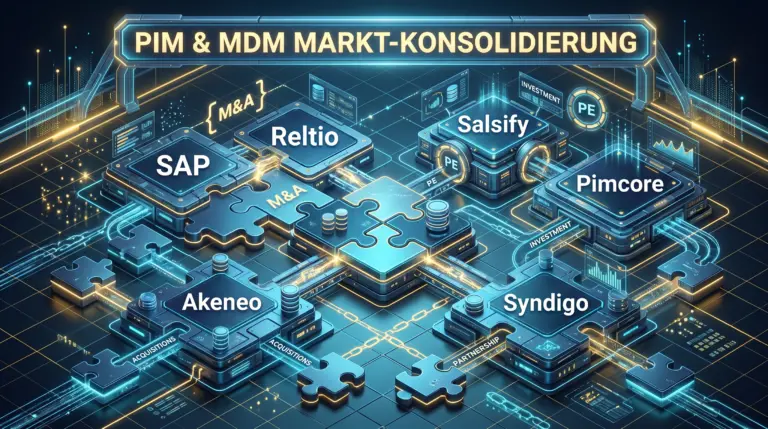
Cinven buys Salsify, Tenzing takes over Pimcore, Akeneo acquires PricingHUB: an overview of all PIM deals in 2025/2026, the three patterns behind them and what users should now look out for in their contracts.
Find out in 3 minutes whether a PIM system could benefit your business and which PIM systems could be right for you!
Webdesign: Deutsche Stadtmarketing