Beyond Chatbots: How Model Context Protocol (MCP) and Agentic Commerce Turn PIM into the Nervous System
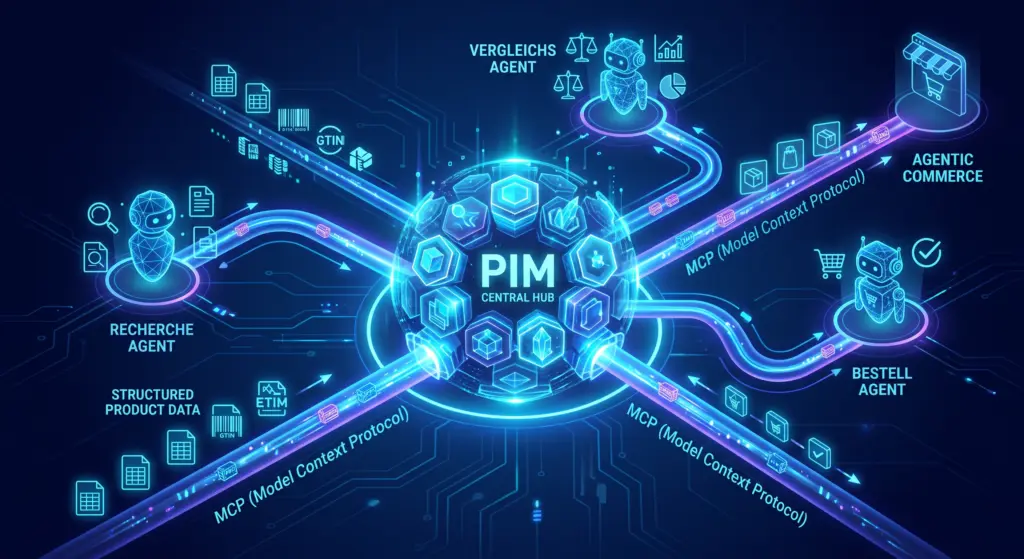
AI agents are increasingly researching, comparing and ordering on their own. They do not browse product pages; they read product data. The Model Context Protocol (MCP) provides an open standard through which agents can access PIM systems directly. For manufacturers and retailers, the question is therefore no longer “How can we write copy faster?” but “Can machines make decisions based on our product data?”.
Key takeaways
In PIM, generative AI has primarily accelerated copywriting while creating new breaks in digital workflows. Agentic AI reads, validates and writes product data directly, using open protocols such as MCP.
Since December 2025, MCP has been a vendor-neutral standard under the Linux Foundation. Akeneo, inriver, Stibo Systems and Reltio (SAP) already offer their own MCP servers. Viamedici has announced one for 2027, and ATAMYA is expanding its MCP server along with its GraphQL API and webhooks.
Whether an AI agent selects your product depends on structured attributes, classifications such as ETIM or ECLASS, typed relationships and reliable identifiers, not visual presentation.
Commerce protocols such as ACP and UCP change rapidly. The PIM data model is the lasting investment that supports any protocol.
Agents with write permissions need deterministic guardrails: minimal permissions, validation within the PIM, approvals and a complete audit trail.
How agent-ready is your product data?
Our vendor-independent Agentic Readiness Assessment shows where your data model, PIM architecture and governance stand today, and what you should tackle first.
The first wave of AI in product data management was generative. Language models wrote product descriptions, translations and metadata in seconds. But the bottleneck simply shifted: employees copied results from chat windows into the PIM, checked values manually and managed prompts in spreadsheets. The AI was fast; the process around it was not.
Agentic AI works differently. An agent receives a goal rather than a prompt, such as “Fill in all missing mandatory attributes for marketplace X” or “Find an available replacement for item Y”. It breaks down the task, calls tools, reads data, checks results and writes them back. To do this, it needs reliable, machine-readable access to the systems that hold the data.
The customer-facing interface is changing too. Gartner expects around 90% of B2B purchases to be intermediated by AI agents by 2028, representing more than US$15 trillion. McKinsey estimates that by 2030, agentic commerce could generate up to US$1 trillion in US retail and US$3 to US$5 trillion worldwide.
In practice, however, there is friction. In March 2026, OpenAI scaled back “Instant Checkout”, the purchasing feature launched in ChatGPT in September 2025; retailers now handle purchases through their own checkout again. Research and product comparisons, however, still take place through the assistant. For manufacturers, that is the real message: whether the agent makes the purchase itself remains an open question. The fact that it shortlists products is already a reality, and that shortlist is based on product data.
What is the Model Context Protocol (MCP)?
The Model Context Protocol (MCP) is an open standard that enables AI applications and agents to access data and tools in external systems. Anthropic released MCP in November 2024. In December 2025, the protocol was transferred to the newly established Agentic AI Foundation (AAIF) under the Linux Foundation. Its members include OpenAI, Google, Microsoft, AWS, SAP, Salesforce and Shopify.
The principle is straightforward: a vendor provides an MCP server that exposes its system’s capabilities as documented tools (“Tools”) and data sources (“Resources”). An AI client, such as an assistant or an agent framework, connects to the server, discovers the available tools and calls them as needed. Instead of building a separate integration for every model and every system, a single standard is enough. This is why MCP is often described as “USB-C for AI”.
An important point for IT leaders: MCP does not replace a PIM’s REST or GraphQL API. Most MCP servers build on existing APIs and translate them into self-describing tools. What is new is that a language model can discover at runtime which operations are available, which parameters they require and which permissions apply. Integration logic thus moves from hard-coded implementations into a standardised, auditable layer.
With the specification dated July 28, 2026, MCP has also become more enterprise-ready. This version uses a stateless core that can scale behind standard load balancers. It strengthens OAuth 2.1-based authorization and aligns it more closely with OpenID Connect. The optional “Enterprise-Managed Authorization” extension allows IT to control access to MCP servers centrally through the identity provider. This substantially addresses two common objections to MCP in the enterprise: scalability and permissions management.
Two directions: agents inside the PIM and agents at the digital shelf
Discussions often conflate two scenarios. Keeping them separate is critical for the architecture.
Internal: agents work in the PIM
External: agents buy from the company
Who uses the agent?
Internal teams: product management, data stewards, e-commerce, compliance
Customers, buyers, AI assistants such as ChatGPT, Gemini or Copilot
Find and compare products, check availability, place orders
Access
The PIM vendor’s MCP server, with user permissions
Product feeds, commerce protocols (ACP, UCP), the shop platform’s MCP server, structured web data
Main risk
Incorrect writes to the golden record
Lack of visibility or inaccurate presentation during product selection
The PIM is the source in both directions. Internally, it is the system in which agents work. Externally, it feeds all channels and protocols. An external purchasing agent will generally not access your PIM directly, but every answer it receives about your products ultimately originates there.
The protocol puzzle: MCP, ACP, UCP, AP2 and A2A
Several protocols for agentic commerce have emerged alongside MCP since 2025. They tend to complement rather than compete with one another.
Protocol
Initiator
Since
Purpose
Relevance to PIM
MCP (Model Context Protocol)
Anthropic, now Agentic AI Foundation (Linux Foundation)
Nov. 2024
Agent access to data and tools
Controlled access to the catalog, attributes and validations
ACP (Agentic Commerce Protocol)
OpenAI and Stripe
Sept. 2025
Product feeds and checkout in ChatGPT; focused on product discovery since March 2026
Complete, up-to-date feeds with pricing and availability
UCP (Universal Commerce Protocol)
Google with Shopify, Etsy, Wayfair, Target and Walmart
Jan. 2026
Purchases directly in Google AI Mode and Gemini
Consistent product data across search, AI Mode and checkout
AP2 (Agent Payments Protocol)
Google
Sept. 2025
Authorization of payments by agents
Indirect: prices and terms must be accurate
A2A (Agent2Agent)
Google, now Linux Foundation
Apr. 2025
Communication between agents
Relevant to chains of agents in procurement and the supply chain
The experience with Instant Checkout shows how quickly individual protocols and business models change. Optimizing for a specific protocol today means building on shifting ground. The underlying data foundation is what remains stable: a well-modeled PIM supports every new channel and every new protocol without having to reinvent the data model.
How PIM vendors are responding: an overview of MCP servers
Several leading PIM and MDM vendors introduced their own MCP servers in 2025 and 2026. Their capabilities vary considerably, particularly when it comes to write permissions.
Official MCP server for products, families, attributes, categories, channels and Reference Entities, with read and write access; clients include Claude Desktop, Cursor and VS Code
Broad write access; according to the documentation, media files, jobs and workflow executions are excluded
MCP server available since September 2025; expanded with the Summer Release 2026 (June 2026) to provide a foundation for custom applications (“MCP Code Writer”)
According to the EPIM roadmap for 2026–2029 (2026 customer roadshow): an Event Hub for real-time data distribution and conversational “Data Expert AI” in 2026; an MCP server with agentic workflow skills as the “backbone for autonomous PIM/MDM processes” in 2027
Announced, supported by AI Review (human-in-the-loop) and a No-Code Agent Builder
Expanding its MCP server: agents using Claude or ChatGPT are set to gain write access in addition to read access. A public GraphQL API with API keys and webhooks for product changes is also due by the end of 2026
According to the October 2026 partner update; the roadmap for 2027 is not yet final
The October 2026 partner update from ATAMYA shows how these components work together. The vendor is primarily expanding the infrastructure agents need: a full GraphQL API, scheduled for public release by the end of 2026, that enables targeted queries in a single call. Webhooks report product changes as events to middleware or an online store, rather than requiring systems to poll continuously. Workflows are triggered when specific attributes change, such as dangerous goods data, regardless of whether the change originated from a supplier import, the ERP system, a person or AI. Selection attributes can now be output in workflows using their plain-text values rather than just their IDs, making work significantly easier for AI agents. For 2027, ATAMYA also plans to add attribute-level metadata that can store, for example, semantic guidance for AI or an attribute’s relevance to the DPP.
Other vendors are also positioning themselves. Salsify explicitly sees itself as the data layer for agentic commerce and introduced AI-searchable catalogue pages in February 2026. Commerce platforms are following suit: Salesforce, for example, is piloting MCP-based tools for shopping agents in B2C Commerce.
For a selection decision, what matters is less whether an MCP server exists than what it is permitted to do. Which objects can be read, and which can be written? Do the PIM’s validation rules and workflows also apply when agents write data? How are permissions assigned, logged and revoked? These questions now belong in every PIM selection process.
Why data quality determines visibility
A person can work around an incomplete data sheet. They recognise the product in the photo, read between the lines or call the sales team. An agent cannot. It filters against strict criteria, and anything it cannot find does not exist as far as it is concerned.
An example from technical wholesale: a purchasing agent for a plant engineering company is looking for a frequency inverter rated at 7.5 kW, 400 V and IP55 that replaces a discontinued model and is available within 48 hours. If your IP rating appears only in free text, the link to the previous model is missing or availability is out of date, your product is excluded from the selection, even though it fits the requirements. The competitor with the more complete data set wins the order.
Data layer
What agents expect
Typical gap
Identification
GTIN, manufacturer part number, unique IDs
Missing or invalid GTINs, duplicates
Attributes
Decision-relevant characteristics as structured values with units
Values in free text, inconsistent units
Classification
ETIM, ECLASS or GS1 standards
Internal product groups only
Relationships
Accessories, spare parts, successors and compatibility as typed relationships
Relationships documented only in PDFs or not maintained at all
Variants
Variants as separate records within a shared group
Variants listed as text within a single item
Commercial data
Price, availability and minimum order quantities from the system of record
Outdated exports, disconnected data flows to the ERP system
Compliance
Certificates, substance data and DPP-relevant information as data
Supporting evidence only available as documents
Many of these requirements are not new. They are the same requirements that the Digital Product Passport sets out. Structuring your data model consistently now meets both sets of requirements with a single investment.
Are your products slipping through the cracks with AI agents?
We review identifiers, attributes, classification and relationships across your core product ranges and identify the biggest gaps.
Guardrails: governance for agents with write access
Once agents are allowed to write data, governance becomes an architectural issue. An incorrect value in the golden record spreads across all channels within minutes. New attack surfaces also emerge: instructions hidden in supplier data or documents (prompt injection), tampered tool descriptions or overly broad access permissions.
Six principles have proven effective:
Least privilege: Agents receive their own service accounts with tightly restricted permissions. Read access is the default, write access the exception.
Validation in the system, not in the prompt: Mandatory fields, value ranges and format rules are enforced in the PIM, regardless of whether a human or an agent is writing data.
Proposals before approval: Agents write to drafts, staging areas or workflow steps. A human approves changes until the error rate is demonstrably low.
Traceability: Every change is linked to an agent, a task and a timestamp, and can be rolled back.
Centralised access management: Access is managed through the identity provider; the current MCP specification offers an optional extension for this. Agents that are no longer needed are deactivated, just like departing employees.
Events rather than queries: An event-driven architecture notifies agents of new or updated products. This reduces system load and keeps data up to date.
Neda Nia, Chief Product & Growth Officer at Stibo Systems, sums it up in the MCP server announcement: “AI agents are only as good as the data they act on.” One might add: and only as secure as the rules under which they operate.
Architecture: the PIM as a context provider
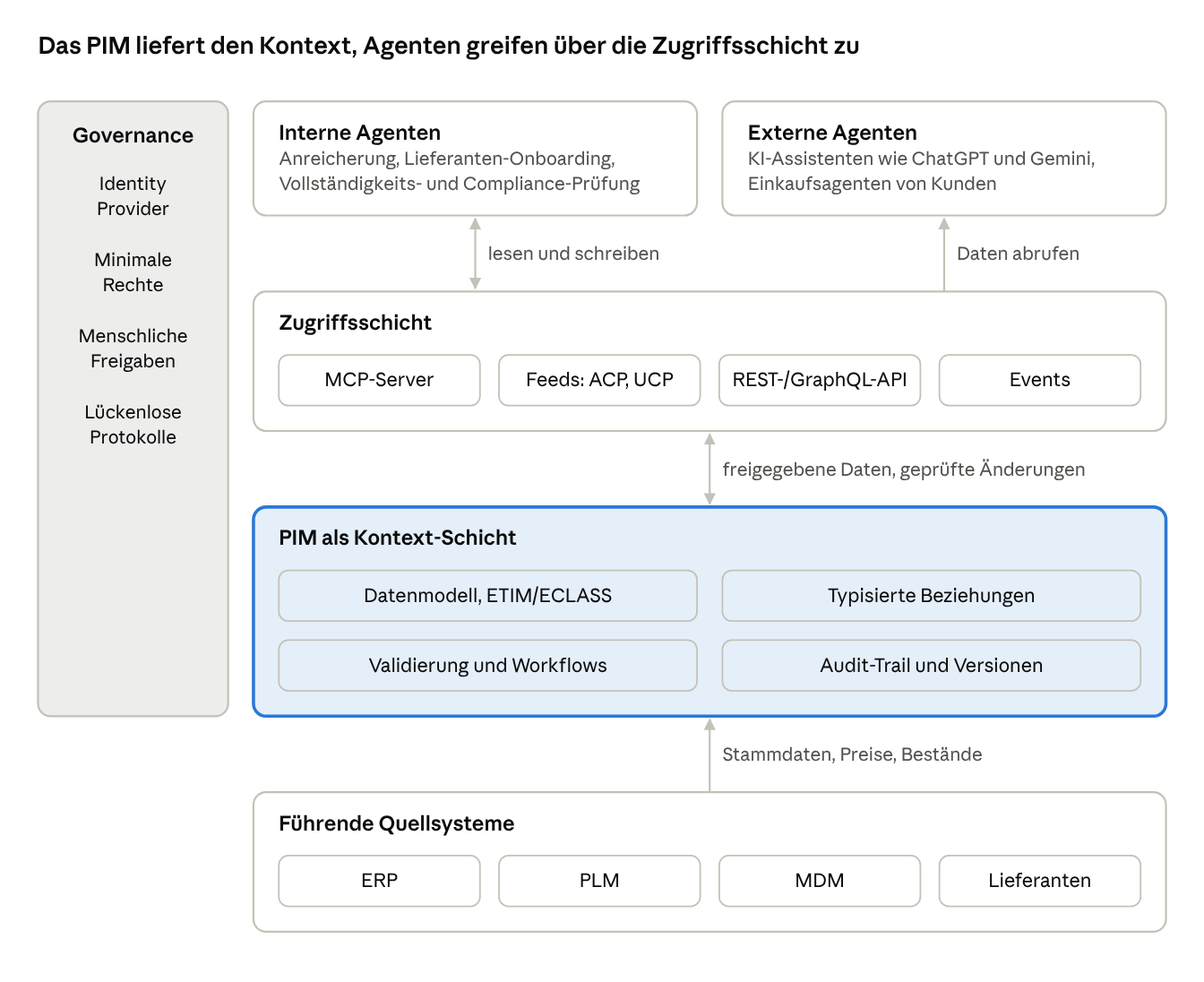
In an agent-ready architecture, the PIM becomes a context provider. ERP, PLM and MDM remain the systems of record for their respective data. The PIM brings that data together into a semantically consistent, classified and approved product view. An access layer of MCP servers, feeds, APIs and events sits above it, serving agents both internally and externally.
Reference architecture: PIM as a context provider, with governance across all layers
No agent bypasses the PIM when writing data: all access goes through the access layer, and governance, including the identity provider, permissions and approvals, applies equally to humans and agents.
Five steps to agentic readiness
Measure visibility: Ask ChatGPT, Gemini, Perplexity and Copilot the questions your customers would ask. Which of your products appear, which details are incorrect, and where does the information come from?
Review the data model: Which attributes drive selection in your core product ranges? How completely are they available as structured values? What is the state of your classification, relationships and identifiers?
Pilot access: Start with an internal, read-only use case using your PIM vendor’s MCP server, such as an assistant for data stewards or a completeness check. Write access comes later.
Establish governance: Define roles, permissions, approval levels and logging for agents before the first agent writes data in production.
Measure and scale: Define metrics: completeness, error rates in channel feeds, time to publication and accurate representation in AI assistants. Only then should you open up additional channels and protocols.
If this reveals that your PIM system cannot support structured attributes, typed relationships or controlled agent access, the issue should be addressed through a structured PIM selection process.
Conclusion: context beats content
Agentic commerce does not make the PIM redundant. It turns the PIM into the nervous system of the product business. Agents need context, and no language model can provide it. Only a well-designed, governed product data model can. MCP provides the connection, not the solution.
Businesses that invest in data structure, classification and governance now will be ready for whichever protocols become established in the coming years. Those that continue to focus solely on generating text will simply be overlooked by agents.
Agentic Readiness Assessment: Is your PIM ready for AI agents?
We provide a vendor-independent assessment of how well your data model, PIM architecture and governance are prepared for AI agents, and turn the findings into a concrete action plan.
MCP is an open standard that enables AI agents to access data and tools in external systems. Anthropic released it in November 2024; since December 2025, it has been managed by the Linux Foundation’s Agentic AI Foundation.
Does MCP replace my PIM system’s API?
No. MCP servers typically build on existing REST or GraphQL APIs. They make the functions of these APIs discoverable and usable by any MCP-compatible AI client through a standardised interface.
What is the difference between MCP, ACP and UCP?
MCP defines how agents access data and tools in general. ACP (OpenAI and Stripe) and UCP (Google with retail partners) are commerce-specific protocols for product feeds and checkout within AI assistants. All three require complete, structured product data.
Which PIM vendors offer an MCP server?
As of October 2026, these include Akeneo, inriver, Stibo Systems and Reltio (SAP). Viamedici has announced an MCP server for 2027, while ATAMYA continues to expand its MCP server. Scope and write permissions vary considerably and should be evaluated in every selection process.
Do I need a new PIM system for agentic commerce?
Not necessarily. What matters is whether your system supports structured attributes, classifications, typed relationships and controlled agent access. Often, the data model needs more work than the software.
Is it safe to give AI agents write access to the PIM?
Yes, with clear guardrails: dedicated service accounts with minimal permissions, validation within the PIM, approval workflows and comprehensive logging. Start with read-only access and expand permissions gradually.
ATAMYA: Partner Tech Talk October 2026 (product update and outlook for 2027)
Viamedici: EPIM Roadmap 2026–2029 (presented at the 2026 customer roadshow)
Request an Agentic Readiness Assessment
Want to know whether your PIM and product data are ready for MCP and AI agents? Leave your contact details and briefly tell us which PIM system you use and where you currently stand.
We will get back to you with a proposal for an Agentic Readiness Assessment tailored to your business.
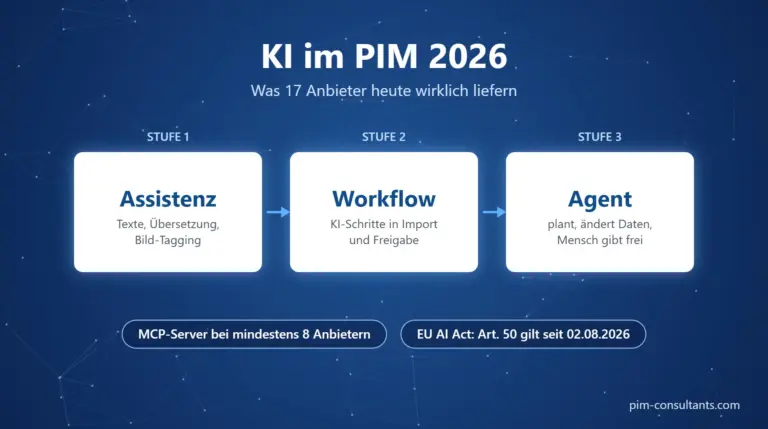
Which AI capabilities PIM vendors actually deliver in 2026: an overview of agents, MCP servers, custom AI models and pricing across 17 vendors, plus obligations under the EU AI Act.
Has the Akeneo Community Edition been discontinued? No. Support for Akeneo 7 On-Premise and PaaS ended on 30 September 2026. Here are the facts and the five options now available to Enterprise customers.
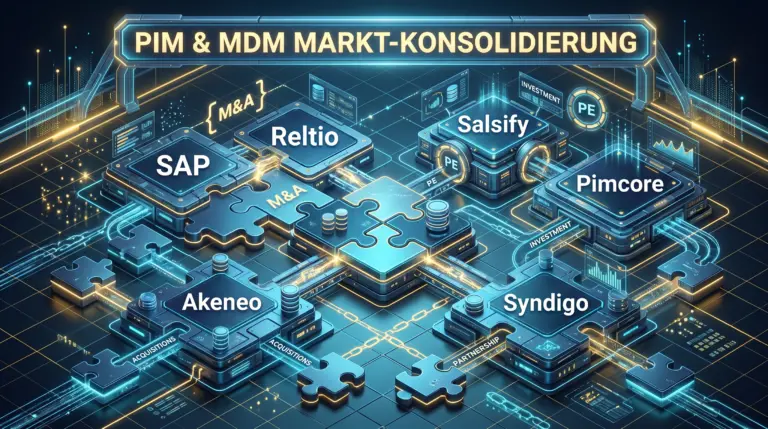
Cinven buys Salsify, Tenzing takes over Pimcore, Akeneo acquires PricingHUB: an overview of all PIM deals in 2025/2026, the three patterns behind them and what users should now look out for in their contracts.
To provide the best experience, we use technologies such as cookies to store and/or access device information. Consenting to these technologies allows us to process data such as browsing behaviour or unique IDs on this website. If you do not consent or withdraw your consent, certain features and functions may be affected.
Functional
Always active
Technical storage or access is strictly necessary for the legitimate purpose of enabling the use of a specific service explicitly requested by the subscriber or user, or for the sole purpose of transmitting a communication over an electronic communications network.
Preferences
Technical storage or access is necessary for the legitimate purpose of storing preferences that have not been requested by the subscriber or user.
Statistics
Technical storage or access used exclusively for statistical purposes.Technical storage or access used exclusively for anonymous statistical purposes. Without a subpoena, voluntary cooperation from your internet service provider or additional records from a third party, information stored or retrieved for this purpose alone cannot usually be used to identify you.
Marketing
Technical storage or access is required to create user profiles to send advertising, or to track the user on a website or across multiple websites for similar marketing purposes.