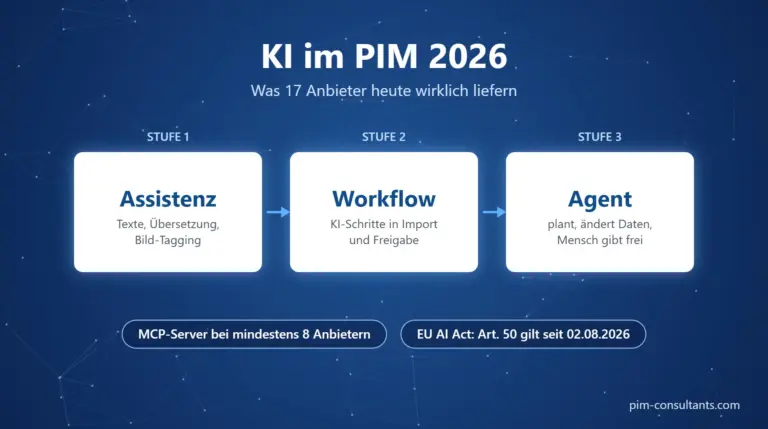
AI in PIM 2026: What vendors actually deliver today
Which AI capabilities PIM vendors actually deliver in 2026: an overview of agents, MCP servers, custom AI models and pricing across 17 vendors, plus obligations under the EU AI Act.

Managing product data across different channels, markets and formats is more complex than ever. Companies that are growing, launching new products or expanding internationally often face data chaos: scattered Excel spreadsheets, fragmented systems and endless email exchanges to coordinate work. This not only slows down internal processes, it also puts the customer experience at risk. Incorrect or incomplete product data can lead to delays, returns or lost revenue.
This is where a PIM (Product Information Management) system comes in. It helps you centrally manage, enrich and publish consistent product information across all channels, from ERP and CRM systems to online shops, marketplaces, print catalogues and points of sale. But selecting the right PIM system is no simple task. The market is vast, and vendors make plenty of promises. That calls for a structured approach focused on your specific requirements.
“Implementing a PIM system is not just an IT project. It is a business transformation that affects all product communications.”
— Maya Kislykh, Bluestone PIM
What do you want to achieve with a PIM system? Faster product launches? Consistent product data across all channels? Easier management of multilingual content? Clear goals help you define the right requirements and measure success later on.
PIM is not just an IT concern. Involve colleagues from product management, marketing, sales and e-commerce early on. This ensures that the system supports real business processes, not just technical requirements.
Where is your product data stored today? In your ERP? In Excel files? In content systems or your DAM? A comprehensive data audit identifies your sources, shows where interfaces are needed and assesses your data quality.
“A PIM system is the central source that all teams use to maintain product information and syndicate it consistently across every channel.”
— PIM-Consultants
Who writes product copy? Who maintains specifications, media assets or translations? Who approves content? Map out the entire data flow. Only then can you identify where automation and workflows in your PIM will add the most value.
What must the system be able to do? Manage multilingual content? Export to marketplaces? Support roles and permissions? Provide an intuitive UI for marketing teams? Create a list of must-haves and nice-to-haves to make it easier to compare vendors. Our PIM criteria checklist, available as an Excel file, provides a template.
Beyond licence fees, you will also need to budget for implementation, data migration, training and ongoing operations. Some vendors use modular or per-user pricing, while others base their pricing on API usage allowances. Think long term.
Which solutions fit your requirements? Our project experience shows that very different vendors may be suitable depending on your priorities, such as Syndigo for syndication to large retail networks, inRiver for a particularly user-friendly interface or Akeneo for open integrations. Our PIM vendor overview covers more than 180 vendors.
Ask vendors to demonstrate specific use cases, such as how the system handles multilingual content, media assets or category-specific attributes. Better still, run a proof of concept using real product data.
A system is only as good as the people who use it. Set aside time and resources for onboarding, training and internal documentation. Good vendors actively support you with change management and long-term system maintenance.
“The PIM market is evolving rapidly, driven by omnichannel requirements and AI automation. Investing in high-quality product data today creates a foundation that can support future channels too.”
— PIM-Consultants
Selecting a PIM system is far more than a technical project. It is a strategic decision with a direct impact on efficiency, time-to-market and the customer experience. Taking a structured approach, clearly defining your goals and involving all relevant departments lays the foundation for a system that fits your business both today and in the future. A well-chosen PIM system becomes a cornerstone of your digital product communication: scalable, easy to integrate and future-proof.
Read more: PIM selection in 6 steps · PIM checklist · Preparing for a PIM demo
If you are about to select a PIM system or want to optimise your existing solution, we are here to help with vendor-neutral, practical advice backed by years of experience. Book a no-obligation consultation today.
News & Blog

Which AI capabilities PIM vendors actually deliver in 2026: an overview of agents, MCP servers, custom AI models and pricing across 17 vendors, plus obligations under the EU AI Act.

Has the Akeneo Community Edition been discontinued? No. Support for Akeneo 7 On-Premise and PaaS ended on 30 September 2026. Here are the facts and the five options now available to Enterprise customers.
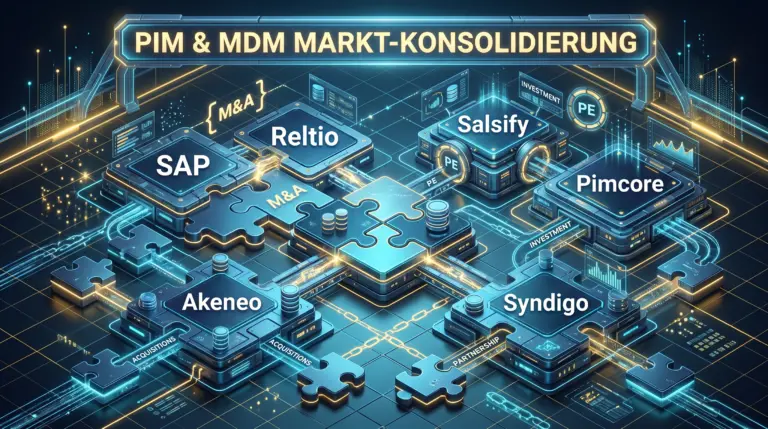
Cinven buys Salsify, Tenzing takes over Pimcore, Akeneo acquires PricingHUB: an overview of all PIM deals in 2025/2026, the three patterns behind them and what users should now look out for in their contracts.
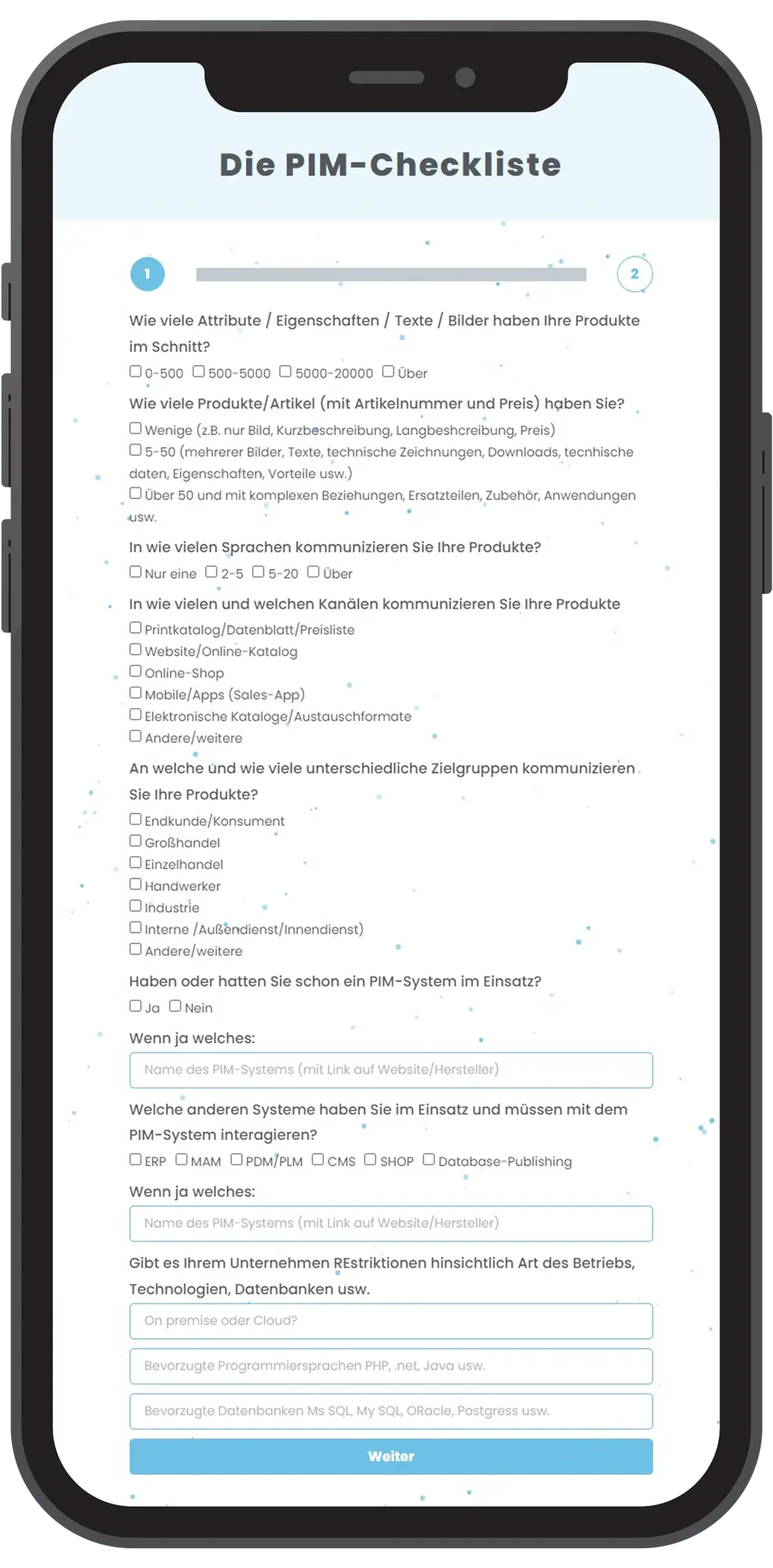
Find out in 3 minutes whether a PIM system could benefit your business and which PIM systems could be right for you!
Webdesign: Deutsche Stadtmarketing