- PIM comparisons
Salsify vs. Stibo Systems: Which Platform Is Right for You?
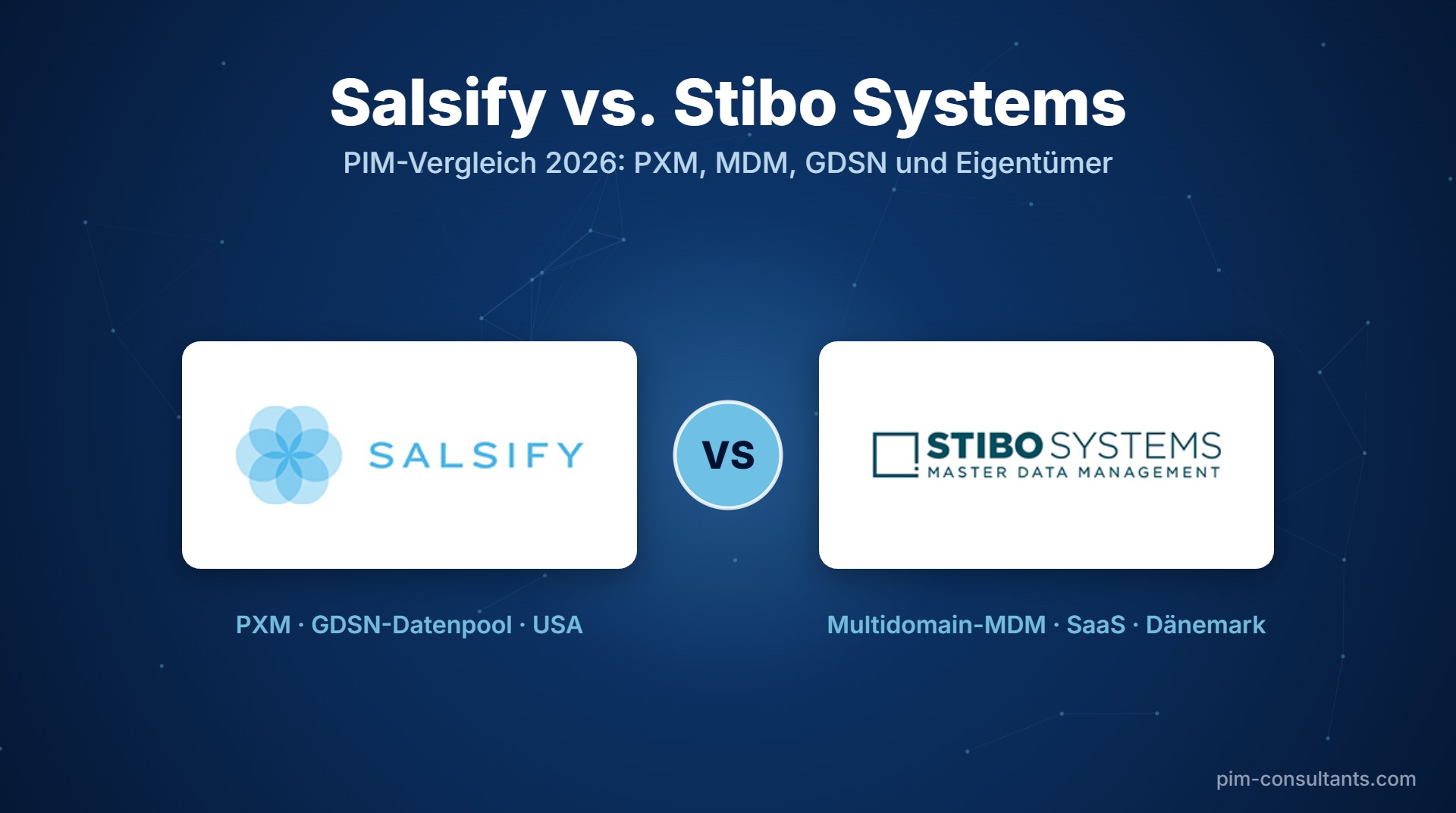
In brief: Salsify and Stibo Systems compete primarily for large brand manufacturers and retailers, but address different core needs. Boston-based Salsify is a PXM platform for brands selling through many retailers: product content is syndicated in each retailer’s required format, distributed through its own GDSN data pool and monitored on the digital shelf. Aarhus-based Stibo Systems is a multidomain MDM platform with strong core PIM capabilities, connecting product, supplier, customer and location data. Salsify is more likely to fit when retailer requirements and syndication drive priorities. Stibo Systems is more likely to fit when the goal is clean master data across multiple domains and systems. Ownership structures are changing at both companies: Cinven plans to acquire Salsify, while Stibo is seeking a minority investor.
Salsify and Stibo Systems compared
| Criterion | Salsify | Stibo Systems |
|---|---|---|
| Origins and ownership | Boston, USA, founded in 2012; acquisition by private equity investor Cinven announced in July 2026 | Aarhus, Denmark, part of the foundation-owned Stibo Group; seeking a minority investor since October 2026, with the foundation retaining control |
| Focus | PXM combining PIM, DAM, syndication, Digital Shelf Analytics and supplier data exchange (SupplierXM) | Multidomain MDM for product, customer, supplier and location data with core PIM capabilities (STEP) |
| Deployment | SaaS | SaaS only; support for on-premises installations ends on December 31, 2027 |
| Retailer connectivity | Global network of retailer and marketplace destinations, customers in over 140 countries; validation against retailer rules before syndication | Fewer ready-made connectors to retailers and marketplaces; strengths in data sourcing and quality rules |
| GDSN | Own GS1-certified data pool; target market rules for Germany, Austria and Switzerland since 2022, seven additional markets in 2025 | Connections to data pools |
| Data model | Designed for product content, media and retailer requirements | Multiple hierarchy levels, complex quality rules and links between domains, such as which supplier delivers which product to which location |
| AI | Intelligence Suite (October 2025), Angie assistant, SalsifyIQ with an MCP layer and automated syndication (announced May 2026) | ProductGen AI for text and translation, MCP server (June 2026), AgentWorkx agent environment (announced September 2026) |
| Customer references | Danone, ASICS, Samsonite, Carrefour, METRO France | MediaMarktSaturn, Miele, WAGO, Siemens Digital Industries, Hilti, ZF |
| Financial position | Self-reported figures for 2025: EBITDA margin above 30%, over US$250 million in cash and cash equivalents, no debt | 2025/26 revenue: DKK1.31 billion (up 6%), SaaS revenue up 17% |
| Pricing | On request, pricing model with many variables | On request, multilayered pricing based on record types and concurrent users |
No paid placements: vendor selection and assessment are vendor-neutral and based on publicly available information.
What Salsify stands for
Salsify is built for brand manufacturers selling their products through many retailers. Product data, images and videos are maintained centrally and delivered in each retailer’s required format. Digital Shelf Analytics shows how products actually appear on retailers’ sites and whether the content is complete. The acquisition of Alkemics in 2021 added SupplierXM for data exchange between brands and retailers. Its own GDSN data pool has supported the target market rules for Germany, Austria and Switzerland since 2022, with seven additional European markets added in 2025. Customers include Danone, ASICS, Samsonite and Lifetime Brands Europe, as well as retailers Carrefour and METRO France. We found no publicly documented projects in German-speaking markets. In July 2026, private equity investor Cinven announced plans to acquire Salsify. Approval has been granted in Australia, but as of the end of October 2026, we had found no confirmation that the transaction had closed. Read more in the Salsify profile.
What Stibo Systems stands for
Stibo Systems manages product, customer, supplier and location data in a single platform and connects these domains. Its strengths include onboarding data from multiple sources, complex quality rules and data models with many hierarchy levels. Customers in German-speaking markets include MediaMarktSaturn, Miele, WAGO, Siemens Digital Industries, Hilti and ZF. Since version 2025.1, STEP has been available only as SaaS, and support for on-premises installations ends on December 31, 2027. For details, see our article Stibo Systems now SaaS-only. For AI, Stibo has introduced ProductGen AI, an MCP server in June 2026 and the AgentWorkx agent environment in September 2026, for which no availability date has yet been announced. In October 2026, it emerged that the foundation-owned Stibo Group was seeking a minority investor for Stibo Systems for the first time. Find out more in our Stibo Systems profile.
When Salsify is the better fit
- Retailer-driven requirements: You are a brand manufacturer supplying many retailers and marketplaces, each with its own requirements.
- GDSN and content together: You need GDSN master data and marketing content from a single platform, for example in grocery or health and beauty retail.
- Digital shelf: You want to see how your products appear on retailers’ sites and where content is missing.
- Ready-made connections: Extensive retailer connectivity matters more to you than a deep data model.
- Focus on product content: Your ERP or an existing MDM system manages customer, supplier and material master data.
When Stibo Systems is the better fit
- Multiple data domains: You want to manage product, supplier, customer and location data together, for example in a retail chain.
- Complex data: You need many hierarchy levels, industry taxonomies and advanced quality rules.
- Multiple sources: Your data comes from multiple ERP systems, suppliers and data pools.
- Manufacturing and retail in DACH: You are looking for customer references from your sector, such as electrical engineering, mechanical engineering or electronics retail, and local Stibo integrators.
- Ownership: It matters to you that a foundation retains majority ownership.
If neither is a fit: If your main priority is product data syndication to retailers and GDSN from a single provider, also compare Syndigo vs. Salsify. In an SAP environment, consider SAP MDG vs. Stibo Systems; for another MDM platform, see Stibo Systems vs. Informatica. Explore more systems on our Salsify alternatives and Stibo alternatives pages and in our MDM software overview. Our article PIM vs. MDM explains the difference between these system categories.
Cost comparison
Both vendors provide pricing only on request and target large enterprises. Salsify’s pricing model has many variables, so clarify renewal terms upfront as well. Stibo Systems has a multilayered pricing model, based on factors such as record types and concurrent users, and some AI features cost extra. Stibo customers with on-premises installations should plan to migrate to SaaS by the end of 2027. For both vendors, a new owner or investor could change pricing and packages later, so pay attention to contract terms and price guarantees. Calculate costs over five years, including implementation, connectors and internal effort. For guidance, see our article on PIM costs and our PIM Vendor & Contract Review.
Questions to ask both vendors
- Which of our retailers and data pools have ready-made connections, and who keeps them up to date when requirements change?
- Which data domains do we need today and in three years, and which are covered by the licence?
- Which AI features are generally available today, and which cost extra?
- How will the new owner or investor affect the roadmap, pricing and support?
- Which customers in German-speaking markets and in our industry can we speak to as references, and which partner will implement the project?
Frequently asked questions
What is the main difference between Salsify and Stibo Systems?
Salsify is a PXM platform for brand manufacturers supplying many retailers, offering syndication, its own GDSN data pool and Digital Shelf Analytics. Stibo Systems is a multidomain MDM platform with strong core PIM capabilities that manages customer, supplier and location data alongside product data.
Which system is better for GDSN?
Salsify operates its own GS1-certified data pool, which has supported the requirements of the German, Austrian and Swiss target markets since 2022. Stibo Systems connects to data pools but does not operate its own.
What do Cinven and the minority investor mean for customers?
At Salsify, a financial investor is acquiring a majority stake. Such acquisitions are often followed by further acquisitions or price adjustments. At Stibo Systems, the foundation remains the majority shareholder, while a minority investor is intended to fund growth and acquisitions. In both cases, pay attention to contract terms, price guarantees and roadmap commitments.
Are Salsify or Stibo Systems suitable for mid-sized companies?
Both target large enterprises. Mid-sized companies whose needs focus primarily on product data can often find leaner, more affordable PIM systems with shorter implementation times, for example through our PIM-Finder.
Your next step
Salsify, Stibo Systems or a third option? We provide a vendor-neutral comparison based on your data domains, trading partners and budget. The initial consultation is free: book a meeting. Our PIM selection page explains the structured selection process.
As of October 2026. Information on licensing, features and ownership is based on vendor information and public announcements and is subject to change.
Sources
- Goodwin: Salsify to be acquired by Cinven (July 2026)
- Australian Merger Tracker: Cinven/Salsify, clearance (August 2026)
- Salsify: 2025 financial results (18 February 2026)
- Salsify: SalsifyIQ (May 2026)
- Digital Commerce 360: Salsify Intelligence Suite (October 2025)
- Salsify: GDSN data pool supports Germany, Austria and Switzerland (14 December 2022)
- Salsify: GDSN Data Pool
- Salsify: Acquisition of Alkemics (2021)
- Salsify: Danone case study
- Salsify: ASICS case study
- Salsify: Samsonite case study
- Salsify: Lifetime Brands Europe case study
- Salsify: Carrefour case study
- Salsify: METRO France case study
- Stiftstidende: Stibo seeks a new co-owner (October 2026)
- Mainsights: Stibo Group explores sale of a minority stake in Stibo Systems (October 2026)
- Stibo Systems: Financial year 2025/26 (25 June 2026)
- Stibo Systems: Update and End-of-Life Information (2026.3)
- Stibo Systems: ProductGen AI
- Stibo Systems: MCP server (June 2026)
- Stibo Systems: AgentWorkx (September 2026)
- Stibo Systems: Customer MediaMarktSaturn
- Stibo Systems: Miele success story
- Stibo Systems: WAGO success story
- Stibo Systems: Customer Siemens Digital Industries
- Stibo Systems: Hilti success story
- Stibo Systems: ZF success story
More PIM insights
News & Blog
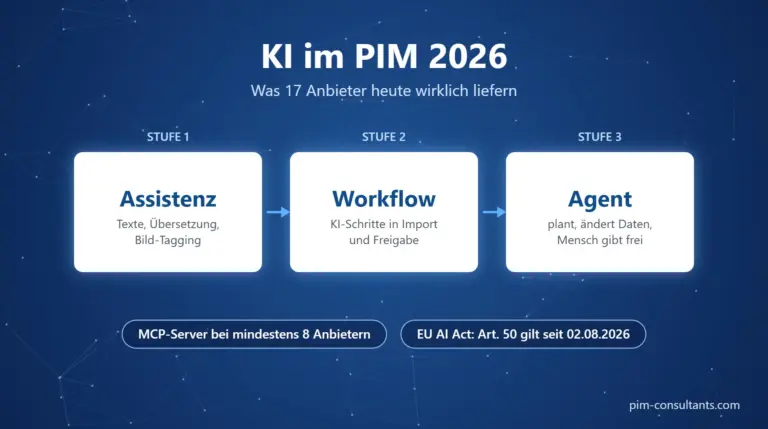
AI in PIM 2026: What vendors actually deliver today
Which AI capabilities PIM vendors actually deliver in 2026: an overview of agents, MCP servers, custom AI models and pricing across 17 vendors, plus obligations under the EU AI Act.

Akeneo Community Edition 2026: Not discontinued, but changing
Has the Akeneo Community Edition been discontinued? No. Support for Akeneo 7 On-Premise and PaaS ended on 30 September 2026. Here are the facts and the five options now available to Enterprise customers.
Billion-Dollar Deals, Private Equity and Platform Mergers: The Comprehensive PIM Consolidation Report 2026
Cinven buys Salsify, Tenzing takes over Pimcore, Akeneo acquires PricingHUB: an overview of all PIM deals in 2025/2026, the three patterns behind them and what users should now look out for in their contracts.