- PIM comparisons
inriver vs. Pimcore: Which PIM Is Right for You?
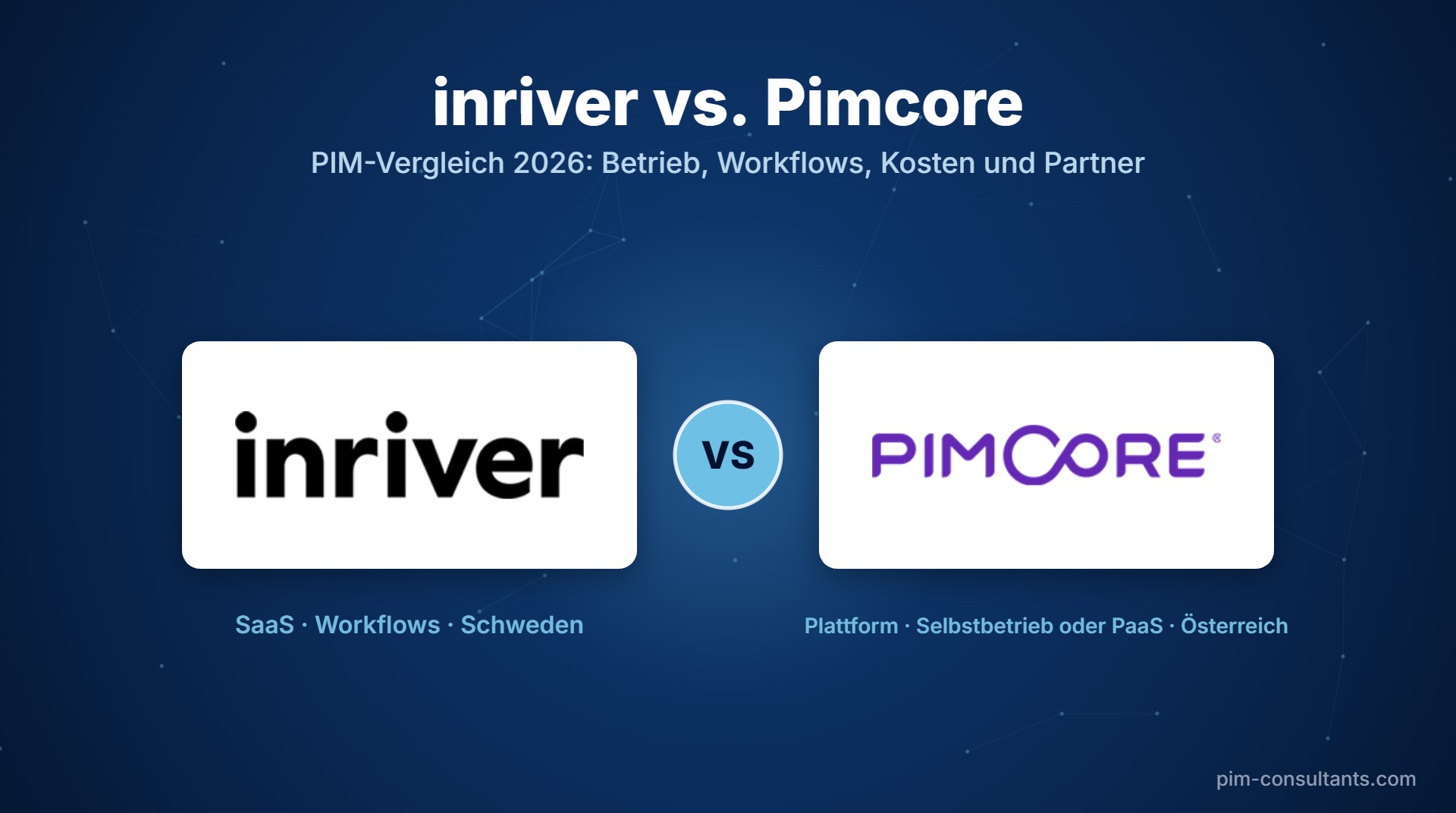
In short: inriver and Pimcore represent two approaches to PIM. Based in Malmö, inriver is a SaaS-only PIM for manufacturers and brands selling internationally, with visual workflows for business users and built-in syndication. Based in Salzburg, Pimcore is a platform for PIM, MDM, DAM and CMS with a fully customisable data model, available as a self-hosted solution or PaaS. inriver is more likely to fit if marketing and product teams will use the system themselves and you do not want to run a platform. Pimcore is more likely to fit if you have complex data, multiple data domains and an in-house development team or a partner.
inriver and Pimcore compared
| Criterion | inriver | Pimcore |
|---|---|---|
| Origins and ownership | Malmö, Sweden, founded in 2007; North American headquarters in Chicago, office in Munich; majority-owned by Thomas H. Lee Partners since 2022, with Verdane retaining a stake | Salzburg, Austria; originated in 2009 as a project at the agency elements, Pimcore GmbH established in 2013; subsidiaries in Germany, the US and Canada; sale of a majority stake to Tenzing agreed in August 2026, pending antitrust approval |
| Focus | PIM for manufacturers and brands selling across multiple channels, with content tailored to each channel and audience | Platform for PIM, MDM, DAM, CMS and commerce on a shared technical foundation |
| Deployment | SaaS, with all customers on the same platform (multi-tenant) | Self-hosted in your own data centre or private cloud, or available as PaaS from the vendor |
| Licensing and pricing | Commercial SaaS licence, pricing on request | Pimcore Open Core License: Community Edition free only for companies with annual revenue below €5 million; Professional $9,900, Enterprise $29,900 per year, PaaS pricing on request |
| Data model | Configurable using entities, fields and relationships | Fully customisable through a point-and-click browser interface, with inheritance across products and variants |
| Workflows | Created visually and launched directly from the product view | Workflow engine, with a visual Workflow Designer available as an extension |
| Syndication | Syndicate Advance built into the product | Output via interfaces; connectors are often developed during implementation or supplied by partners |
| AI | Inspire for text generation and translation, agents in multi-step workflows (March 2026), MCP server available since September 2025 | Copilot in the Enterprise Edition, Agent Bundle with proposal, review and approval steps (Pimcore Labs), MCP in the Agent Bundle |
| Customer references | Fjällräven, Atlas Copco, Alfa Laval, Michelin, ITW Construction Products Europe | ebm-papst, Saint-Gobain Weber, LEDVANCE, Henkell Freixenet, PALFINGER |
| Partners in the DACH region | 13 integrators in our directory | 56 integrators in our directory |
No paid placements: vendor selection and assessment are vendor-neutral and based on publicly available information.
What inriver offers
inriver is a SaaS PIM in which all customers use the same platform. Marketing and product teams maintain product information and use it to create content for online stores, marketplaces and retailers, tailored to each channel and audience. You create workflows visually and launch them directly from the product view. Syndicate Advance combines PIM and syndication in one product, while Inspire generates text and translations. Since March 2026, agents have been working in multi-step workflows, and an MCP server has been available since September 2025. Private equity firm Thomas H. Lee Partners has held a majority stake since 2022, with Verdane retaining a stake. inriver was founded in Malmö in 2007. According to the 2022 announcement, inriver had over 700 customers with more than 1,600 brands at the time, as well as an office in Munich. Customers include Fjällräven, Atlas Copco, Alfa Laval, Michelin and ITW Construction Products Europe. Find out more in the inriver profile.
What Pimcore offers
Pimcore brings together product data, master data, digital assets and web content on a single technical platform. You define the data model yourself, including inheritance across products and variants. This makes Pimcore attractive to companies with complex product ranges, multiple data sources or in-house developers. According to the announcement of Tenzing’s investment, there are more than 120,000 installations, including over 400 enterprise customers. Customers in German-speaking markets include ebm-papst, Saint-Gobain Weber, LEDVANCE, Henkell Freixenet and PALFINGER. With version 12, Pimcore moved away from the GPL: the Pimcore Open Core License allows free use only for companies with annual revenue of up to €5 million. Above that threshold, you need a commercial edition. Those who want to retain an open-source licence can turn to OpenDXP, a fork of Pimcore 11 under GPLv3. In August 2026, the previous majority owner, Nordwind Growth, agreed to sell its stake to Tenzing. At the time of the latest update, regulatory approval was still pending. Read more in our Pimcore profile.
When inriver is the better fit
- Business users come first: Marketing and product management use the system daily and need to work without developer support.
- Day-to-day approvals: Teams and countries coordinate through workflows that business users launch directly from the product view.
- Multiple channels: You tailor content by channel, retailer and target audience, and want syndication from the same product record.
- No in-house operations: You want the vendor to handle hosting and updates.
- International brands: You sell worldwide and want customer references from manufacturers and brands with a similar profile.
When Pimcore is the better fit
- Deployment options: You want to self-host, use a private cloud or choose the vendor’s PaaS offering.
- Multiple data domains: Beyond product data, you want to manage master data, digital assets or web content on one platform.
- A complex data model: You manage technical products with numerous dependencies, variants and inheritance rules.
- Your own team or a partner: An internal team or one of the Pimcore integrators handles implementation and ongoing development.
- Predictable licensing: You want published list prices, with the free Community Edition also available to small businesses.
If neither is the right fit: if you want SaaS and work with many suppliers or marketplaces, consider Akeneo. See inriver vs. Akeneo and Akeneo vs. Pimcore. If you want to use Pimcore without licence fees, compare Pimcore vs. OpenDXP. For a comparison of Pimcore with a SaaS PIM built on MACH architecture, see Bluestone PIM vs. Pimcore. Our pages on inriver alternatives and Pimcore alternatives cover further systems. Find partners for inriver under inriver integrators.
Cost comparison
inriver sells annual SaaS licences, with pricing available from the vendor on request. Implementation partner services come on top and have a major impact on total costs, particularly for mid-sized businesses. Pimcore publishes list prices: Professional costs $9,900 and Enterprise $29,900 per year, with PaaS pricing available on request. The Community Edition is free only for companies with annual revenue below €5 million. With Pimcore, you also need to factor in hosting, operations and, above all, implementation. Pimcore is therefore not automatically cheaper: project effort is usually higher, while ongoing licence fees are often lower. Calculate costs over five years, including implementation, connectors, operations and internal effort. Our article on PIM costs provides guidance.
Questions to ask both vendors
- Which of our workflows do you support out of the box, and what will we need to develop? Please demonstrate this using our own data.
- Which channels, retailers and marketplaces have ready-made integrations, and what costs extra?
- Who operates the platform, who installs updates, and which extensions will we need to adapt afterwards?
- Which implementation partners in German-speaking markets have delivered projects in our industry?
- How will ownership by Thomas H. Lee Partners at inriver and Tenzing at Pimcore affect roadmaps and pricing?
Frequently asked questions
What is the main difference between inriver and Pimcore?
inriver is a SaaS-only PIM with visual workflows and syndication for manufacturers and brands selling through multiple channels. Pimcore is a platform for PIM, MDM, DAM and CMS with a fully customizable data model, available as a self-hosted solution or as PaaS.
Can I host inriver myself?
No, inriver runs as multi-tenant SaaS. If self-hosting is a requirement, Pimcore or its free fork OpenDXP are options.
Is Pimcore cheaper than inriver?
Not necessarily. Pimcore’s license pricing is public and often lower, but you also need to factor in hosting, operations and typically greater implementation effort. With inriver, costs are driven by the SaaS license and partner services. Compare the total cost of ownership over five years.
Which system is faster to implement?
That depends on the scope. As a SaaS solution, inriver includes the platform, workflows and syndication, with implementation handled by a partner. Pimcore is a development project in which you design your own data model and integrations. This usually takes longer but offers greater flexibility.
Your next step
inriver, Pimcore or a different system altogether? We provide a vendor-neutral comparison based on your processes, channels and budget. The initial consultation is free: book a meeting. Our PIM selection page explains the structured selection process.
As of October 2026. Information on licenses, pricing, features and ownership is based on vendor information and public announcements and is subject to change.
Sources
- inriver: Growth investment from Thomas H. Lee Partners (19 May 2022)
- inriver: Company history (founded in 2007)
- inriver: Syndicate Advance
- inriver: Inspire
- inriver: Agents and workflow orchestration (24 March 2026)
- inriver: MCP
- inriver: Customer Spotlight Fjällräven
- inriver: Customer Spotlight Atlas Copco
- inriver: Customer Spotlight Alfa Laval
- inriver: Customer Spotlight Michelin
- inriver: Customer Spotlight ITW Construction Products Europe
- Pimcore: Pricing
- Pimcore: Moving away from the GPL, Pimcore Open Core License
- Dechert: Tenzing invests in Pimcore (27 August 2026)
- Trending Topics: Majority stake in Pimcore sold to Tenzing (August 2026)
- Pimcore: About us (since 2009)
- pressetext: elements.at and Pimcore (17 November 2010)
- Commercial register: pimcore GmbH, FN 398049t, registered on 26 June 2013
- Pimcore: Agent Bundle
- Pimcore: Copilot
- Pimcore: Workflow Designer
- Pimcore: Customer ebm-papst
- Pimcore: Customer Saint-Gobain Weber
- Pimcore: Customer LEDVANCE
- Pimcore: Customer Henkell Freixenet
- Pimcore: Customer PALFINGER
More PIM insights
News & Blog
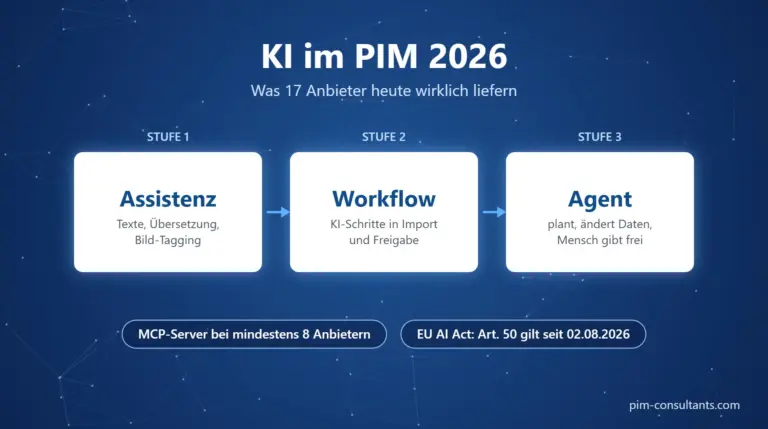
AI in PIM 2026: What vendors actually deliver today
Which AI capabilities PIM vendors actually deliver in 2026: an overview of agents, MCP servers, custom AI models and pricing across 17 vendors, plus obligations under the EU AI Act.
Akeneo Community Edition 2026: Not discontinued, but changing
Has the Akeneo Community Edition been discontinued? No. Support for Akeneo 7 On-Premise and PaaS ended on 30 September 2026. Here are the facts and the five options now available to Enterprise customers.
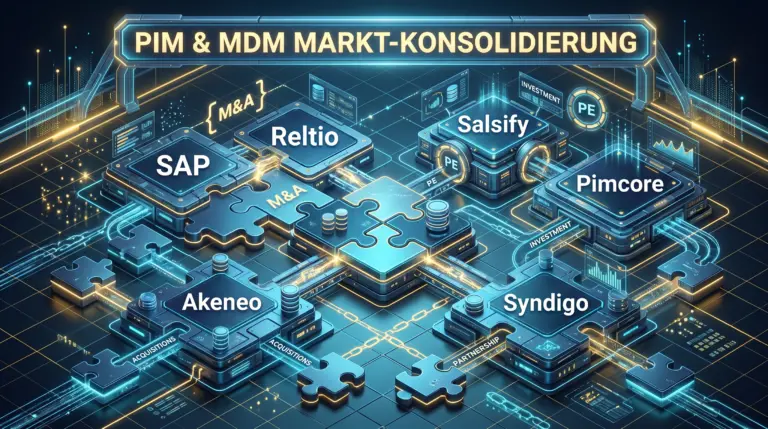
Billion-Dollar Deals, Private Equity and Platform Mergers: The Comprehensive PIM Consolidation Report 2026
Cinven buys Salsify, Tenzing takes over Pimcore, Akeneo acquires PricingHUB: an overview of all PIM deals in 2025/2026, the three patterns behind them and what users should now look out for in their contracts.