- PIM comparisons
Bluestone PIM vs. Pimcore: Which PIM Is Right for You?
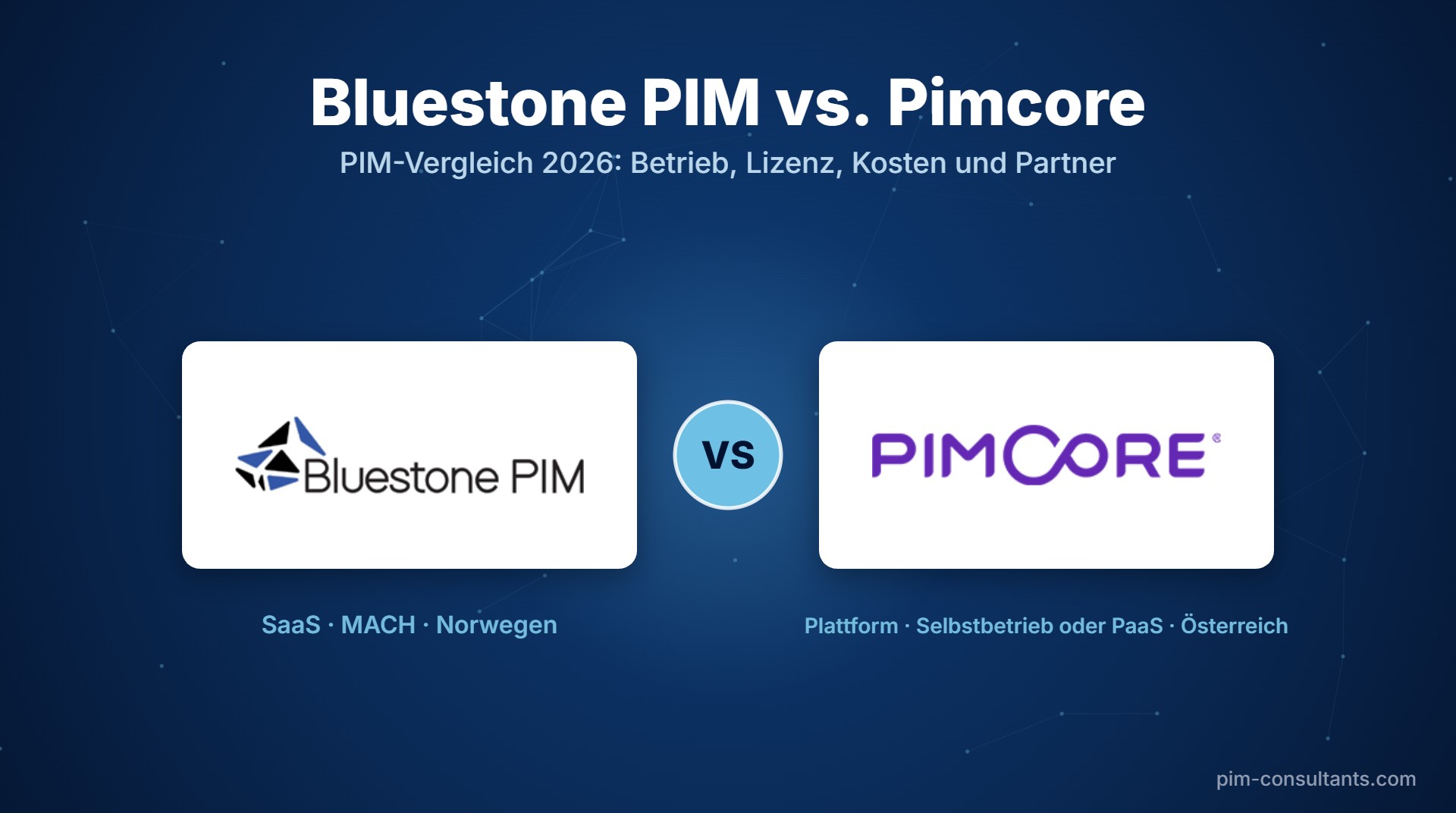
In brief: Bluestone PIM and Pimcore both target companies with development expertise, but their deployment models are fundamentally different. Bluestone, from Norway, is a SaaS-only PIM with a MACH architecture, used primarily by retailers in Scandinavia, the Netherlands and the UK. Pimcore, from Salzburg, is a platform for PIM, MDM, DAM and CMS with a freely definable data model, available for self-hosting or as PaaS. Bluestone is more likely to fit if you are assembling a commerce stack from cloud services and do not want to manage servers. Pimcore is more likely to fit if you need control over code, hosting and multiple data domains, and want local partners.
Bluestone PIM and Pimcore compared
| Criterion | Bluestone PIM | Pimcore |
|---|---|---|
| Origin and ownership | Tønsberg, Norway, founded in 2016; first external investors in January 2024 (Scale Leap Capital, Narwhal Investments) | Salzburg, Austria; originated in 2009 as a project at the agency elements, Pimcore GmbH established in 2013; subsidiaries in Germany, the US and Canada; sale of a majority stake to Tenzing agreed in August 2026, pending competition clearance |
| Focus | PIM with DAM, API-first and headless, extended through apps and other MACH services | Platform for PIM, MDM, DAM, CMS and commerce on a single technology foundation |
| Deployment | SaaS only | Self-hosted in your own data centre or private cloud, or available as PaaS from the vendor |
| Licensing and pricing | Monthly charges based on users, items, languages, data transfer and marketplace apps; no published price list | Pimcore Open Core License: Community Edition free only for companies with annual revenue below €5 million; Professional $9,900, Enterprise $29,900 per year, PaaS pricing on request |
| Data model | Configurable within the SaaS framework, extensible through APIs | Freely definable through a point-and-click browser interface, with inheritance across products and variants |
| Channels and marketplaces | Through apps and partner services such as Productsup or WakeupData, requiring additional licences | Syndication through APIs; connectors are often built during the project or supplied by partners |
| AI | AI agent requiring confirmation before every change, MCP server, option to use your own Anthropic, Google or OpenAI key | Copilot in the Enterprise Edition, Agent Bundle with proposal, review and approval steps (Pimcore Labs), MCP in the Agent Bundle |
| Customer references | Stadium, Zeeman, Saint-Gobain Distribution Norway, Dolby, Jernia | ebm-papst, Saint-Gobain Weber, LEDVANCE, Henkell Freixenet, PALFINGER |
| Partners in Germany, Austria and Switzerland | No office in Germany listed; 3 integrators in our directory | 56 integrators in our directory |
No paid placements: vendor selection and assessment are vendor-neutral and based on publicly available information.
What Bluestone PIM offers
Bluestone was founded in Norway in 2016 and became the first PIM vendor to join the MACH Alliance in 2021. The system is built API-first and headless: you connect your online shop, search and CMS as separate services, such as commercetools, Shopify or Contentstack. Public case studies feature retailers such as Stadium, Zeeman and Saint-Gobain Distribution Norway, while press releases cover Jernia and Dolby. Ready-made integrations with NOBB and Cobuilder are available for the Norwegian construction industry. Bluestone’s AI offering includes an agent that asks for confirmation before every change and an MCP server for external assistants. It also offers its own Digital Product Passport solution. In January 2024, Scale Leap Capital and Narwhal Investments became its first external investors, supporting expansion into markets including the UK, Germany and Benelux. Bluestone does not currently list an office in Germany. Read more in our Bluestone PIM profile and on our Bluestone PIM alternatives page.
What Pimcore offers
Pimcore brings product data, master data, digital assets and web content together on a single technical foundation. You define the data model yourself, including inheritance across products and variants. This makes Pimcore attractive to companies with complex product ranges, multiple data sources or in-house developers. Customers in German-speaking markets include ebm-papst, Saint-Gobain Weber, LEDVANCE, Henkell Freixenet and PALFINGER. With version 12, Pimcore moved away from the GPL: the Pimcore Open Core License allows free use only up to €5 million in annual revenue. Above that threshold, you need a commercial edition. Companies that want to retain an open-source licence can consider OpenDXP, a fork of Pimcore 11 under GPLv3. In August 2026, the existing majority shareholder Nordwind Growth agreed to sell its stake to investor Tenzing; at the latest update, competition clearance was still pending. Read more in our Pimcore profile.
When Bluestone PIM is the better fit
- Composable Commerce: You use commercetools, Contentstack or other MACH services and have a team or agency to connect the components.
- No infrastructure to manage: You do not want responsibility for servers or updates and prefer usage-based pricing.
- Retail with large product ranges: Your focus is on physical and online retail, as illustrated by the Stadium and Zeeman case studies.
- Nordic markets: You sell in Scandinavia, for example as a building materials retailer connected to NOBB and Cobuilder.
- AI with control: You want an AI agent that asks for approval before every change, with the option to connect your own language model.
When Pimcore is the better fit
- Self-hosting: You need or want to run the platform in your own data centre or private cloud, for example for data sovereignty reasons.
- Multiple data domains: In addition to product data, you want to manage master data, digital assets or web content on one platform.
- Complex data model: You manage technical products with many dependencies, variants and inheritance relationships.
- Local partners: A wide choice of Pimcore integrators in German-speaking markets is important to you.
- Predictable licensing: You want public list prices rather than usage-based billing.
If neither is the right fit: if you want SaaS but need a supplier portal and marketplace syndication from a single provider, consider Akeneo. See Akeneo vs. Pimcore. If you want to use Pimcore without licence fees, compare Pimcore vs. OpenDXP. For a comparison of Pimcore with a SaaS PIM designed for business users, see inriver vs. Pimcore. Explore more systems on our pages covering Bluestone PIM alternatives, Pimcore alternatives and open-source PIM comparison.
Cost comparison
Bluestone does not publish a price list. Billing is monthly, based on users, items, languages, data transfer and connected marketplace apps. The standard arrangement is payment for three months in advance, with discounts for longer commitments. Pimcore publishes list prices: Professional costs $9,900 and Enterprise $29,900 per year, while PaaS pricing is available on request. The Community Edition is free only for companies with annual revenue below €5 million. With Pimcore, you also need to budget for hosting, operations and, above all, implementation by a partner. With Bluestone, additional costs include integration into your commerce stack and, where needed, licences for syndication services. Pimcore is therefore not automatically cheaper: project costs are usually higher, while ongoing licence fees are often lower. Calculate costs over five years, including implementation, operations and internal effort. Our article on PIM costs provides guidance.
Questions to ask both vendors
- Which implementation partners do you have in German-speaking markets, and which reference customers in our industry can we speak to?
- How will pricing develop over five years as the number of items, languages and channels grows?
- Which online stores, marketplaces and ERP systems have ready-made integrations, and what costs extra?
- Who runs the platform, who installs updates, and which extensions will we need to adapt afterwards?
- How will new owners or investors affect the roadmap and pricing for customers?
- If we switch platforms, how can we export all our data and digital assets?
Frequently asked questions
What is the main difference between Bluestone PIM and Pimcore?
The operating model. Bluestone is a pure SaaS PIM with a MACH architecture, with hosting and updates handled by the vendor. Pimcore is a platform for PIM, MDM, DAM and CMS that you can host yourself or use as a PaaS offering, with a data model you can customise freely.
Is Pimcore cheaper than Bluestone PIM?
Not necessarily. The Pimcore Community Edition is only free for companies with annual revenue below €5 million. Above that threshold, list prices start at US$9,900 per year. Hosting, operations and development are additional costs. Bluestone charges monthly based on usage. Compare the total cost over five years.
Can I self-host Bluestone PIM?
No, Bluestone is only available as SaaS. If self-hosting is a requirement, Pimcore or the free fork OpenDXP are options.
Which system has more partners in the German-speaking market?
Pimcore. Our directory lists 56 integrators for Pimcore and 3 for Bluestone PIM. Bluestone does not currently list an office in Germany, but plans to expand in this market. In either case, ask for customer references in your region.
Your next step
Bluestone PIM, Pimcore or perhaps a third system? We provide a vendor-neutral comparison based on your system landscape, your team and your budget. The initial consultation is free: Book a consultation. Our PIM selection page explains the structured selection process.
As of October 2026. Information on licences, prices, features and ownership is based on vendor information and public announcements and is subject to change.
Sources
- Bluestone PIM: Strategic Investment for Next Growth Phase (January 2024)
- Bluestone PIM: Contact and Locations
- Bluestone PIM: Pricing Model
- MACH Alliance: Bluestone PIM as the First PIM Platform (May 2021)
- Bluestone PIM: Extension Hub
- Bluestone PIM: AI Agent
- Bluestone PIM: MCP Overview
- Bluestone PIM: Digital Product Passport Solution
- Bluestone PIM: Stadium Case Study
- Bluestone PIM: Zeeman Case Study
- Bluestone PIM: Saint-Gobain Distribution Norway Case Study
- Bluestone PIM: Dolby
- Bluestone PIM: Jernia
- Pimcore: Pricing
- Pimcore: Moving Away from the GPL, Pimcore Open Core License
- Dechert: Tenzing Invests in Pimcore (27 August 2026)
- Trending Topics: Majority Stake in Pimcore Sold to Tenzing (August 2026)
- Pimcore: About Us (Since 2009)
- pressetext: elements.at and Pimcore (17 November 2010)
- Commercial Register: pimcore GmbH, FN 398049t, Registered on 26 June 2013
- Pimcore: Agent Bundle
- Pimcore: Copilot
- Pimcore: Customer ebm-papst
- Pimcore: Customer Saint-Gobain Weber
- Pimcore: Customer LEDVANCE
- Pimcore: Customer Henkell Freixenet
- Pimcore: Customer PALFINGER
- OpenDXP on GitHub
More PIM insights
News & Blog
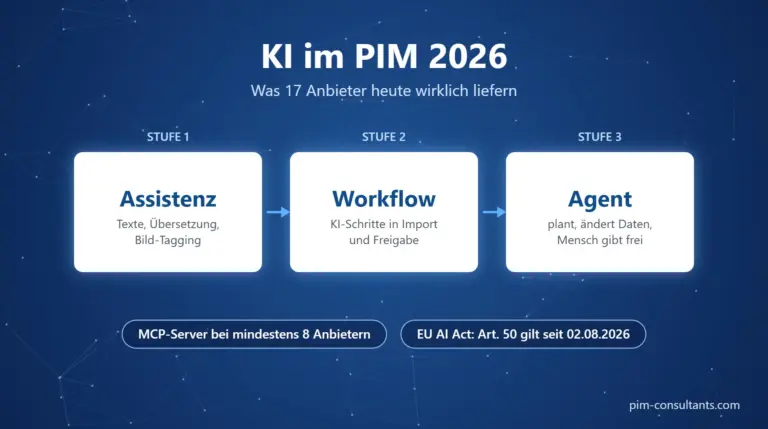
AI in PIM 2026: What vendors actually deliver today
Which AI capabilities PIM vendors actually deliver in 2026: an overview of agents, MCP servers, custom AI models and pricing across 17 vendors, plus obligations under the EU AI Act.
Akeneo Community Edition 2026: Not discontinued, but changing
Has the Akeneo Community Edition been discontinued? No. Support for Akeneo 7 On-Premise and PaaS ended on 30 September 2026. Here are the facts and the five options now available to Enterprise customers.
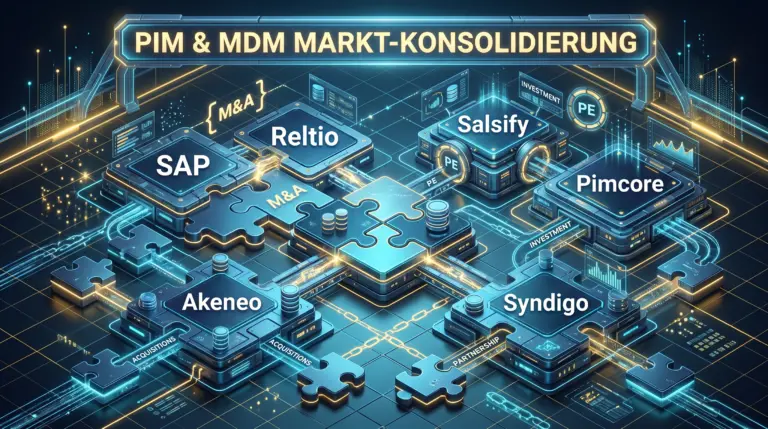
Billion-Dollar Deals, Private Equity and Platform Mergers: The Comprehensive PIM Consolidation Report 2026
Cinven buys Salsify, Tenzing takes over Pimcore, Akeneo acquires PricingHUB: an overview of all PIM deals in 2025/2026, the three patterns behind them and what users should now look out for in their contracts.