- General
PIM and DAM: choose one vendor or separate systems?
Product images, data sheets, certificates and videos are all part of a product’s information. That is why many PIM vendors offer their own DAM module, and some DAM vendors offer their own PIM module. Whether to buy both from one vendor or connect two specialist systems is one of the first decisions in any selection process. This article explains the differences, provides figures from our directories and lists the questions you should address before deciding.
Key takeaways
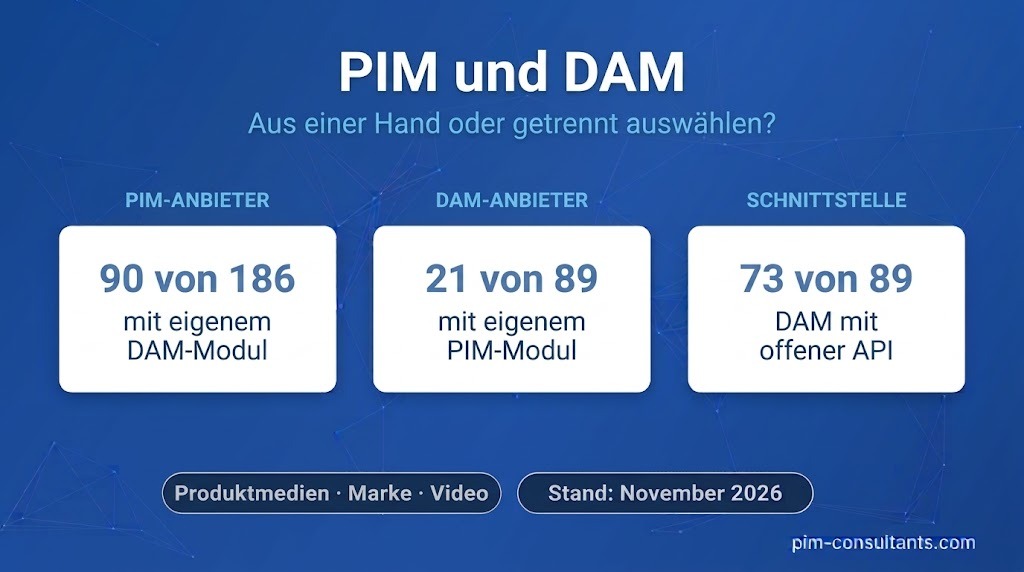
- According to the PIM-Consultants directory, 90 of 186 PIM vendors offer their own DAM module, and 21 of 89 DAM vendors offer their own PIM module (as of November 2026).
- 73 of the 89 DAM vendors list an open API. Ready-made connectors are most commonly available for Akeneo (15 DAM vendors), SAP (11), inriver and Stibo STEP (10 each), Salsify (9), Centric PXM (5) and Pimcore (4).
- A single-vendor solution is a good fit if your assets are primarily product assets and you want one data model, one contract and no interface between PIM and DAM.
- Separate systems are a good fit if marketing, brand teams and agencies manage many assets that are not linked to products, if a DAM is already in place, or if rights management, video and a brand portal are important.
- What matters is not the module’s name, but whether it meets your asset management requirements and how assets are linked to products.
What “one vendor” can mean
- PIM with a DAM module: Assets are stored in the PIM and managed directly within the product record. The functionality is often geared towards product assets.
- DAM with a PIM module: An asset management platform extended to include product data. Strong on assets, but the product data model needs careful evaluation.
- Platform with separately licensed modules: One vendor, one database, with PIM and DAM available individually or together.
One vendor or separate systems: a comparison
| Criterion | One vendor | Separate systems |
|---|---|---|
| Data model | one model, with assets linked directly to products and variants | connected via a connector or API, with mapping based on product numbers or IDs |
| Interfaces | none between PIM and DAM | a connector that needs to be maintained as new versions of either system are released |
| Asset management features | often geared towards product images and documents | full DAM functionality, such as rights and licence management, video, a brand portal and approvals |
| Users | primarily product management and e-commerce | also marketing, brand teams, agencies and sales |
| Contracts and implementation | one contract, one project, often bundled pricing | two contracts and two implementations |
| Vendor dependency | one vendor for both | one system can be changed without replacing the other |
When a single-vendor solution is a good fit
- Your assets are mainly product images, data sheets, certificates and manuals.
- There is no DAM yet, or the existing system is due to be replaced anyway.
- A small team manages product data and assets together.
- Your online shop, marketplaces and retailers source images directly from the PIM.
When separate systems are a better fit
- A DAM is already in place and widely used by marketing.
- Many assets are not linked to products: campaigns, brand imagery, videos and press photos.
- You need rights and licence management, multi-stage approvals, a brand portal or video processing.
- Agencies and partners work directly with the assets.
- You want to be able to replace PIM and DAM independently.
Specialist DAM systems provide broad coverage of these requirements: in the directory, 76 of the 89 DAM vendors list approval workflows, 69 video processing, 60 rights and licence management and 45 a brand portal. When evaluating a DAM module within a PIM, check each of these capabilities individually.
What to consider with separate systems
- Mapping: Assets should be mapped automatically to the correct product and variant, for example using the product number in the filename or metadata.
- Direction and frequency: Which data flows in which direction, in real time or on a schedule?
- Delivery: Does the DAM deliver images in the required formats to your online shop and marketplaces, or does the PIM retrieve and forward them?
- Rights and expiry dates: Are expired usage rights also reflected in the PIM and across your channels?
- Maintenance: Who keeps the connector up to date when new versions are released, and what does it cost?
The DAM vendor overview shows which DAM systems have a ready-made connector for your PIM, for example using the Connector Akeneo or Connector SAP filter. You can find PIM systems with their own DAM module in the PIM vendor overview.
Six questions to guide your decision
- What assets do you manage today, and how many are linked to products?
- Who works with the assets: only product management and e-commerce, or also marketing, agencies and sales?
- Is a DAM already in place, and how satisfied are its users?
- Which asset management features are essential, such as rights management, video, a brand portal or web-to-print?
- Is there a maintained connector for your combination of systems, and who operates it?
- What are the licensing and implementation costs of each option over five years?
Frequently asked questions
Should you buy PIM and DAM from one vendor or select separate systems?
That depends on your assets. If they are mainly product assets and there is no DAM yet, there is a strong case for a single-vendor solution. If marketing and agencies manage many assets that are not linked to products, or a DAM is already in place, two connected systems are often the better choice. In either case, check each asset management capability individually.
How many PIM systems have their own DAM?
According to the PIM-Consultants directory, 90 of 186 PIM vendors offer their own DAM module (as of November 2026). Conversely, 21 of 89 DAM vendors have their own PIM module.
Can a DAM replace a PIM?
Rarely. A DAM manages files and their metadata. Product attributes, variants, classifications and syndication to channels are the responsibility of a PIM. A DAM can cover both only if it has a fully developed PIM module.
Is an open API enough, or do you need a ready-made connector?
A ready-made connector reduces development and maintenance effort. An open API makes integration possible, but the integration still needs to be built and operated. 73 of the 89 DAM vendors in the directory list an open API.
Sources
- PIM-Consultants: PIM vendor directory, Modules filter (as of November 2026)
- PIM-Consultants: DAM vendor directory, Features and PIM Integration filters (as of November 2026)
As of November 2026
Request vendor-neutral advice
Considering whether to source PIM and DAM from a single vendor? Send us a brief description of the digital assets you manage, who works with them and which systems are already in place.
We will get back to you with an initial assessment.
PIM Market Update newsletter
Acquisitions, new vendors and practical tips: by email every six to eight weeks
Concise and vendor-neutral: developments in the PIM market and what they mean for your selection process. Unsubscribe at any time.
More PIM insights
News & Blog

PIM in Corporate Groups: What Matters with Multiple ERP Systems
In large enterprises, product data rarely comes from a single ERP system. Acquisitions, national subsidiaries and production sites bring their own systems, often with different
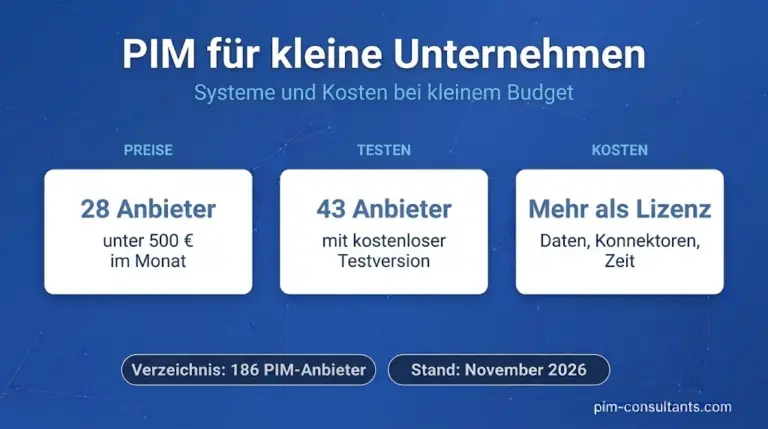
PIM for Small Businesses: Systems and Costs on a Tight Budget
Small businesses rarely need an enterprise PIM, but often need more than a spreadsheet and their online store’s product management features. Once the same product
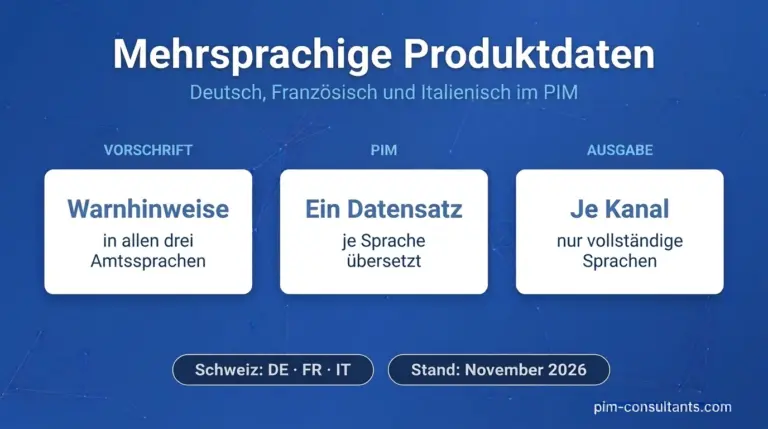
Multilingual product data: German, French and Italian in PIM
Which languages Swiss regulations require for product information, how a PIM handles German, French and Italian, and which questions you should ask vendors.
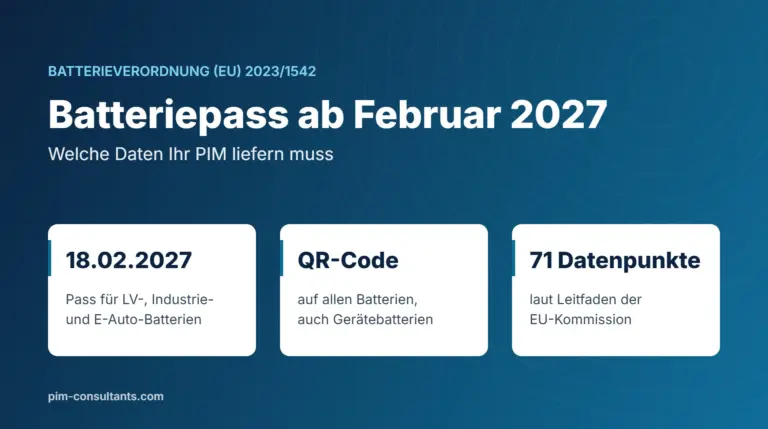
Battery passport from February 2027: What data your PIM must provide
From 18 February 2027, battery passports will be mandatory for LMT, industrial and electric vehicle batteries, with QR codes required on all batteries. Find out which data comes from PIM, ERP and battery management systems.
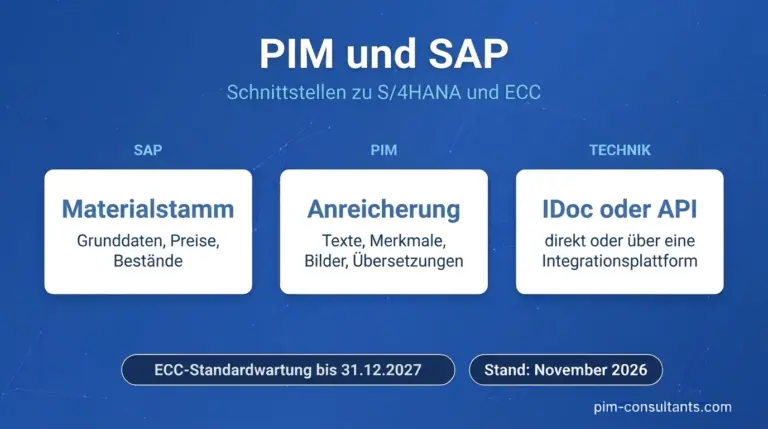
PIM and SAP: interfaces, data ownership and suitable systems 2026
Connecting PIM and SAP: which data belongs where, IDoc or API, ready-made SAP connectors for selected PIM systems, and what the move to S/4HANA means.
PIM Systems Compared 2026: 18 Vendors at a Glance
An independent overview of 18 PIM systems: headquarters, deployment, pricing, target customers and partners, plus data from our directory of 186 vendors.