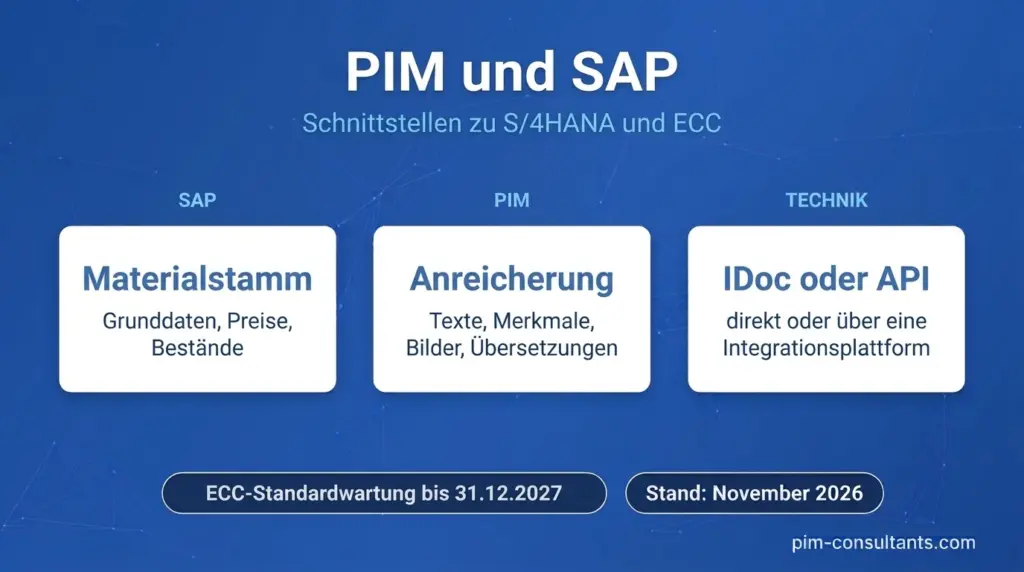
In many manufacturing and retail companies, SAP is the system of record for products: material numbers, units of measure, weights, prices and stock levels originate in the material master. But this data alone is not enough for online stores, marketplaces, dealers and catalogues. Text, attributes, images and translations are maintained in a PIM system. Bringing the two together requires a clear division of responsibilities and a reliable interface. This article explains which data belongs where, how the integration works technically and which PIM systems offer ready-made SAP connectors.
Key takeaways
- SAP remains the system of record for commercial and logistics data, while the PIM handles everything sales channels need to sell products.
- The typical workflow: products are created in SAP, transferred to the PIM, enriched there and distributed to the channels.
- On the technical side, integration uses IDocs, SAP S/4HANA APIs or an integration platform such as SAP Integration Suite.
- Several PIM vendors offer ready-made connectors or templates, including Akeneo, AtroPIM, inriver, Pimcore (through partners) and Stibo Systems.
- Mainstream maintenance for SAP ECC 6.0 (enhancement packages 6 to 8) ends on 31 December 2027, with paid extended maintenance ending in 2030. New interfaces should therefore take S/4HANA into account.
Which data belongs where?
| Data area | Typical system of record | Examples |
|---|
| Basic data | SAP | Material number, description, unit of measure, weight, dimensions, material group |
| Commercial data | SAP | Prices, pricing conditions, stock levels, availability, customs tariff code |
| Sales copy and attributes | PIM | Product descriptions, selling points, technical attributes for channels |
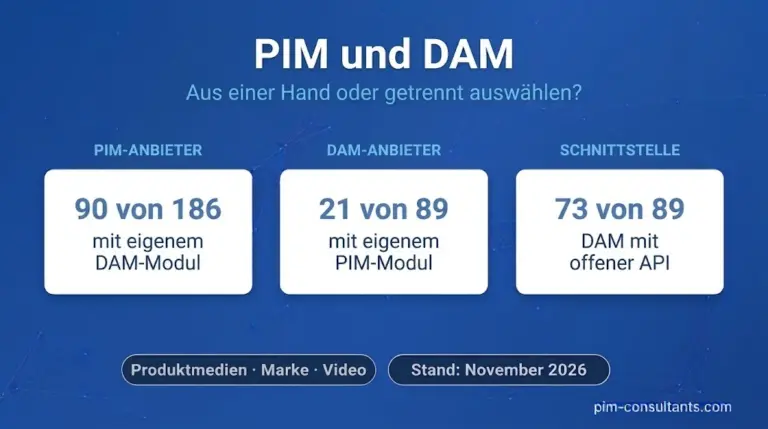
| Media and documents | PIM or DAM | Product images, data sheets, assembly instructions, safety information |
| Translations | PIM | Text and attributes by language and country |
| Classification | PIM, sometimes SAP | ETIM, ECLASS, GS1, channel categories |
| Status and approval | Coordinated between systems | Sales approval in SAP, channel approval in the PIM |
Every field must have exactly one system of record. Maintaining the same field in both SAP and the PIM creates inconsistencies. Define data ownership before selecting a system and document it in your requirements.
How the data flows
- Creation in SAP: The product is created in the material master, usually by purchasing, product management or the master data team.
- Transfer to the PIM: Basic data is sent automatically to the PIM when a product is created and whenever it changes.
- Enrichment in the PIM: Product management and marketing add text, attributes, images and translations. Workflows check that all mandatory information is available for each channel.
- Distribution to channels: The PIM supplies the online store, marketplaces, dealers and catalogue.
- Return flow, if needed: The PIM writes selected fields, such as classifications or short descriptions, back to SAP. Keep this return flow to a minimum.
Technical integration options
- IDocs: SAP’s traditional data exchange format. The MATMAS message type is available for material master data. Stibo Systems, for example, uses IDoc MATMAS 05 for its connector, supporting R/3, ECC and S/4HANA.
- SAP S/4HANA APIs: S/4HANA makes master data available through application programming interfaces (OData). Newer connectors, such as diva-e’s Pimcore connector, use these interfaces.
- Integration platform: SAP Integration Suite, with its Cloud Integration component, runs on the SAP Business Technology Platform (BTP) and acts as an intermediary between SAP and the PIM. Akeneo offers templates for this, diva-e’s Pimcore connector uses Cloud Integration, and inriver has built its connector on SAP BTP.
- General-purpose integration software: Middleware from other vendors can also connect SAP and the PIM. This is worth considering if your company already uses it.
Ready-made SAP connectors for selected PIM systems
The table lists connectors publicly described by the vendors or their partners. It is sorted alphabetically and is not a ranking. Even with a ready-made connector, integration remains a project: mapping fields, defining rules and testing.
| System | SAP integration according to the vendor | Technology |
|---|
| Akeneo | Templates (“Accelerators”) for S/4HANA: material master data from SAP to PIM and back from PIM to SAP | SAP Integration Suite, part of an integration project |
| AtroPIM | Connector for SAP S/4HANA: one-off import, one-way or two-way synchronisation of products, categories, attributes, images and prices | S/4HANA API, pricing on request |
| inriver | SAP-certified connector for S/4HANA Cloud (May 2026): product data from SAP to PIM and on to SAP Commerce Cloud | SAP Business Technology Platform, add-on module in the SAP Store |
| Pimcore | Partner connector from diva-e: material master data, prices, stock levels and orders between S/4HANA and Pimcore | SAP Cloud Integration on SAP BTP, OData; according to diva-e, €500 per month with a three-year term |
| SAP Commerce Cloud | Built-in Product Content Management in SAP’s e-commerce platform | No additional interface required if the online store runs on SAP Commerce |
| Stibo Systems | “SAP Connectivity for Material Master” for R/3, ECC and S/4HANA | IDoc MATMAS 05 |
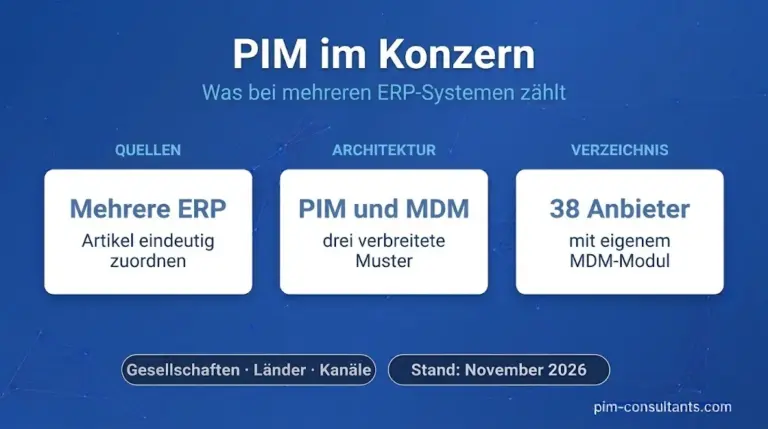
Other vendors connect to SAP through partners or project-specific solutions. Ask specifically for references using your SAP version. If you are considering SAP Master Data Governance as a central master data solution, our comparison SAP MDG vs. Stibo Systems explains how it differs from an MDM system.
ECC or S/4HANA: what migration means for the interface
Mainstream maintenance for SAP ECC 6.0 with enhancement packages 6 to 8 ends on 31 December 2027. Extended maintenance is available at an additional cost until the end of 2030. Many companies are therefore implementing PIM and S/4HANA at the same time or in quick succession. This has implications for the interface:
- A new connection to ECC should be designed to keep working when you move to S/4HANA, for example by using an integration platform rather than direct point-to-point connections.
- The migration is a good opportunity to clean up material master data and move sales copy from SAP to PIM.
- Clarify early on whether your company will run S/4HANA in the cloud or in its own data centre. Not every connector supports both options.
Questions to ask every vendor
- Which SAP versions does the integration support: ECC, S/4HANA on-premises, S/4HANA Cloud?
- Is the connector a standard product from the vendor, a partner product or a project-specific solution?
- Which objects are transferred: material master data, classification, prices, stock levels, orders?
- Are changes transferred immediately or at fixed intervals?
- How are errors reported, and who resolves them?
- Who maintains the integration when new versions of SAP or PIM are released, and what does this cost?
- Are there reference customers with a comparable SAP landscape?
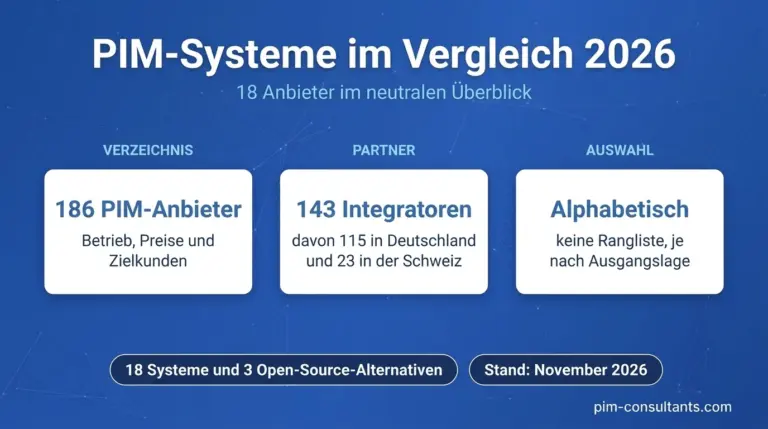
Our overview PIM systems compared shows which other PIM systems might be suitable. You can find experienced partners for your system in our integrator directory.
Frequently asked questions
Do I need PIM if I already have SAP?
If you only need product data for internal processes, SAP is often sufficient. Once online stores, marketplaces, retailers or catalogues require multilingual copy, attributes and images, PIM is usually the better place to manage them. SAP then remains the system of record for basic and commercial data.
Which PIM systems have an SAP interface?
Vendors that describe ready-made integrations or templates include Akeneo, AtroPIM, inriver, Pimcore (through its partner diva-e) and Stibo Systems. SAP Commerce Cloud comes with its own Product Content Management. Even with a ready-made connector, implementation is still a project.
IDoc or API: which is better?
IDocs are tried and tested and supported by both ECC and S/4HANA. S/4HANA APIs and integration platforms such as SAP Integration Suite are more flexible and better suited to cloud scenarios. More recent integrations, such as those from AtroPIM, inriver and Pimcore partner diva-e, use S/4HANA APIs or SAP BTP.
What happens to the PIM interface when migrating to S/4HANA?
That depends on its architecture. If the connection runs through an integration platform, usually only the SAP side needs to be adapted. Direct connections to ECC often need to be rebuilt. You should therefore design the interface to be S/4HANA-ready from the outset.
Which data stays in SAP?
Typically, basic data such as material number, unit of measure and weight, as well as commercial data such as prices and stock levels. Sales copy, channel-specific attributes, images and translations belong in PIM.
Sources
As of November 2026
Have questions? We are happy to advise you.
Planning to implement PIM alongside SAP or migrate to S/4HANA? Get in touch.