- General
Battery passport from February 2027: What data your PIM must provide
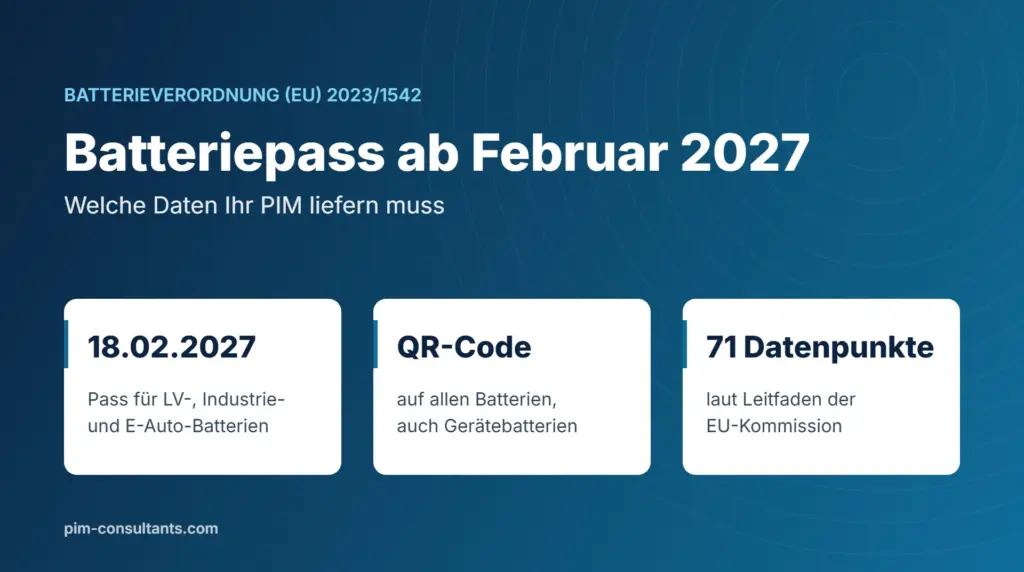
From 18 February 2027, every light means of transport battery, industrial battery over 2 kWh and electric vehicle battery placed on the EU market will need a digital battery passport. On the same day, QR codes will become mandatory on all batteries, including portable batteries. This makes the battery passport the first Digital Product Passport to become mandatory in practice. Much of the information it contains is model-level data that belongs in a PIM system. This article explains what the battery passport contains, who must provide it and which data comes from PIM, ERP and battery management systems. Our guide to the Digital Product Passport explains the broader context.
Key points at a glance
- The legal basis is the Batteries Regulation (EU) 2023/1542. From 18 February 2027, the battery passport applies to light means of transport batteries (LMT batteries), industrial batteries over 2 kWh and electric vehicle batteries (Art. 77(1)).
- From the same date, all batteries must carry a QR code. For the three categories, it links to the battery passport. For all other batteries, it links to labelling, the declaration of conformity and disposal information (Art. 13(6)).
- Responsibility lies with the economic operator placing the battery on the market, meaning the manufacturer or importer (Art. 77(4)).
- The European Commission’s guidance (version 2.0, August 2026) lists 71 data points. Depending on the category, 32 to 49 of these will be mandatory in February 2027, while others apply only in specific cases.
- The passport contains information about both the battery model and the individual battery. Model-level data typically comes from PIM, serial number and production data from ERP or MES, and condition data is supplied continuously by the battery management system.
- Outstanding issues include the rules on access based on legitimate interest, the carbon footprint and recycled content. Supply chain due diligence obligations have been postponed until 18 August 2027.
Who is affected
The Batteries Regulation distinguishes five categories: portable batteries, starting, lighting and ignition batteries, light means of transport batteries, industrial batteries and electric vehicle batteries. Three of these require a battery passport:
| Category | Examples | Battery passport from 18 February 2027 | QR code from 18 February 2027 |
|---|---|---|---|
| Light means of transport (LMT) batteries | E-bikes, e-scooters | Yes | Yes, links to the battery passport |
| Industrial batteries over 2 kWh | Stationary storage systems, industrial trucks, industrial equipment | Yes | Yes, links to the battery passport |
| Electric vehicle batteries | Traction batteries in hybrid and electric cars | Yes | Yes, links to the battery passport |
| Industrial batteries up to 2 kWh, portable batteries | Power tool batteries, batteries in electronic devices | No | Yes, links to labelling, the declaration of conformity and disposal information |
| Starting, lighting and ignition batteries | Lead-acid batteries in vehicles | No | Yes, includes information on recovered raw materials, among other details |
The 2 kWh threshold applies only to industrial batteries. The passport must be provided by whoever places the battery on the EU market or puts it into service. They may authorise other parties, such as a service provider, in writing, but remain responsible for ensuring that the information is accurate, complete and up to date (Art. 77(4)). This affects not only cell manufacturers, but also manufacturers of e-bikes, storage systems, machinery and vehicles that place batteries on the market, as well as importers.
The deadlines
| Date | Requirement | Status as of November 2026 |
|---|---|---|
| 18 August 2025 | Separate collection symbol on all batteries (Art. 13(4)) | In force |
| 16 July 2026 | Implementing Regulation (EU) 2026/1778 on the EU product passport registry; the registry has been operational with a test environment since July 2026 | In force |
| 18 August 2026 or later | General labelling, capacity and durability information (Art. 13(1) to (3)), no later than 18 months after the relevant implementing act | Implementing act not yet adopted |
| 18 February 2027 | Battery passport for LMT batteries, industrial batteries over 2 kWh and electric vehicle batteries (Art. 77) | Confirmed |
| 18 February 2027 | QR code on all batteries (Art. 13(6)) | Confirmed |
| 18 February 2027 | Portable batteries incorporated into products must be removable and replaceable by the end user, and LMT batteries by independent professionals (Art. 11) | Confirmed |
| 18.08.2027 | Supply chain due diligence obligations for companies with net turnover of €40 million or more (Art. 47, 48), postponed by Regulation (EU) 2025/1561 | Confirmed |
| Pending | Carbon footprint declaration (Art. 7), recycled content, access rules for persons with a legitimate interest (Art. 77(9)) | Legal acts are still outstanding; the relevant data points will remain empty in February 2027 |
Industry associations are calling for the battery passport to be postponed. As of early November 2026, no legislative proposal had been put forward. You should therefore plan for 18 February 2027.
What the battery passport contains
The content is specified in Annex XIII of the Batteries Regulation. The European Commission has translated these requirements into 71 data points in its guidance document “Digital Batteries Passport – data points by category” (Version 2.0, dated 15 August 2026). For each category, it states whether a data point is mandatory, optional, required only in certain cases or not yet to be completed in February 2027. An analysis of the guidance identifies 46 mandatory data points for electric vehicle batteries, 49 for LMT batteries and 32 for industrial batteries, plus additional conditional information in each case. The guidance is not binding, but it is the best starting point for your data model.
The information is divided into access levels (Art. 77(2)):
- Public: including manufacturer, battery category, identifier, weight, capacity, chemistry, hazardous substances, performance and durability, as well as take-back and recycling information.
- Persons with a legitimate interest, for example in repair, remanufacturing and recycling: information such as detailed composition, dismantling instructions, safety information and state of health.
- Notified bodies, market surveillance authorities and the Commission: for example, test reports.
An implementing act is intended to define exactly who qualifies as a person with a legitimate interest. It was scheduled for 18 August 2026 and has not yet been adopted.
Technically, the passport must be based on open standards, be machine-readable and allow data exchange without vendor lock-in (Art. 77(5)). It is accessible via a QR code linked to a unique identifier compliant with ISO/IEC 15459 (Art. 77(3)). The economic operator uploads this identifier to the EU product passport registry (Art. 77(10)). If a battery is remanufactured or repurposed, it receives a new passport linked to the old one. The passport ceases to exist after recycling.
Which data comes from the PIM system
The battery passport combines three types of data. The following breakdown is typical, although the specifics depend on your system landscape:
| Information | Level | Typical source |
|---|---|---|
| Manufacturer, authorised representative, brand, battery category, model identifier | Model | PIM |
| Chemistry, hazardous substances, critical raw materials, material composition | Model | PLM or compliance system, consolidated in PIM |
| Rated capacity, voltage, weight, temperature range, expected service life and other performance metrics | Model | Engineering and test reports, maintained in PIM |
| Declaration of conformity, safety information, dismantling instructions | Model, by language | PIM or DAM as version-controlled documents |
| Take-back, collection and recycling | Model, by country | PIM |
| Serial number or batch, place and date of manufacture | Individual battery | ERP or MES |
| State of health, charging cycles, events such as accidents | Individual battery, continuously updated | Battery management system |
| Carbon footprint, recycled content | Model | Life cycle assessment and procurement, once the legal acts are in place |
The PIM system is therefore not the battery passport platform, but the source of most of the static information. The platform that publishes the passport retrieves model data from PIM, individual battery data from ERP or MES and condition data from the battery management system. The same pattern will later apply to product passports for other product groups under the Ecodesign Regulation (EU) 2024/1781.
Six steps to preparing your PIM system for the battery passport
- Determine which products are affected: Flag all items that contain a battery or are themselves batteries, and assign a category and capacity to each battery. This shows you where a passport is required and where only a QR code is needed.
- Create a data model: Map the 71 data points in the Commission guidance as an attribute group, with mandatory status by category and access level by attribute.
- Separate model and individual battery data: Keep model data in the PIM. Define how the identifier for each individual battery from ERP or MES is linked to the model.
- Integrate documents: Maintain version-controlled declarations of conformity, safety information and dismantling instructions in the PIM or DAM for each language.
- Prepare the output: Clarify the format and interface for the battery passport platform, identifier assignment in accordance with ISO/IEC 15459, the QR code and registration in the EU registry.
- Test: Check your data before February 2027. The free BatteryPass-Ready test environment (Fraunhofer IPK, acatech, TU Berlin, GEFEG) checks completeness by battery category, data exchange and registration.
Retailers should also take action: from February 2027, all batteries will carry a QR code, and customers will ask about the linked information. The General Product Safety Regulation also applies to information provided in online retail. See our article on GPSR product data.
Questions for your PIM provider
- Is there a ready-made data model for the battery passport based on the Commission guidance, and who maintains it when new legislation is adopted?
- How do you map access levels for each attribute (public, legitimate interest, authorities)?
- What interfaces are available for battery passport or DPP platforms and the EU registry?
- How do you link model data to individual battery identifiers from ERP or MES?
- How are documents version-controlled to ensure that each passport references the correct version?
Our comparisons for the electrical industry, mechanical engineering, the automotive industry and wholesale show which systems could suit your sector.
Frequently asked questions
When does the battery passport become mandatory?
From 18 February 2027 for all light means of transport batteries, industrial batteries over 2 kWh and electric vehicle batteries placed on the market or put into service in the EU (Article 77(1) of Regulation (EU) 2023/1542).
Do portable batteries need a battery passport?
No. However, from 18 February 2027 they must carry a QR code linking to labelling information, the declaration of conformity and information on take-back and disposal (Article 13(6)).
Who is responsible for the battery passport?
The economic operator placing the battery on the EU market, meaning the manufacturer or importer. They may authorise others in writing, but remain responsible for the accuracy of the information (Article 77(4)).
Which data comes from the PIM?
Primarily model data: manufacturer, category, chemistry, hazardous substances, capacity, weight, performance specifications, documents such as the declaration of conformity and dismantling instructions, and take-back information. Serial numbers come from ERP or MES, while condition data comes from the battery management system.
Will the deadline be postponed?
Not as of November 2026. Only supply chain due diligence obligations have been postponed, to 18 August 2027. Legislation on the CO2 footprint, recycled content and access rules is still pending. These fields will remain blank for now, but the passport requirement still applies.
Note: This article reflects the position as of 3 November 2026 and does not constitute legal advice.
Sources
- Regulation (EU) 2023/1542 (Batteries Regulation), Articles 13 and 77: EUR-Lex
- European Commission: Guidance Document “Digital Batteries Passport: data points by category”, announcement dated 21 August 2026: single-market-economy.ec.europa.eu
- Implementing Regulation (EU) 2026/1778 on the product passport registry: EUR-Lex
- Regulation (EU) 2025/1561 (postponement of due diligence obligations): EUR-Lex
- Haufe: Battery passport from 2027, new test environment now online (24 June 2026): haufe.de
- Rödl & Partner: EU Batteries Regulation, the digital battery passport arrives in February 2027 (12 March 2026): roedl.com
- Arianee: The 71 data points of the EU Battery Passport (analysis of the guidance): arianee.com
- Battery-Tech Network: Status of implementing acts (14 August 2026): battery-tech.net
Request vendor-neutral advice
Want to supply reliable data from your PIM to the battery passport? Send us a brief message outlining your battery categories and systems.
We will get back to you with an initial assessment and a proposal for the next steps.
PIM Market Update newsletter
Acquisitions, new vendors, practical tips: by email every six to eight weeks
Concise and vendor-neutral: what is happening in the PIM market and what it means for your selection process. Unsubscribe at any time.
More PIM insights
News & Blog
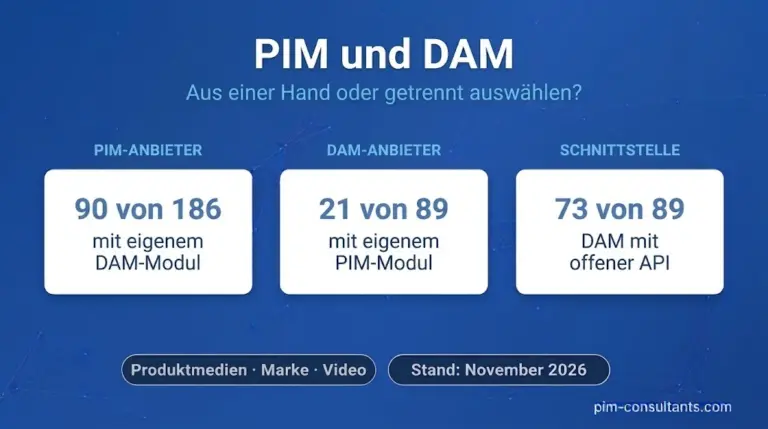
PIM and DAM: choose one vendor or separate systems?
Product images, data sheets, certificates and videos are all part of a product’s information. That is why many PIM vendors offer their own DAM module,
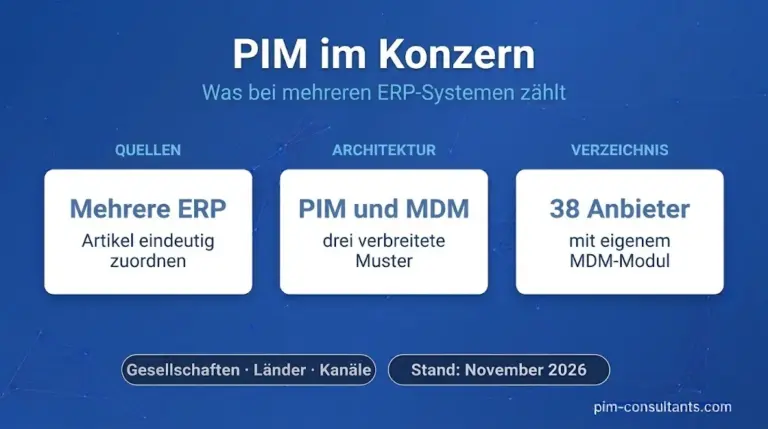
PIM in Corporate Groups: What Matters with Multiple ERP Systems
In large enterprises, product data rarely comes from a single ERP system. Acquisitions, national subsidiaries and production sites bring their own systems, often with different
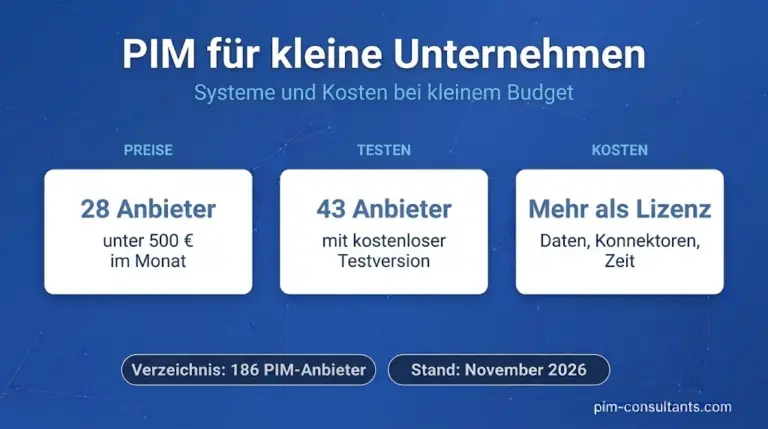
PIM for Small Businesses: Systems and Costs on a Tight Budget
Small businesses rarely need an enterprise PIM, but often need more than a spreadsheet and their online store’s product management features. Once the same product
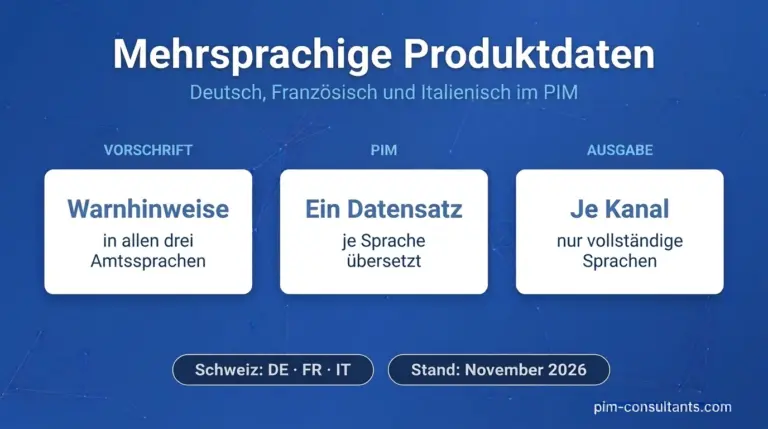
Multilingual product data: German, French and Italian in PIM
Which languages Swiss regulations require for product information, how a PIM handles German, French and Italian, and which questions you should ask vendors.
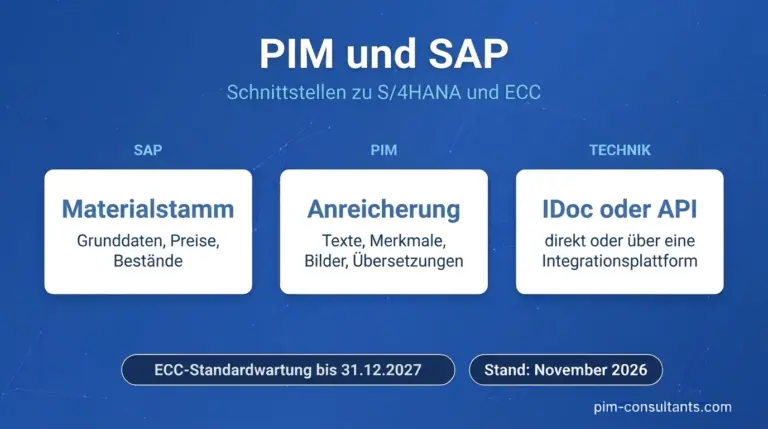
PIM and SAP: interfaces, data ownership and suitable systems 2026
Connecting PIM and SAP: which data belongs where, IDoc or API, ready-made SAP connectors for selected PIM systems, and what the move to S/4HANA means.
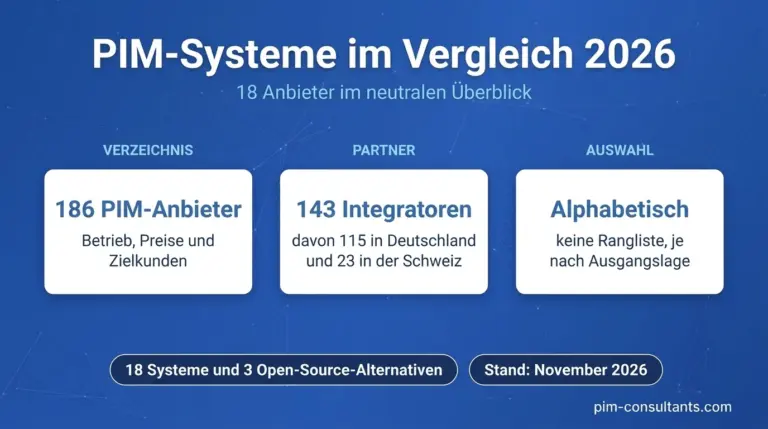
PIM Systems Compared 2026: 18 Vendors at a Glance
An independent overview of 18 PIM systems: headquarters, deployment, pricing, target customers and partners, plus data from our directory of 186 vendors.