If you sell across Switzerland, you need product data in German, French and often Italian too. For some content, the languages are prescribed by law; for other content, customers and marketplaces determine what is needed. A PIM system keeps translations together, shows which language versions are complete and delivers the right version to each channel. This article explains what Swiss regulations require, how a PIM handles multiple languages and which questions you should ask vendors.
At a glance
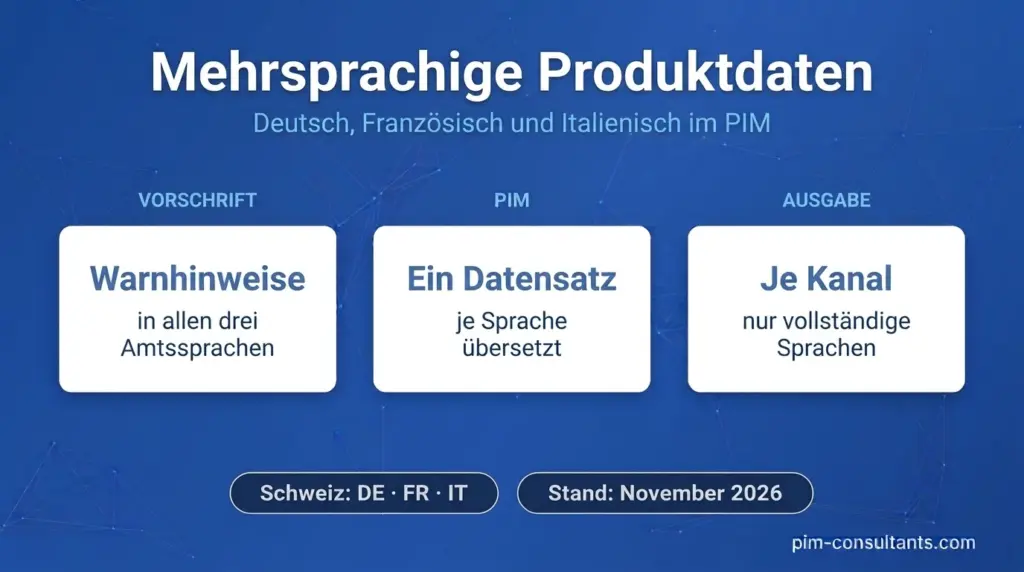
- Under the Swiss Product Safety Ordinance, written warnings and safety information must be available in all three official languages, German, French and Italian, where symbols alone are insufficient (Art. 8 and 11 PrSV).
- Instructions for use must be available in the official language of the region where the product is expected to be used. For medical devices, all three official languages are generally required. For prepacked food, at least one official language is sufficient.
- According to the Federal Statistical Office, 61% of the population speak German as their main language, around 23% French and 8% Italian (2023).
- A PIM separates language-dependent and language-independent fields, shows translation status by language and channel, and blocks incomplete language versions from syndication.
- For the Swiss market, a separate “German (Switzerland)” language variant is worthwhile once you also sell in Germany or Austria: Switzerland uses ss instead of ß.
What Swiss regulations require
The following overview summarises the main language requirements for product information. It is not a substitute for legal advice; additional rules apply to specific product groups.
| Content | Languages | Basis |
|---|
| Written warnings and safety information (products covered by product safety legislation) | All three official languages; symbols may replace text if they provide sufficient information | Art. 8 para. 2 and Art. 11 PrSV |
| Operating, user and maintenance instructions, information brochures | Official language of the region where the product is expected to be used | Art. 8 para. 1 PrSV |
| Labelling and instructions for use for medical devices | Generally all three official languages; exceptions apply, for example to devices intended solely for healthcare professionals | Art. 16 MepV |
| Labelling of prepacked food | At least one official language; exceptionally, another language if the information remains clear | Art. 36 para. 2 LGV |
| Product titles on Galaxus | German is mandatory; French, Italian and English are supported | ChannelEngine guide for Galaxus |
For a PIM, this means that safety information, instructions and data sheets are not simply marketing copy to be translated when needed. They belong in the data model as separate, language-dependent content, with mandatory languages defined for each product group. Businesses shipping from Switzerland to the EU must also meet the language requirements of their destination countries, for example under the General Product Safety Regulation (GPSR). Read more in GPSR: What product data the regulation requires.
Who speaks which language
According to the Federal Statistical Office’s survey on language, religion and culture, German and Swiss German were the main languages of 61% of the population in 2023, French of around 23%, Italian of 8% and Romansh of 0.5%. English was cited by 6%. Respondents could name more than one language. Selling only in German therefore reaches a large share of the market, but leaves out French-speaking Switzerland and Ticino. Romansh plays virtually no role in product data.
How a PIM handles multiple languages
Language-dependent and language-independent fields
Sales copy, a product name or safety information has a separate version for each language. Dimensions, weight, GTIN or material selected from a list, by contrast, are maintained only once and displayed in the relevant language. This distinction determines the maintenance effort: the more attributes are set up as selection lists with translated values, the less free text needs to be translated.
Language, or language and country
Many PIM systems use locales, combinations of language and country such as German (Switzerland) and German (Germany). This is worthwhile if you sell in several countries: Switzerland uses ss instead of ß, and prices, legal text and delivery information differ. A fallback rule, for example from German (Switzerland) to German (Germany), reduces maintenance effort, but must not replace mandatory content.
Completeness by language and channel
A good PIM shows which languages are complete for each product and only syndicates content that is ready for the relevant channel. This prevents a product from appearing in a French-speaking Swiss shop with no French description. For the basics, see Completeness in the PIM Wiki.
Translation workflow
Translation can be handled in-house, by an agency or using AI translation. What matters is the workflow: the PIM flags changes to source texts, sends them for translation, imports the results and routes them for approval. XLIFF is an established format for exchanging content with translation services. A glossary of agreed terms ensures that technical terminology is translated consistently across all channels. For more information, see Localisation and translation management in the PIM Wiki.
Media and documents
Instructions, data sheets and images containing text also have language-specific versions. The PIM or connected DAM must associate files with a language and deliver the correct version for each channel.
Four common mistakes
- Translating in the shop rather than in the PIM. This leaves all other channels without the translated texts, and no one knows which version is authoritative.
- One field for all languages. Text such as “Akku / batterie / batteria” in a single field cannot be reliably syndicated or validated.
- AI translation without approval. Machine translation saves time, but safety information and technical terminology should be checked before publication.
- Using German texts from Germany unchanged in Switzerland. Swiss customers immediately notice ß, euro prices and German legal texts.
Questions to ask PIM vendors
- How many languages and locales are included in the price, and what does each additional one cost?
- Can individual attributes be defined as language-dependent or language-independent?
- Does the system show completeness by language and channel, and can it block incomplete language versions?
- How does the translation workflow handle status tracking, export and import (for example XLIFF), integration with translation services and AI translation with approval?
- Are there fallback rules between locales, and can they be disabled for mandatory content?
- How are documents and images managed and syndicated by language?
These questions belong in the requirements analysis, not just at the implementation stage. Our PIM criteria checklist provides a template. The article PIM in Switzerland explains which systems Swiss integrators support and what else is different in Switzerland.
Conclusion
In Switzerland, multilingual content is not an optional extra but an everyday requirement. Safety information, instructions and medical devices are subject to specific language requirements, while marketplaces and customers in French-speaking Switzerland and Ticino expect French and Italian. The main value of a PIM here is structure: maintain each piece of information once, translate it into each language, check completeness and syndicate it correctly to each channel. Plan your translation workflow from the outset and test it with real examples during PIM selection.
Frequently asked questions
Which languages do I need for product data in Switzerland?
That depends on the product and channel. Under the Product Safety Ordinance, written warnings and safety information must be available in German, French and Italian, while instructions must be in the official language of the region where the product is used. For sales copy, the market determines the requirements: businesses selling nationwide need at least German and French.
Do warnings have to be in three languages?
Yes, if they appear as text: under Art. 8 of the Product Safety Ordinance, written warnings and safety information must be provided in all Swiss official languages. Symbols can replace text if they convey sufficient information.
Is German from Germany sufficient for the Swiss market?
For many texts, yes, but the differences are noticeable: Switzerland uses ss instead of ß, prices are in Swiss francs, and legal texts differ. Businesses selling in both countries should create separate locales in the PIM for German (Switzerland) and German (Germany).
Can AI handle translation?
AI translation significantly speeds up the work. However, safety information, technical terminology and mandatory information should be checked before publication. A PIM with an approval workflow and glossary keeps the process under control.
How does a PIM handle German, French and Italian?
Through language-dependent fields and locales: texts are stored for each language, while attributes such as dimensions are maintained once and displayed in translation. The PIM shows translation status by language and channel and only syndicates complete versions.
Sources
As of: November 2026