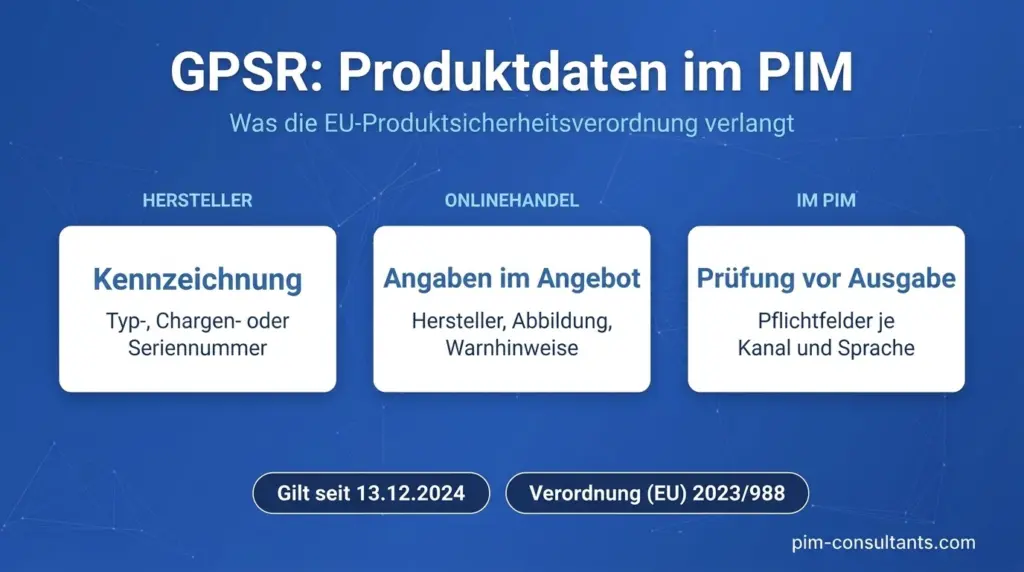
Regulation (EU) 2023/988 on general product safety, known as the GPSR, has applied directly in all EU Member States since 13 December 2024. It requires information on products, in documentation and, in particular, in online listings. Much of this information is product data that belongs in a PIM system. This article explains what data the GPSR requires, who must provide it and how to manage it in PIM. Our wiki article GPSR / General Product Safety Regulation explains the key concepts.
At a glance
- Manufacturers must label products with a type, batch or serial number and provide their name, trade name or trademark, postal address and electronic address (Art. 9).
- Online listings must already include these manufacturer details, product identification including an image, and warnings and safety information (Art. 19).
- Products from manufacturers outside the EU require an economic operator established in the EU (Art. 4).
- Online marketplaces must provide fields for this mandatory information and display it in the product listing (Art. 22).
- For PIM, this means managing economic operators as separate data objects, making identification attributes and safety information mandatory fields for each language, and validating the data before every export.
What information the GPSR requires
| Requirement | Who is responsible | Article | What belongs in PIM |
|---|
| Product identification (type, batch or serial number) | Manufacturer | Art. 9 | Fields for type and item number, a rule for batch or serial numbers |
| Name, trade name or trademark, postal address, electronic address | Manufacturer | Art. 9 | Manufacturer object with address, email or contact form, linked to the item |
| Importer contact details | Importer | Art. 11 | Importer object linked to the item |
| Economic operator in the EU for products from manufacturers outside the EU | Manufacturer, importer, authorised representative or fulfilment service provider | Art. 4 | Responsible person with contact details for each item or brand |
| Instructions for use and safety information in easily understandable language | Manufacturer | Art. 9 | Documents and information by language and version |
| Information in online listings: manufacturer details, product identification including an image, warnings and safety information | Anyone offering products online | Art. 19 | Channel profiles that include these fields as mandatory output |
| Fields for mandatory information on marketplaces | Online marketplaces | Art. 22 | Mapping of mandatory fields for each marketplace |
Distributors must check that manufacturer and importer details and the identification number are present (Art. 12). If they are missing, the product must not be sold. A transitional provision applies to products lawfully placed on the market before 13 December 2024 (Art. 51).
What an online listing must include
Article 19 applies to anyone offering products through distance sales, including online shops, marketplace sellers and B2C catalogues. The listing itself must display:
- the manufacturer’s name, registered trade name or trademark, postal address and electronic address,
- for manufacturers outside the EU, the name and contact details of the responsible person in the EU,
- information identifying the product, including an image, its type and any other identifiers,
- warnings and safety information in the language of the country where the product is offered.
In Germany, safety information must be provided in German. The amended Product Safety Act came into force on 19 February 2026 and sets out language requirements and penalties, among other provisions. Supplementary digital information, for example via a QR code, does not replace the mandatory information.
How to manage GPSR requirements in PIM
- Economic operators as separate objects: Create separate records for manufacturers, importers and responsible persons in the EU, and link them to the relevant brand or item. This allows you to update an address in one place rather than across thousands of items.
- Identification as a mandatory field: A type or item number must be entered for every item. Record whether the product also carries a batch or serial number.
- Safety information by language: Warnings are texts with a language and version, not footnotes in marketing copy. Store them as structured data so that online stores and marketplaces can display them where needed.
- Documents with language and validity information: User manuals and safety data sheets belong in the PIM or connected DAM, along with their language, version and validity period.
- Check product images: Every item offered online needs at least one product image.
- Validation before syndication: Make GPSR fields mandatory for each channel. Items with incomplete information must not be published in the online store or on marketplaces.
- Marketplace mapping: Map your fields to the marketplaces’ GPSR fields so that the information appears in their product listings.
- Traceability: Record which information was sent to which channel and when. This helps with enquiries from market surveillance authorities and with recalls.
What retailers and marketplace sellers should check
- Do your suppliers provide complete manufacturer, importer and product identification details, for example via BMEcat or a supplier portal?
- Are warnings provided in the language of each target country?
- Does your onboarding process identify missing information before items are approved?
- Can you quickly identify all affected items and channels in the event of a recall?
What applies to Swiss companies?
The GPSR is EU law and does not apply in Switzerland. However, companies selling from Switzerland into the EU must comply with it. Since Switzerland is not an EU member, these products require an economic operator established in the EU, whose details must also appear in the online offer. Read more about Swiss-specific requirements in our article PIM in Switzerland.
Frequently asked questions
When did the GPSR start to apply?
It has applied directly in all EU member states since 13 December 2024. In Germany, the amended Product Safety Act entered into force on 19 February 2026.
What information must an online store display?
The manufacturer’s name, trade name or trademark, postal and electronic address; for manufacturers outside the EU, the responsible person in the EU; product identification details, including an image; and warnings and safety information in the local language (Art. 19).
Does the GPSR also apply to B2B business?
The GPSR covers consumer products. This includes products intended primarily for commercial use but which consumers may use under reasonably foreseeable conditions. Review your product range with this in mind. If in doubt, contact your chamber of commerce or seek legal advice.
Do I need a PIM system for GPSR compliance?
Not necessarily. However, if you have many items, multiple languages and several channels, a PIM system is the simplest way to maintain consistent information, validate it before syndication and deliver it to your online store and marketplaces.
What about products sold before December 2024?
Products placed on the market before 13 December 2024 in accordance with the legislation in force at the time may continue to be sold (Art. 51). The new rules apply to new goods.
This article provides an overview and is not a substitute for legal advice.
Sources
Last updated: November 2026
Have any questions? We are happy to advise you.
Want to check whether your PIM system captures all GPSR information and delivers it to every channel? Get in touch.