For Swiss manufacturers and retailers, the same basic principles apply to PIM selection as in Germany or Austria. However, some factors carry more weight in Switzerland: product data in several national languages, Swiss marketplaces such as Galaxus, Swiss ERP systems and local regulations. This article outlines what to look for, which systems Swiss partners support and how much an implementation costs.
Key points at a glance
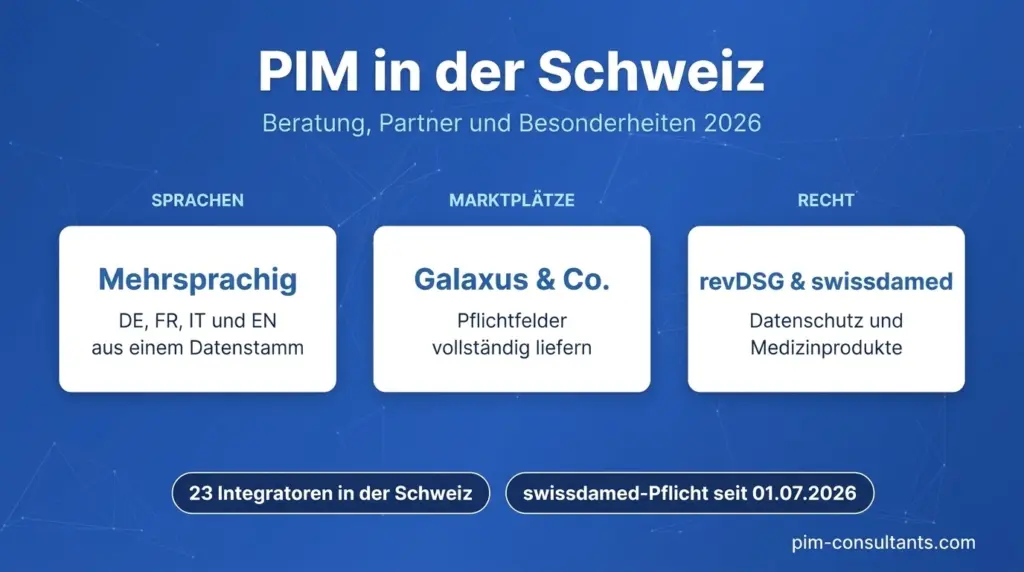
- Companies selling nationwide need to maintain product copy in at least German and French, and often Italian too. The PIM must properly support languages, translation status and translation workflows.
- Galaxus requires, among other things, a brand, GTIN, weight, a main image on a white background and a German product title. Text in French, Italian and English is also supported.
- The revised Data Protection Act has been in force since 1 September 2023. Registration in swissdamed has been mandatory for medical devices since 1 July 2026.
- According to the PIM-Consultants directory, there are 23 PIM integrators in Switzerland (as of November 2026). The systems they support most frequently are Akeneo, Pimcore and Viamedici. The number of partners says nothing about a system’s suitability for your business.
- Based in Pfäffikon SZ, PIM-Consultants provides vendor-neutral advice, from requirements analysis through to contract negotiations.
What is different in Switzerland
Multilingual product data
Switzerland has four national languages. Companies selling across all regions need product copy, attributes, documents and safety information in several languages. A PIM should therefore:
- separate language-dependent and language-independent fields (a unit of measurement is not translated, but sales copy is),
- show translation status for each item and language, and block syndication for languages with incomplete content,
- send content to agencies, internal teams or AI translation services and import the translations back into the system,
- define which languages are syndicated to each channel.
Multilingual content requires ongoing work, not just during implementation. Plan for translation costs and approval processes from the outset.
Marketplaces: Galaxus and others
Many retailers and brands sell through the Digitec Galaxus merchant programme. Galaxus now also operates its marketplace in Germany. According to the guide provided by connector vendor ChannelEngine, Galaxus requires at least the following for each product:
- brand name (up to 100 characters),
- GTIN, for example an EAN,
- weight in grams,
- a main image: front view on a white background, at least 600 pixels on the longest side, without logos or watermarks,
- a product title in German (up to 100 characters, without the brand, category or promotional copy).
Titles and descriptions in French, Italian and English are also supported, with descriptions of up to 4,000 characters without HTML. According to ChannelEngine, product data is transferred via (S)FTP; each offer also requires a price, VAT rate and stock level. A PIM makes this easier if it validates these mandatory fields, provides images in the required format and syndicates data directly or through a feed management tool.
ERP integration
Alongside SAP and Microsoft Dynamics, Switzerland has its own ERP systems, such as Abacus, Proffix and bexio. Ask early on whether a ready-made connector exists between your ERP and the PIM, or whether integration requires middleware or custom development. Also define which system is the master for each field: prices and stock levels usually remain in the ERP, while copy, attributes and images are held in the PIM.
Data protection and hosting
The fully revised Data Protection Act (DSG) has been in force since 1 September 2023. A PIM primarily contains product data. Personal data is involved wherever users, suppliers or customers have access, for example in supplier portals or approval workflows. For SaaS solutions, clarify where the data is stored, which subprocessors are involved and how the provider handles cross-border data transfers.
Industry-specific regulations
- Medical devices: Since 1 July 2026, manufacturers and their authorised representatives have been required to register products in the swissdamed UDI Devices module before placing them on the Swiss market for the first time. Existing products are generally subject to a transition period until 31 December 2026. From January 2027, Swissmedic will charge fees of CHF 200 for the first UDI-DI and CHF 20 for each additional one, capped at CHF 10,000 per year. Read more in our comparison for medical technology and pharmaceuticals.
- Consumer goods and retail: In 2022, GS1 Switzerland selected Bayard and its Byrd platform as the partner for a new Product Content Hub intended to replace the existing Trustbox solution. If you supply master data to Swiss retailers, check which data pool connections the PIM supports.
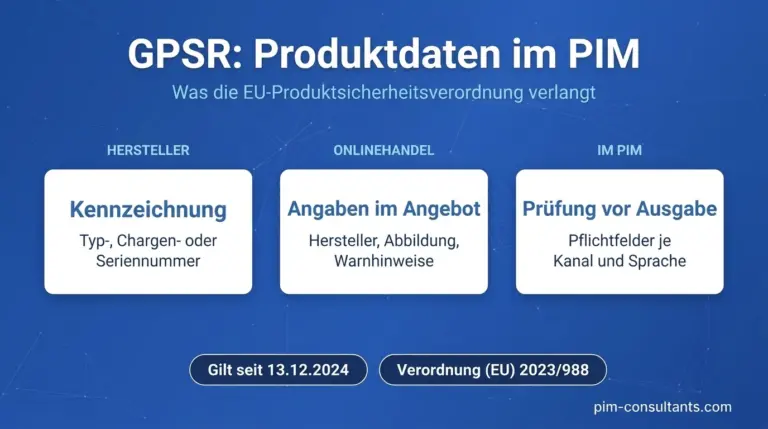
- Exporting to the EU: Companies selling from Switzerland into the EU must comply with EU rules, such as the General Product Safety Regulation (GPSR), which requires specific information in online retail. Our article GPSR: What product data the regulation requires explains what this means for product data.
Which PIM systems Swiss partners support
The following overview shows which systems the integrators listed for Switzerland in our directory report experience with. It is neither a ranking nor a recommendation. You can find all partners in the integrator directory, filtered for Switzerland.
| System | Partners for Switzerland (according to the directory) |
|---|
| Akeneo | Arcmedia, brix Solutions, Jakala, Numendo, Unic |
| Pimcore | bbv Software Services, CODATA, DACHCOM, PIT Solutions |
| Viamedici | Advellence, foryouandyourcustomers, proaxia |
| Stibo Systems | arhis, foryouandyourcustomers |
| ATAMYA | aclevion, Media Motion |
| Centric PXM | aclevion, Numendo |
| SAP Commerce Cloud | PIT Solutions, Unic |
| SCAYLE | Jung von Matt TECH, nexum |
| Other PIM systems (one partner each) | 4ALLPORTAL (click it), censhare (aclevion), Crystallize (S’NCE Group), novomind iPIM (brix Solutions), OpenDXP (DACHCOM), pirobase and Syndigo (Advellence), Quable (Numendo) |
| MDM systems | Ataccama ONE (arhis, synvert), Profisee (Advellence, pmOne), CluedIn (PwC Schweiz) |
As of November 2026, based on information from vendors’ and integrators’ partner pages.
What PIM implementation costs
The indicative figures on our PIM implementation and costs page also apply to Swiss projects: for larger mid-sized businesses, PIM software costs around €100,000 to €250,000 depending on the category, while enterprise systems cost approximately €500,000. Implementation typically adds €150,000 to €250,000, and the first channel usually goes live after six to twelve months. For smaller product ranges, SaaS systems are available for under €500 per month.
In addition to the usual costs, Swiss projects should budget for translations for each language, connections to marketplaces such as Galaxus, Swiss ERP systems and, where needed, data pools.
PIM selection with PIM-Consultants in Switzerland
PIM-Consultants is a service provided by Digitize! GmbH, based in Pfäffikon SZ. We provide Swiss companies with vendor-neutral support in selecting, implementing and operating PIM systems. PIM selection follows six steps: setting priorities, requirements analysis, market overview, software evaluation, proposal comparison and negotiation. It usually takes two to three months.
- For an initial overview: the PIM-Finder with all profiles.
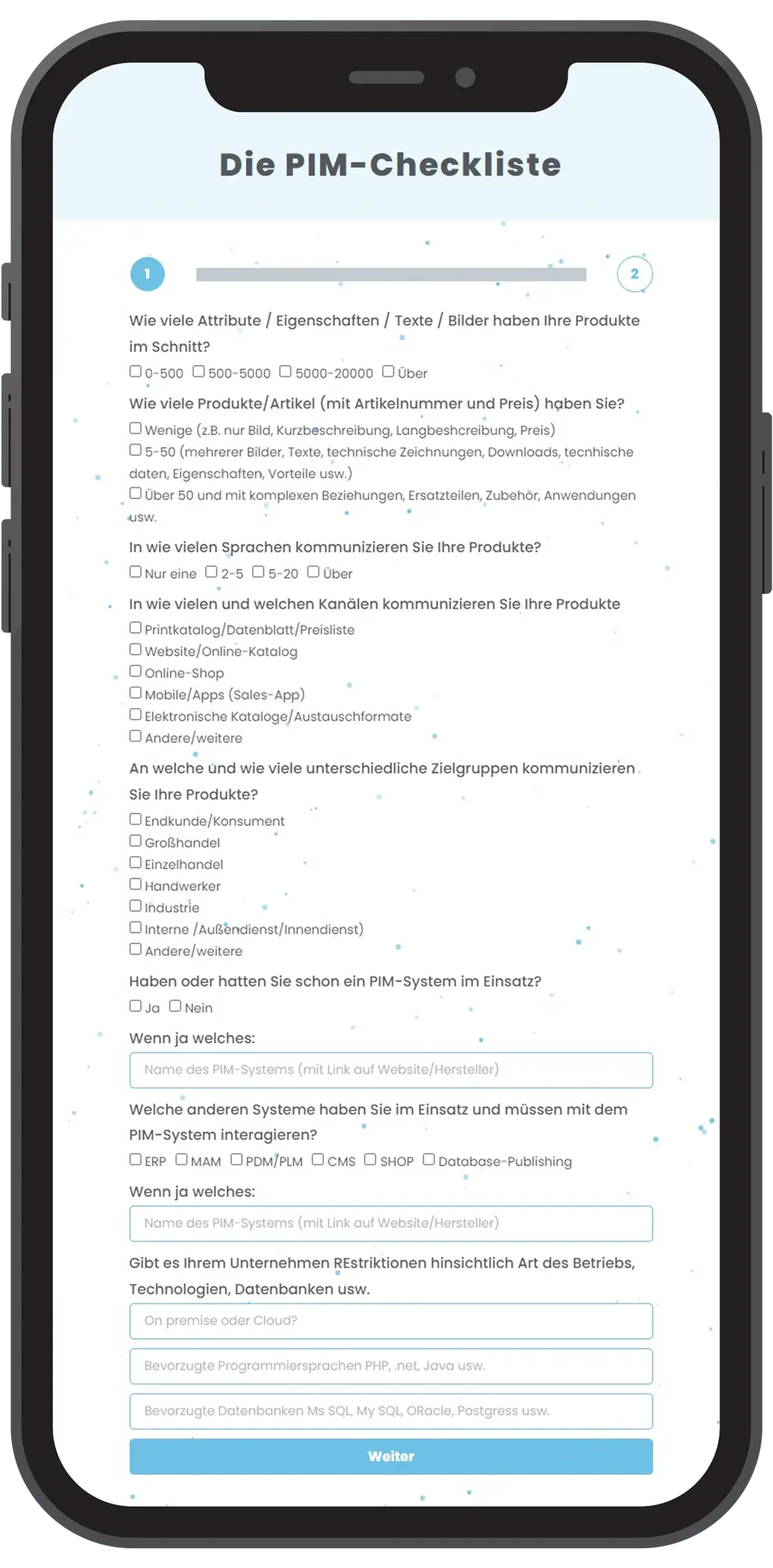
- To create your own shortlist: the free criteria checklist for SMEs with 46 assessment questions in 14 groups.
- For your project: a free, no-obligation initial consultation via our contact page.
Frequently asked questions
Which PIM system is suitable for Swiss SMEs?
That depends on your product range, languages, channels and ERP, not the system’s country of origin. Lightweight SaaS systems are an option for smaller product ranges, while more flexible platforms are generally better suited to technical products or ranges with many variants. Above all, check multilingual capabilities, connectivity to your ERP and marketplaces such as Galaxus, and whether there is an implementation partner near you.
What does a PIM system cost in Switzerland?
For larger mid-sized businesses, the combined cost of software and implementation is usually in the mid-six-figure range (in euros). For small product ranges, SaaS options are available for under €500 per month. Swiss projects involve additional costs for translations and Switzerland-specific integrations.
How does a PIM handle German, French and Italian?
Through language-specific fields: each text is stored in each language, while attributes such as dimensions or materials are maintained once and displayed in translation. A good PIM shows translation status, prevents publication in languages with incomplete content and passes texts to translation services or AI translation tools.
Do I need a PIM for Galaxus?
Not necessarily. However, once you have several hundred items or multiple channels, a PIM helps you supply complete, consistent data for Galaxus’s mandatory fields (including brand, GTIN, weight, main image and German title), rather than maintaining them manually for each channel.
Are there independent PIM consultants in Switzerland?
Yes. Based in Pfäffikon SZ, PIM-Consultants provides vendor-neutral advice on selection, implementation and operation. You can find implementation partners for individual systems in the integrator directory.
Sources
As of November 2026
Have questions? We’re happy to advise you.
Planning a PIM project in Switzerland and want to know which systems suit your languages, channels and ERP? Get in touch.