Austrian manufacturers and retailers generally sell across Germany, Austria and Switzerland and comply with the same EU rules as companies in Germany. Some aspects are specific to Austria, however: master data exchange with retailers via GS1 Sync, packaging licensing, the Austrian Accessibility Act and Austrian food terminology. This article explains what this means for a PIM system, which providers and integrators operate in Austria and how to approach selection.
Key takeaways
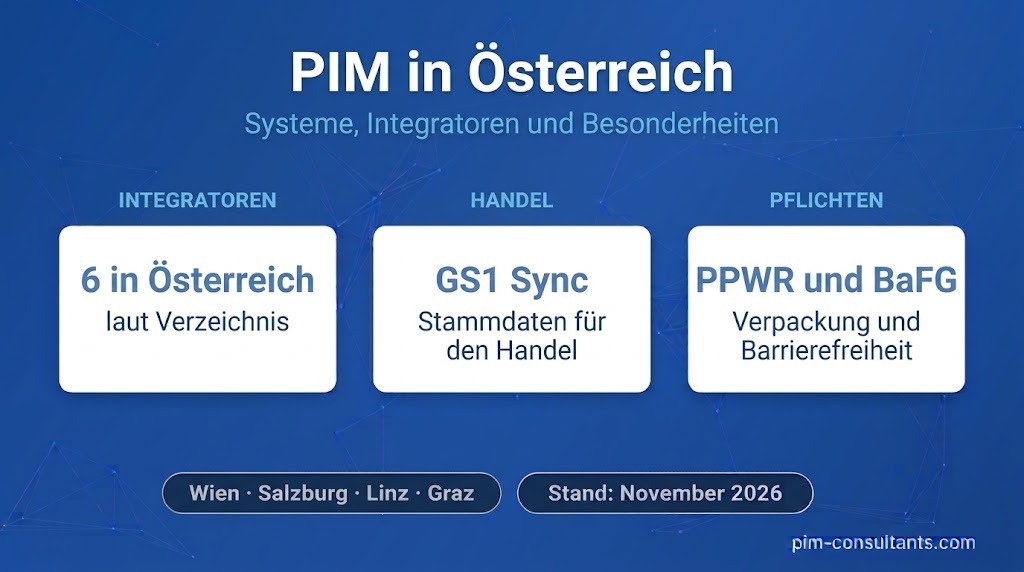
- According to the PIM-Consultants directory, 6 of the 143 integrators operate in Austria. Of these, 4 implement Pimcore, while Akeneo, Viamedici and Profisee are also represented (as of November 2026).
- Austria is home to PIM providers including Pimcore (Salzburg), Paradine and Productbay (both Vienna), as well as DAM providers CELUM and Agravity (both Linz).
- In grocery and health and beauty retail, item master data is often exchanged via GS1 Sync, the master data pool operated by GS1 Austria. REWE expects data via GS1 Sync, the RIAG item master data portal or GDSN.
- Since 28 June 2025, the Austrian Accessibility Act (BaFG) has applied to online shops selling to consumers. Product images therefore need meaningful alternative text.
- The EU Packaging and Packaging Waste Regulation (PPWR) has applied since 12 August 2026. For now, the obligation to participate in a collection and recovery scheme in Austria remains unchanged.
What is different in Austria
Master data for retailers: GS1 Sync
GS1 Austria operates GS1 Sync, a dedicated master data pool for the Austrian market that forms part of the global GDSN network. Suppliers maintain their item data once, and retailers use it, including for their online shops. This includes mandatory information such as ingredients and allergens, hazard statements, quality labels, marketing copy and product images. According to GS1 Austria, INTERSPAR.at is one of more than 45 data recipients. REWE expects master data via GS1 Sync, the RIAG item master data portal or GDSN and only accepts data that has passed its own quality checks.
For your PIM system, this means it should support the attributes of the GS1 data model and deliver data to GS1 Sync or another GDSN data pool, either directly or via a connector. Ask providers about proven integrations and reference customers that use them to supply data to Austrian retailers.
Language: German with Austrian terminology
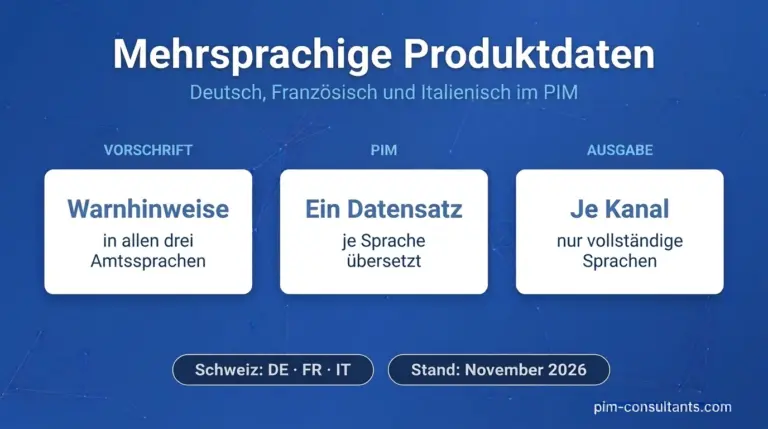
Many companies use the same copy for Austria as for Germany. In the food sector, a separate “German (Austria)” language variant is worthwhile: Protocol No. 10 to the EU Accession Treaty gives 23 Austrian food terms, such as Erdäpfel, Paradeiser, Topfen and Marillen, the same status as their equivalents commonly used in Germany. Unlike Switzerland, Austria uses the letter ß. In the PIM system, shared copy should be maintained once, with only differing terms overridden for each language variant. For more on this, see Multilingual product data.
Packaging: PPWR and licensing
The EU Packaging and Packaging Waste Regulation has applied directly since 12 August 2026. According to a factsheet issued by the responsible federal ministry, the Waste Management Act 2002 and the Packaging Ordinance 2014 remain applicable insofar as they are compatible with the PPWR. The obligation to participate in a collection and recovery scheme remains unchanged for now; since 1 October 2026, it has also applied to coffee capsules and tea bags. Packaging manufacturers need an EU declaration of conformity with technical documentation.
For your PIM system, this means packaging should be maintained as separate objects with components, materials and weights, so that licensing, compliance documentation and labelling all draw on the same data. The article PPWR in PIM shows what this kind of data model looks like.
Accessibility in online shops
The Austrian Accessibility Act (BaFG) has applied since 28 June 2025. It covers online shops selling to consumers; B2B-only offerings are generally outside its scope. The exemption for microenterprises (fewer than 10 employees and annual turnover or a balance sheet total of no more than €2 million) applies only to services, not to product manufacturers. The technical benchmark is EN 301 549, which references WCAG 2.1 Level AA.
For your PIM system, this means maintaining alternative text for product images in separate, translatable fields and providing important product information as text, not just within images.
ERP integration
Alongside SAP and Microsoft Dynamics, Austrian companies also use local ERP solutions such as BMD or mesonic WinLine. Check early on whether a ready-made connector is available for your ERP or whether a custom interface is needed. This has a greater impact on project effort and partner selection than most features.
Vendors and integrators in Austria
According to the PIM-Consultants directory, these integrators operate in Austria (as of November 2026):
Vendors based in Austria include:
- PIM: Pimcore from Salzburg (a platform for PIM, MDM and DAM), Paradine eptos from Vienna (product master data) and Productbay from Vienna (AI-powered PIM and DAM for retailers).
- DAM: CELUM and Agravity from Linz, M@RS by mediamid and STOCKITO from Vienna.
These listings are not recommendations. PIM-Consultants has no partnerships with vendors or integrators. If you are considering integrators from Germany, ask about references in Austria and on-site meetings. You can find all integrators in the integrator directory and all systems in the PIM vendor overview.
Which PIM systems are right for Austrian companies?
There is no specifically “Austrian” PIM. The right system depends on your product range, channels, system landscape and company size. For Austria, you should also check:
- Connectivity to GS1 Sync or another GDSN data pool if you supply grocery or drugstore retailers,
- Language variants with inheritance, such as German (Austria), German (Germany) and German (Switzerland),
- Packaging data as a separate data model for PPWR and packaging licensing,
- Fields for alternative text and accessible product information,
- A connector for your ERP and an experienced integrator with references in Austria.
The article PIM systems compared 2026 provides an independent overview of 18 widely used systems, including headquarters, deployment options, indicative pricing and target customers. For smaller budgets, see PIM for small businesses; for multiple legal entities and ERP systems, see PIM for corporate groups.
What PIM implementation costs
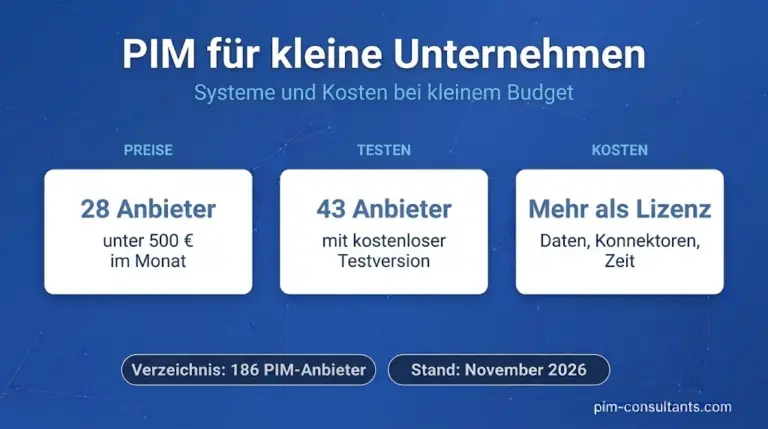
Costs are broadly in line with Germany: depending on the category, software costs range from around €100,000 (entry-level) to €500,000 (enterprise), while implementation for mid-sized companies typically costs €150,000 to €250,000. SaaS plans for small product ranges start below €500 per month. For details, see PIM implementation and costs.
PIM consulting with an office in Vienna
PIM-Consultants is a service provided by Digitize! GmbH, headquartered in Pfäffikon SZ with an office in Vienna (Görgengasse 26/3/4, 1190 Vienna). We focus on vendor-neutral PIM selection and PIM consulting, including assessing whether an existing PIM is configured correctly and still meets your requirements. PIM selection follows six steps and generally takes two to three months.
Frequently asked questions
Which PIM systems are suitable for Austrian manufacturers and retailers?
Your product range, channels and system landscape are the deciding factors, not your country. For Austria, additional considerations include connectivity to GS1 Sync or GDSN, a German (Austria) language variant, packaging data and accessible product information. The PIM-Consultants directory lists 6 integrators operating in Austria, 4 of which implement Pimcore.
Which PIM vendors are based in Austria?
They include Pimcore from Salzburg, as well as Paradine and Productbay from Vienna. In digital asset management, CELUM and Agravity are based in Linz, while mediamid (M@RS) and STOCKITO are based in Vienna.
Do I need a PIM system for GS1 Sync?
Not necessarily. Small product ranges can also be maintained through portals. If you have many products, variants and channels, a PIM connected to GS1 Sync or a GDSN data pool reduces duplicate data maintenance and errors.
Does the Austrian Accessibility Act also apply to B2B online shops?
Generally not: the BaFG covers offerings to consumers. Businesses selling to consumers have been required to make their online shops accessible since 28 June 2025. The exemption for microenterprises applies only to services.
Are there independent PIM consultants in Austria?
Yes. PIM-Consultants provides vendor-neutral advice on PIM selection and other PIM consulting services, has an office in Vienna and has no partnerships with vendors or integrators.
Sources
Last updated: November 2026. This article is not a substitute for legal advice.