- PIM comparisons
PIM for Food and Beverages: Providers Compared for 2026
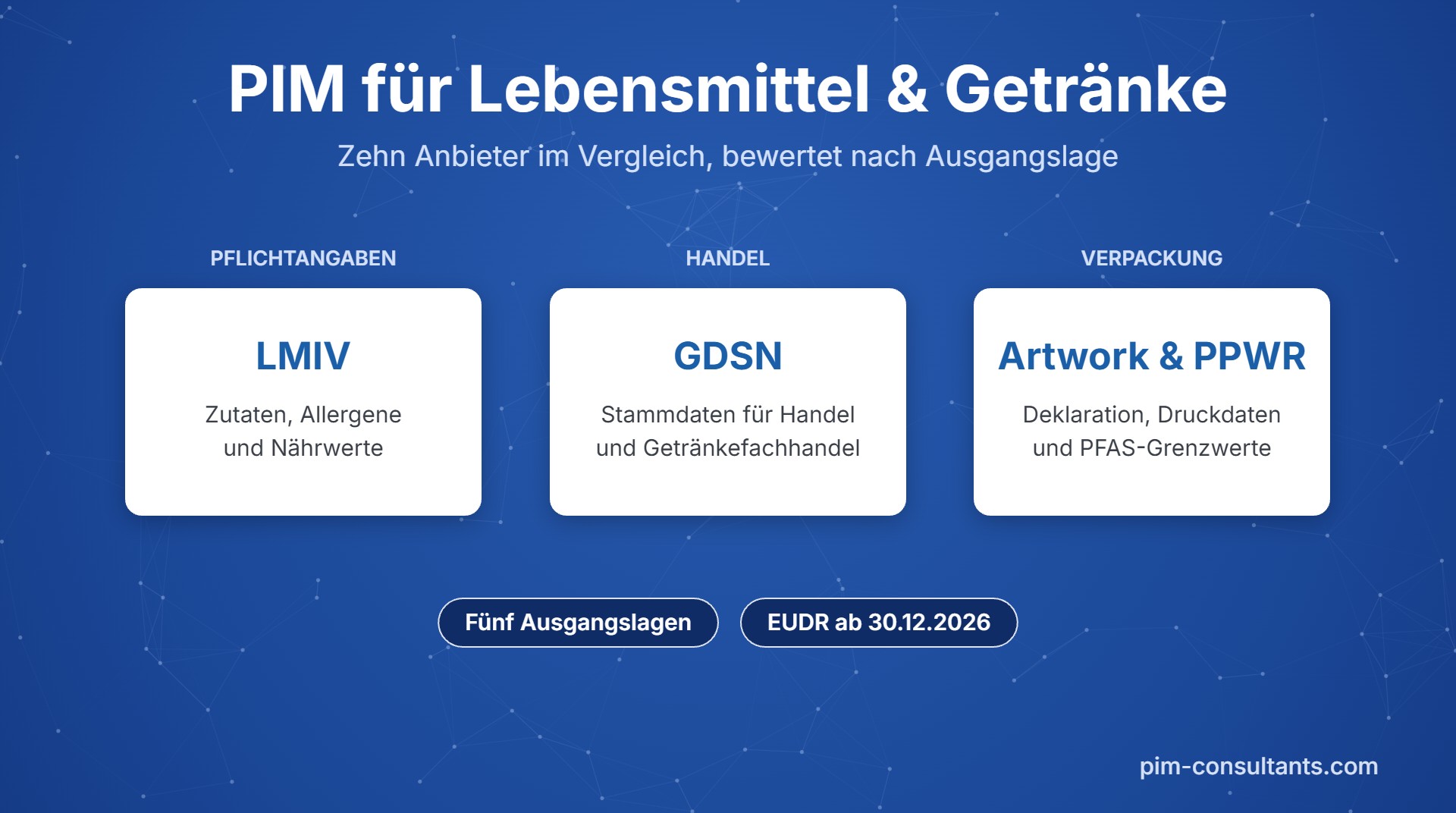
In brief: In the food and beverage industry, the right PIM depends on your starting point, not the provider’s name. Suppliers to grocery retailers need complete mandatory information under the Food Information to Consumers Regulation (FIC) and clean master data in GDSN. In 2026 and 2027, PFAS limits for food packaging, stricter rules on environmental claims and the EU Deforestation Regulation add further requirements. We assessed ten providers against seven requirements: mandatory information, recipes and specifications, GDSN and retail master data, packaging and artwork, sustainability and origin, beverage-specific requirements, and the digital shelf and 2D codes. These translate into five typical business scenarios: brand manufacturers supplying grocery retailers; manufacturers with recipe and packaging processes; the beverage and wine industry; direct sales and e-commerce; and corporate groups with a global master data strategy. Our assessment following the comparison shows which solution suits each scenario.
What a PIM for food and beverages needs to do
- Mandatory information under FIC: Food name, ingredients list, allergens, ingredient quantities, net quantity, food business operator, origin (where required), alcohol content from 1.2% ABV and the nutrition declaration must be available as structured data for each product and language. In e-commerce, this information must be available before checkout; only the best-before or use-by date can be provided at delivery (Art. 14 FIC).
- Recipes and specifications: Ingredient, allergen and nutritional data originate in product development and quality assurance. When a recipe changes, labels, online shops and retail data must be updated at the same time, and the modified product must be clearly identifiable. The PIM therefore needs reliable integration with specification or PLM systems and version control for labelling information.
- GDSN and retail master data: Grocery retailers require master data compliant with GS1 standards through GDSN, including the logistics hierarchy from the consumer unit to the pallet. GS1 Germany provides a mapping of mandatory FIC information to GDSN attributes. The PIM must connect to a data pool, such as 1WorldSync (which has included atrify since May 2023), BYRD by BAYARD or Syndigo.
- Packaging and artwork: Labelling text, logos, dielines and print files belong in an approval process involving marketing, quality assurance and the printer. Since 12 August 2026, PFAS limits for food packaging have applied under the Packaging Regulation (EU) 2025/40; the new labelling requirements for packaging materials are expected to follow in 2029.
- Sustainability, origin and claims: Since 27 September 2026, generic environmental claims such as “climate-neutral” have required evidence in Germany, and sustainability labels have required a recognised certification scheme. From 30 December 2026, the Deforestation Regulation (EUDR) requires due diligence statements for products including cocoa, coffee, palm oil, soya and cattle. The PIM should be able to maintain claims, labels and supporting evidence for each product and store references to the statements.
- Beverage-specific requirements: Since 8 December 2023, wines have required an ingredients list and a nutrition declaration. Both may be provided online via a QR code, while the energy value and allergens must remain on the label. In Germany, specialist beverage wholesalers frequently obtain master data through GEDAT’s getITEM. Container formats, crates and returnable packaging add further requirements.
- Digital shelf and 2D codes: Online retailers and marketplaces require images, copy and nutritional information in their own formats. By the end of 2027, point-of-sale systems are expected to be able to read GS1-compliant 2D codes. Through GS1 Digital Link, the same code leads to product information online. The PIM supplies the content the code links to.
Deadlines affecting food and beverage product data
Several regulations take effect between 2026 and 2029. Each requires information to be maintained and approved for every product, then delivered to labels, online shops and retailers at the same time.
| Date | Regulation | What it means for product data |
|---|---|---|
| since 13 December 2014 | Food Information to Consumers Regulation (EU) 1169/2011 | Mandatory information on labels and in distance selling before checkout; nutrition declaration mandatory since 13 December 2016. |
| since 8 December 2023 | Wine: ingredients and nutritional information | Ingredients list and nutrition declaration for wines produced from this date; electronic labels via QR code permitted, without advertising or collection of user data. |
| 12 August 2026 | Packaging Regulation (EU) 2025/40 (PPWR) | Regulation applies; PFAS limits for food packaging and a limit for heavy metals. Supporting evidence forms part of the technical documentation. |
| 27.09.2026 | Amendment to the German Act Against Unfair Competition (UWG) implementing Directive (EU) 2024/825 | Generic environmental claims require evidence, labels require certification, and climate neutrality claims based on offsetting are prohibited. |
| 30.12.2026 | Deforestation Regulation (EU) 2023/1115, amended by (EU) 2025/2650 | Applies to medium-sized and large companies; due diligence statements required for cocoa, coffee, palm oil, soy and cattle, among others. Downstream companies collect the reference numbers. |
| 30.06.2027 | Deforestation Regulation | Also applies to micro and small enterprises. |
| End of 2027 | GS1: 2D codes at checkout | Checkout systems are expected to read GS1-compliant 2D codes; during the transition, products carry both a barcode and a 2D code. |
| Expected in 2029 | PPWR: harmonised labelling | Information on material composition on packaging; implementing acts are still pending (read more). |
PIM vendors for food and beverages compared
Vendors are listed alphabetically, not ranked. We have included only vendors with public customer references in food or beverages. Features are based on vendor information; references are included only where publicly documented.
| Vendor | Focus | Strengths in food and beverages | References (publicly documented) | Best suited to |
|---|---|---|---|---|
| Akeneo (Nantes, Düsseldorf office) | SaaS PIM focused on channels and product experience | Dedicated Food & Beverage industry page; KoRo consolidated four tools into one platform, with implementation in seven months without an external partner; Wein Wolf improved data quality from below 30% to 97% and launched an online shop in twelve months | KoRo (Berlin), Wein Wolf (wine and spirits) | Brands and retailers with online and retail operations that prefer SaaS |
| BYRD by BAYARD (Cologne, Markant Group) | Product content platform with its own GDSN data pool, b-synced | Master data and product content for retailers via GDSN; Danone DACH consolidated its data delivery to retailers into a single process in less than three months; retailers such as Aldi Süd, Colruyt and Denner use BYRD | Danone DACH, Radeberger Gruppe, Amecke | Branded manufacturers primarily supplying GDSN data to grocery retailers |
| dataroom by datagraphis (Wiesbaden) | PIM, media asset management and workflow management | Packaging and labelling workflows involving marketing, quality assurance and print suppliers; Dr. Oetker had 4,200 workflows, 3,570 products, 2,500 labelling declarations and 9,000 packaging variants after around 18 months; Wernsing manages food information data under the EU Food Information to Consumers Regulation (LMIV) for 15 brands | Dr. Oetker, Wernsing Feinkost, Fuchs Gruppe, SALOMON FoodWorld | Manufacturers focused on packaging development and labelling |
| Equadis (Carouge, Switzerland) | Product data platform focused on GS1 standards and retail data | Completeness checks against GS1 standards, bulk updates and delivery to retail partners, product listings and tenders; around 1,000 GTINs at Panzani, working together since 2004 | Panzani, La Martiniquaise-Bardinet, La Molisana | Manufacturers focused on retail and foodservice listings |
| inriver (Malmö) | PIM focused on product experience and catalogues | Dedicated Food + Beverage industry page; Spendrups produced a 172-page catalogue directly from the PIM in under two months, with automatic assignment of substitute products in the online shop | Spendrups (beer, wine, spirits), Saputo (dairy), Lantmännen | Food and beverage manufacturers with catalogue and online sales |
| Pimcore (Salzburg) | Open-core platform for PIM, MDM, DAM and CMS | PIM, DAM and website on one platform; Henkell Freixenet’s B2B portal serves over 80 brands in 150 countries with 12,000 media assets; Rügenwalder Mühle launched a website with a retailer locator in six months | Henkell Freixenet, Rügenwalder Mühle, Bauli, Lactalis | Manufacturers with an in-house development team or partner that want to connect PIM, portal and website |
| Salsify (Boston) | PXM platform with syndication and a GDSN data pool | Ingredients, nutritional values, allergens, certificates and claims in one system; syndication to online retailers and marketplaces; at Danone, more than 1,000 items went live on four platforms in 90 days | Danone, Ghirardelli, Barcel USA | Brands with a strong online business through major retailers and marketplaces |
| Stibo Systems (Aarhus, Hamburg office) | Multi-domain MDM (STEP) with PIM, now available only as SaaS | Product, formulation, raw material and packaging data throughout the development process; at Loacker, around 1,000 hours saved per innovation project, starting with Germany, Italy and the US | Loacker (South Tyrol), Diageo, Kellanova | Large enterprises with formulation and innovation processes spanning multiple domains |
| Syndigo (Chicago) | PIM, MDM and syndication with its own GDSN data pool | Nutritional values, allergens and dietary information, content for foodservice and retail; at Aviko, multilingual syndication via API from its own product databases | Aviko, PepsiCo, The J.M. Smucker Co., Perfetti Van Melle | Manufacturers serving retail and foodservice markets across many countries |
| synfoxx/p by Systrion (Hamburg) | PIM (synfoxx/p, PRISMA) with a GS1 data pool and master data consulting | GS1 master data and GDSN; Systrion provides the platform behind getITEM, GEDAT’s item master database for around 2,000 specialist beverage wholesalers; Upfield Professional uses the platform for its rollout across 95 countries | Unilever Deutschland (PRISMA), Krombacher, GEDAT, Upfield Professional | Manufacturers supplying the German food and beverage retail market, with a focus on GS1 master data |
Other vendors with food and beverage references: A3 PIM by Agena3000 (Valrhona, Vitakraft), Aptean PLM Lascom Edition as a specification and formulation system (Lactalis, Picard, Monin), elytra PIM (Pistor, Switzerland, around 21,000 items), Perfion (Mack & Schühle), Quable (AdVini, Cooperl), Sales Layer (Just Spices, around 1,000 items across six markets) and SyncForce+ (Signature Foods, Bieze Food Group).
Our assessment: which solution fits which starting point
We assessed the ten vendors against the seven requirements in the first section, based on publicly available evidence. No vendor is equally strong across all seven: some have their roots in retail master data, others in packaging, formulation or online channels. We therefore distinguish between five starting points.
Starting point 1: branded manufacturers with grocery retail listings
What matters here is complete GS1 master data in the GDSN and direct connections to retailers. BYRD has a documented reference at Danone DACH: supplying data to retailers via GDSN was consolidated into a single process in less than three months; retailers such as Aldi Süd, Colruyt and Denner use the platform. Systrion (synfoxx/p, PRISMA) has an established presence in the German market with Unilever Deutschland and Krombacher and operates a GS1 data pool. Switzerland-based Equadis offers checks against GS1 standards and product listing processes, while Syndigo is a good fit when foodservice and multiple countries also need to be served. Check which data pools your retailers use and how the PIM passes formulation changes to the data pool without duplicate data maintenance.
Starting point 2: manufacturers with formulation and packaging processes
When every formulation change triggers a new labelling declaration and new print files, the process offers the greatest scope for improvement. dataroom has a documented reference at Dr. Oetker with 9,000 packaging variants and 2,500 labelling declarations, connecting master data from SAP with the packaging workflow. At Loacker, Stibo Systems covers product, formulation, raw material and packaging data throughout the development process, saving around 1,000 hours per innovation project. For companies managing specifications in a separate PLM, Aptean PLM Lascom Edition offers a specialist system that complements a PIM. With the PPWR, packaging data is becoming even more important.
Starting point 3: the beverage and wine industry
Beverage manufacturers supply not only grocery retailers but also specialist beverage wholesalers and the hospitality sector. Systrion provides the platform behind GEDAT’s getITEM, which around 2,000 specialist beverage wholesalers use to obtain master data. Warsteiner, for example, also publishes its item master data in the GDSN via getITEM. inriver generates a 172-page catalogue directly from the PIM for Spendrups, Akeneo has improved data quality at Wein Wolf from below 30% to 97%, and Pimcore runs a B2B portal for over 80 brands for Henkell Freixenet. For wines, maintaining the electronic label with ingredients and nutritional information is part of data management.
Scenario 4: Direct-to-consumer sales and e-commerce
Brands with their own online shop and a marketplace presence need fast data maintenance and multiple output formats. KoRo is a reference customer for Akeneo: four tools in one platform, implemented in seven months without an external partner. Salsify brought over 1,000 Danone items onto four platforms in 90 days and has strong capabilities for major online retailers. Pimcore connects PIM and website, as demonstrated at Rügenwalder Mühle. Make sure that mandatory information and allergens in the online shop come from the same source as the information on the label.
Scenario 5: Corporate groups with a global master data strategy
For businesses spanning many countries, plants and brands, product, supplier and material data need to be managed together. Stibo Systems has reference customers including Diageo, Kellanova and Loacker and is now available exclusively as SaaS (learn more). At The J.M. Smucker Co., Syndigo combines master data management with syndication and its own GDSN data pool. Use the proof of concept to test how local formulations, languages and retailer requirements can be accommodated within a global data model.
Questions you should ask every vendor
- Which information required by the EU Food Information to Consumers Regulation (FIC) is included in the standard model, and how are allergens, nutritional information and origin details maintained for each language?
- How does the PIM receive formulation changes from specifications or PLM, and how is the updated declaration versioned and distributed to labels, online shops and retailers?
- Which GDSN data pool do you use to supply grocery retailers, and how do you model the logistics hierarchy up to pallet level?
- How do you support packaging development and artwork approval, and where is the supporting documentation for PFAS and packaging materials stored?
- How do you manage claims, certification labels and their supporting evidence, and can you store reference numbers from EUDR due diligence statements for each item?
- How do you deliver content for online retailers, marketplaces and the GS1 Digital Link?
- Which food or beverage customers in Germany, Austria or Switzerland can we speak to as references?
Frequently asked questions
Which PIM is suitable for food manufacturers?
That depends on your starting point. For branded manufacturers whose products are listed with grocery retailers, BYRD, Systrion (synfoxx/p), Equadis and Syndigo are leading options because GDSN and retail master data are key requirements. dataroom and Stibo Systems have proven use cases for formulation and packaging processes, while Akeneo, Salsify and Pimcore have proven use cases for e-commerce and direct-to-consumer sales. Beverage manufacturers should also consider specialist beverage wholesalers and wine labelling requirements.
What information must an online food shop display?
All mandatory information under the FIC Regulation must be available before the purchase is completed: the name of the food, ingredients, allergens, net quantity, nutritional information, the food business operator and, where required, origin and alcohol content. Only the best-before or use-by date does not have to be provided until delivery (Article 14 of the FIC Regulation). This information must be provided at no additional cost.
Do I need GDSN for grocery retail?
Generally, yes. Grocery retailers obtain master data in line with GS1 standards via the GDSN, through a certified data pool such as 1WorldSync with atrify, BYRD or Syndigo. In Germany, specialist beverage wholesalers often use GEDAT’s getITEM. The PIM should supply data to the data pool so that labels, online shops and retailers display the same information.
What changes in 2026 for packaging and environmental information?
Since 12 August 2026, Packaging Regulation (EU) 2025/40 has applied, including PFAS limits for food packaging. Since 27 September 2026, generic environmental claims in Germany have required supporting evidence, sustainability labels have required certification, and carbon neutrality claims can no longer be based on offsetting. The new labelling requirements for packaging materials are expected to follow in 2029.
What does the EU Deforestation Regulation mean for product data?
From 30 December 2026, medium-sized and large companies must demonstrate that products derived from cocoa, coffee, palm oil, soya and cattle, among others, are deforestation-free. For micro and small enterprises, this requirement applies from 30 June 2027. Due diligence statements are usually created in procurement and supply chain systems. The PIM should be able to maintain links to items and the statements’ reference numbers.
Your next step
GDSN platform, packaging workflow or multi-domain MDM? We provide a vendor-neutral comparison based on your products, channels and system landscape. The initial consultation is free: Book a consultation. Our PIM selection page explains the structured selection process, while the PIM-Finder provides an initial shortlist.
As of October 2026. Information on features, standards and interfaces is based on vendor specifications and should be verified during the project. This article does not constitute legal advice. Please consult your quality assurance team or legal advisers on labelling matters.
Sources
- Article 14 of the Food Information to Consumers Regulation (LMIV): Distance selling
- GS1 Germany: LMIV, mandatory information and GDSN implementation (PDF)
- LGL Bayern: Wine, ingredients and nutritional information (PDF)
- Klingele: PPWR Article 5, PFAS limits from 12 August 2026
- IHK Karlsruhe: Environmental claims, amendment to the German Act Against Unfair Competition (UWG)
- tanso: EUDR, simplification and postponement adopted (Regulation (EU) 2025/2650)
- EUR-Lex: Deforestation Regulation (EU) 2023/1115
- GS1 Germany: 2D codes in retail
- 1WorldSync: Acquisition of atrify (May 2023)
- Retail Optimiser: GS1 Germany sells atrify to 1WorldSync
- about-drinks: GEDAT, getITEM and Systrion
- Akeneo: Customer Story KoRo
- Akeneo: Customer Story Wein Wolf
- Akeneo: PIM for Food and Beverage
- BYRD: Success Story Danone
- BYRD: Success Story Radeberger Gruppe (PDF)
- BYRD: Success Story Amecke (PDF)
- datagraphis: Dr. Oetker
- datagraphis: Wernsing Feinkost
- datagraphis: Fuchs Gruppe
- Equadis: Panzani customer story
- Equadis: Customer stories
- inriver: Case Study Spendrups
- inriver: Customer Spotlight Saputo
- inriver: Food + Beverage
- Pimcore: Henkell Freixenet
- Pimcore: Rügenwalder Mühle
- Pimcore: Bauli
- Salsify: Case Study Danone
- Salsify: Food & Beverage
- Stibo Systems: Loacker
- Stibo Systems: Diageo
- Stibo Systems: Success Story Kellogg’s (Kellanova)
- Syndigo: Case Study Aviko
- Syndigo: Case Study The J.M. Smucker Co.
- Syndigo: Foodservice
- Systrion: Customer references
- Systrion: Panel discussion with Warsteiner on getITEM
- Perfion: Case Study Mack & Schühle
- elytra: Case Pistor
- Sales Layer: Case Study Just Spices
- Lascom: PLM for Food and Beverage
- Agena3000: Customer testimonials 2022
- Quable: Customer Case AdVini
- SyncForce+: PIM for Food and Pet Food
More PIM insights
News & Blog
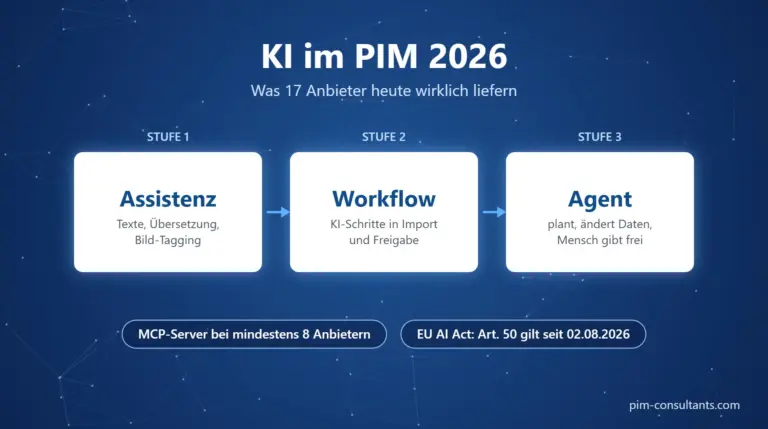
AI in PIM 2026: What vendors actually deliver today
Which AI capabilities PIM vendors actually deliver in 2026: an overview of agents, MCP servers, custom AI models and pricing across 17 vendors, plus obligations under the EU AI Act.

Akeneo Community Edition 2026: Not discontinued, but changing
Has the Akeneo Community Edition been discontinued? No. Support for Akeneo 7 On-Premise and PaaS ended on 30 September 2026. Here are the facts and the five options now available to Enterprise customers.
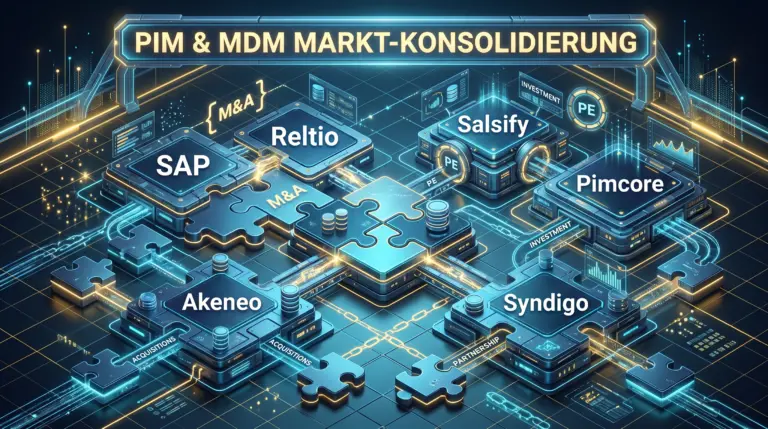
Billion-Dollar Deals, Private Equity and Platform Mergers: The Comprehensive PIM Consolidation Report 2026
Cinven buys Salsify, Tenzing takes over Pimcore, Akeneo acquires PricingHUB: an overview of all PIM deals in 2025/2026, the three patterns behind them and what users should now look out for in their contracts.