- PIM comparisons
PIM in Medical Technology and Pharma: Vendor Comparison 2026
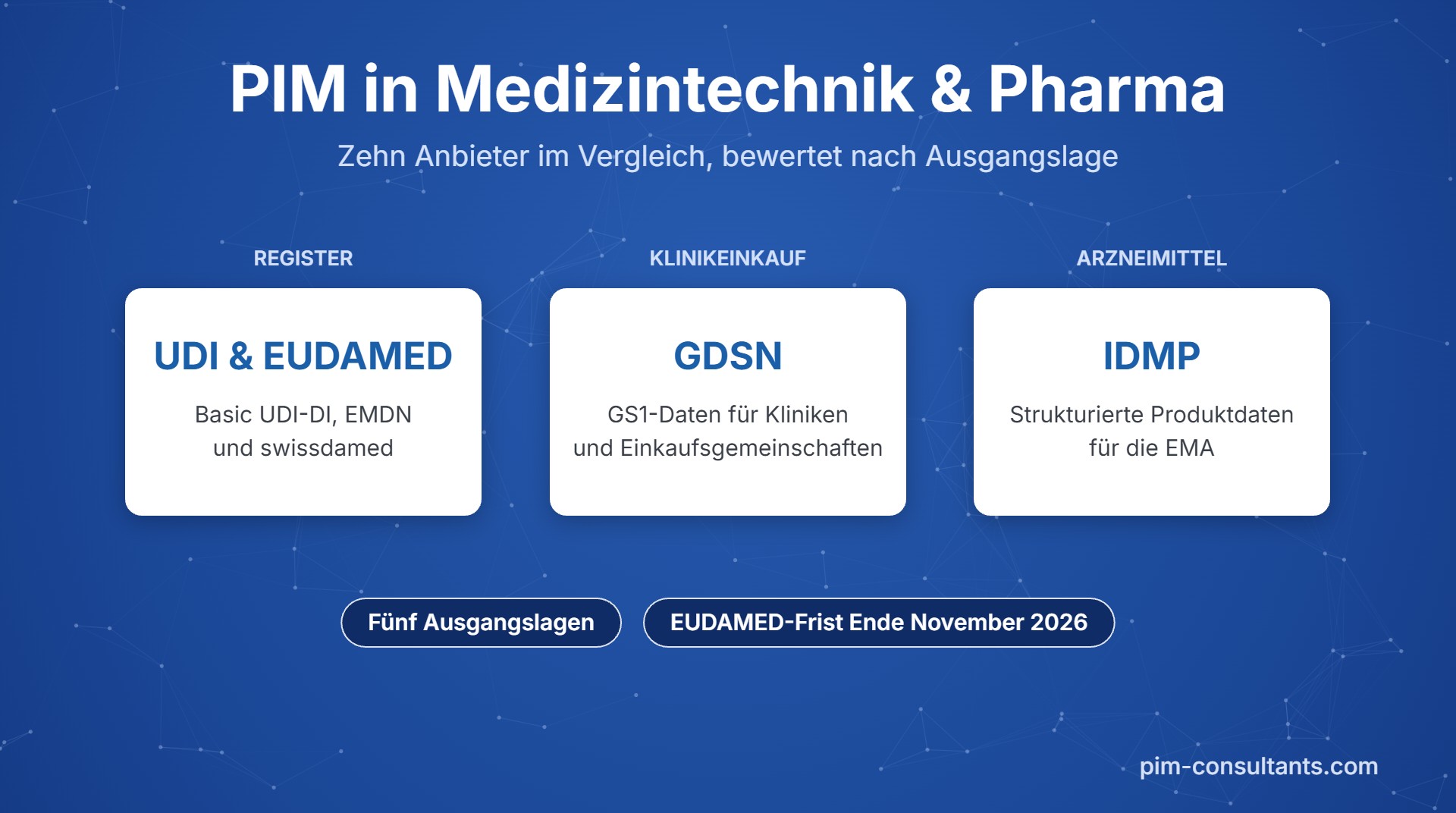
In brief: In medical technology, the right PIM depends on your starting point, not the vendor’s name. EUDAMED has been mandatory since 28 May 2026, and registration in swissdamed has been required in Switzerland since 1 July 2026. Products already on the market must be registered in EUDAMED by the end of November 2026. We assessed ten vendors against eight requirements: UDI hierarchy, registry data and EMDN, instructions for use, market-specific status, approval and evidence, GDSN, sets and variants, and IDMP for medicinal products. This identifies five typical starting points: a corporate group with multiple ERP systems; a mid-sized company with registry obligations; a manufacturer with a dealer network and catalogues; a laboratory and healthcare distributor; and a pharmaceutical manufacturer with IDMP obligations. Our assessment following the comparison shows which solution fits each starting point.
What a PIM must deliver in medical technology and pharmaceuticals
- UDI hierarchy: The Basic UDI-DI groups products with the same intended purpose, risk class and essential characteristics, linking them to their certificate and technical documentation. Below this level, each version and packaging level has its own UDI-DI. Batch and serial numbers (UDI-PI) are generated in manufacturing and ERP. The PIM must model this hierarchy, including package contents and identifiers for legacy devices (EUDAMED-DI).
- Registry data and nomenclature: For each UDI-DI, EUDAMED requires information such as trade name, model, risk class, sterility, storage conditions and the EMDN code. The EMDN is revised annually and contains around 8,500 entries in 2026. The USA additionally requires GUDID with GMDN codes, and Switzerland requires swissdamed. The PIM should have an export profile for each registry, with mandatory fields and validation rules.
- Instructions for use: Since 16 July 2025, manufacturers have been permitted to provide electronic instructions for use for all products intended for professional users (Implementing Regulation (EU) 2025/1234). Paper remains mandatory for lay users. The website address must be included in EUDAMED. The PIM or a connected document management system must manage versions by country and language.
- Market-specific status: Certificates, notified bodies, validity, legacy status and registration in EUDAMED, swissdamed or GUDID determine where a product may be sold and displayed. The PIM should maintain the status for each country and control syndication accordingly.
- Approval and evidence: Product data forms part of the labelling. Changes require approval workflows, roles, an audit trail and version records that align with quality management under ISO 13485. Clarify early on which system is the system of record for which data: ERP, PLM, RIM or PIM.
- GDSN and hospital procurement: Hospitals and group purchasing organisations require product data to GS1 standards via the GDSN, for example through the HCDP initiative of hospital purchasing groups in Germany. To support this, the PIM needs a connection to a data pool such as 1WorldSync (which has included atrify since May 2023) or Syndigo.
- Sets, systems and variants: Treatment units, systems, accessories, spare parts and single-use items in many sizes create numerous relationships. The PIM must model bills of materials, sets and variants and link them to packaging levels.
- Medicinal products and IDMP: For medicinal products, the European Medicines Agency (EMA) requires structured product data in accordance with ISO IDMP through its Product Management Service. This data is usually held in RIM or MDM systems. The PIM handles commercial and channel data and must reconcile pack sizes and names with these systems.
Deadlines affecting product data in medical technology and pharmaceuticals
EUDAMED, swissdamed and the EMA’s IDMP requirements take effect in quick succession in 2026 and 2027. The same applies to every deadline: data must be maintained in a system that can deliver it complete, approved and in the correct format.
| Date | Regulation | What it means for product data |
|---|---|---|
| since 16 July 2025 | Implementing Regulation (EU) 2025/1234 (electronic instructions for use) | eIFU permitted for all products intended for professional users, including in Switzerland. The eIFU website address becomes part of the UDI data in EUDAMED. |
| 28 May 2026 | EUDAMED, Decision (EU) 2025/2371 | The Actor, UDI/Device, Notified Bodies and Certificates, and Market Surveillance modules are mandatory. New products must be registered before they are first placed on the market. |
| 1 July 2026 | swissdamed (Switzerland) | Mandatory registration of devices, systems and procedure packs in the UDI Devices module. From January 2027, each UDI-DI incurs a fee (CHF200 for the first, CHF20 for each additional one, capped at CHF10,000 per year). |
| Late November 2026 | EUDAMED, Regulation (EU) 2024/1860 | Devices already on the market, including legacy devices, must be registered. Sources cite either 27 or 28 November; plan for the earlier date. |
| December 2026 | EMA, Product Management Service | Structured manufacturer information for nationally authorised medicinal products. |
| 31.12.2026 | swissdamed (Switzerland) | End of the registration transition period. Devices subject to reportable incidents or field safety corrective actions have no transition period. |
| 28.05.2027 | EUDAMED, notified bodies | Certificates issued before 28.05.2026 must be in EUDAMED. Certificate and UDI data must match. |
| June 2027 | EMA, Product Management Service | Submit structured pack size data for additional nationally authorised medicinal products. |
The modules for vigilance, clinical investigations and performance studies are not yet mandatory; until then, these reports follow national procedures.
PIM providers for medical technology and pharmaceuticals compared
Providers are listed alphabetically, not ranked. We have included only providers with publicly available evidence of work in medical technology, laboratories, diagnostics or pharmaceuticals. Features are based on vendor statements; customer references are included only where publicly documented.
| Provider | Focus | Strengths in medical technology and pharmaceuticals | Customer references (publicly documented) | Best suited to |
|---|---|---|---|---|
| 4ALLPORTAL (Gütersloh) | PIM and DAM in one platform | Consolidating large product ranges from multiple sources, with maintenance by content and SEO teams without developer support; at medizinfuchs.de, over 350,000 items from more than 200 mail-order pharmacies | medizinfuchs.de (price comparison for medicines in Germany and Austria) | Healthcare retailers with large product ranges from multiple sources |
| Akeneo (Nantes, Düsseldorf office) | SaaS PIM focused on channels and product experience | Localisation and version control, integration with online stores and marketplaces; at Axonlab, around 150,000 products, 8 Sage ERP systems and 9 Shopware stores across 9 countries; at AMG Medical, catalogue production reduced from around one year to three months | Axonlab (diagnostics and life sciences), AMG Medical (medical and home healthcare products), Doctipharma (online pharmacy stores, France) | Manufacturers and distributors of medical, laboratory and diagnostic supplies with multiple online channels that prefer SaaS |
| Centric PXM by Centric Software (Campbell, USA; formerly Contentserv) | PXM platform with PIM and DAM | Centralised product data and media for partner portals, distributors and multilingual print catalogues; at HEINE, around 7,000 active items in 8 languages | HEINE Optotechnik (diagnostic instruments, Gilching) | Medical technology manufacturers with distributor networks and catalogues |
| Informatica (Redwood City, USA; part of Salesforce since November 2025) | Multi-domain MDM with Product 360 | Product 360 for Life Sciences industry template covering medicinal product, packaging and pharmaceutical product data, marketing authorisation information and IDMP support; FDA UDI accelerator based on multi-domain MDM | No publicly documented named customer reference found in medical technology or pharmaceuticals | Pharmaceutical and life sciences groups with IDMP obligations and a multi-domain MDM strategy |
| osapiens for Medical Devices (Mannheim; known as BYRD Health by BAYARD until March 2026) | Master data, content and compliance platform for medical devices | UDI submissions to EUDAMED, GUDID and TGA, GDSN, integration with the HCDP initiative; at PAJUNK, a UDI connector, bulk GUDID uploads instead of manual uploads, and automated HCDP publication | PAJUNK (regional anaesthesia, Geisingen) | Medical technology manufacturers looking to automate registry submissions and GDSN, often alongside an existing PIM |
| Pimcore (Salzburg) | Open-core platform for PIM, MDM, DAM and CMS | Flexible data model, PIM, website and online shop on a single platform; around 10,000 products and variants migrated at KNAUER, findability improved by 70%, maintenance effort reduced by 40% | Vitalsana (mail-order pharmacy, Zur-Rose-Gruppe), KNAUER (HPLC laboratory equipment, Berlin), Heidolph (laboratory equipment), Deutscher Apotheker Verlag (Index Nominum drug database) | Pharmaceutical distributors and laboratory equipment manufacturers with an in-house development team or partner |
| Sales Layer (Valencia) | SaaS PIM with industry templates | According to its industry page: UDI-DI per item, media per packaging level, field mapping for GUDID and EUDAMED, country-specific instructions for use with version history, integration with ERP, QMS, GHX and SAP Ariba | Unigloves (disposable gloves, UK) | Mid-sized manufacturers and distributors looking to implement a SaaS PIM quickly using a medical device template |
| Stibo Systems (Aarhus, Hamburg office) | Multi-domain MDM (STEP) with PIM and DAM, now available exclusively as SaaS | Consolidation of multiple ERP systems, approval workflows, audit trail, GDSN; at Halyard Health, over 6,000 item numbers with 400 attributes from three SAP systems, syndication to GDSN via 1WorldSync | Halyard Health (medical devices, USA), Shionogi (pharmaceuticals, Japan) | Large enterprises with multiple ERP systems and master data spanning multiple domains |
| Syndigo (Chicago) | PIM, MDM and syndication with its own GDSN data pool | UDI submission services, GDSN content for medical devices supplied to hospitals; at B. Braun, a central PIM for around 5,000 products and 120,000 variants with over 150 digital channels; at Ypsomed, syndication with connections to ERP, PIM, e-commerce, CMS and databases such as EUDAMED | B. Braun (Melsungen), Ypsomed (insulin pumps and injection systems, Switzerland) | Large enterprises and manufacturers that need to syndicate product data to registries, hospitals, distributors and numerous channels |
| Viamedici (Ettlingen) | Platform for PIM, MDM, DAM and product configuration | According to its industry pages and medical device white paper (December 2025): consolidation from multiple systems, rule validation before publication, channel-specific exports for registries such as GUDID and EUDAMED and for GDSN data pools, certificates and instructions for use as version-controlled assets, variants with inheritance, audit trail and approvals, product configuration (CPQ) | No publicly named reference customer in medical devices or pharmaceuticals | Manufacturers of configurable equipment with extensive variants that use SAP and are looking for PIM, MDM and configuration on a single platform |
Our assessment: which solution fits which starting point
We assessed the ten vendors against the eight requirements in the first section, wherever public evidence was available. No vendor covers all eight with publicly named reference customers. We therefore distinguish between five starting points.
Starting point 1: a large enterprise with multiple ERP systems, operations in many countries and GDSN obligations
The priority here is to consolidate data from multiple systems, approve it and deliver it to registries, hospitals and distributors. Stibo Systems has publicly documented this at Halyard Health: over 6,000 item numbers with 400 attributes from three SAP systems, approval workflows and syndication to GDSN via 1WorldSync. Note that since 2025, Stibo has been available exclusively as SaaS. Syndigo has a documented implementation at B. Braun: a central PIM for around 5,000 products and 120,000 variants, around 20 connected systems, including SAP, and over 150 digital channels; the Aesculap catalogue, containing around 6,300 surgical instruments, is generated directly from the PIM. The solution partner is Advellence. At Ypsomed, the focus is on syndication and connections to databases such as EUDAMED. Use your own data in the proof of concept to check whether Basic UDI-DI, UDI-DI and packaging levels can be modelled without custom development and whether the export passes EUDAMED’s validation rules.
Starting point 2: a mid-sized manufacturer primarily serving registries and hospital procurement teams
In 2026, many manufacturers in Germany, Austria and Switzerland submit data to three registries (EUDAMED, swissdamed and often GUDID), while also meeting the GDSN requirements of group purchasing organisations. A clear division of responsibilities makes sense here: a specialised data hub for regulatory submissions and GDSN, and a PIM for marketing and sales. At PAJUNK, osapiens for Medical Devices switched GUDID submissions to bulk upload and automated publication to the HCDP. Sales Layer provides a template with UDI-DI for each item, field mapping for GUDID and EUDAMED, and instructions for use by country. Decide in advance which system will be the source of truth for UDI data and who will be responsible for exports.
Scenario 3: Manufacturers with dealer networks, catalogues and devices with many variants
Centric PXM has a publicly documented reference at HEINE: around 7,000 active items, eight languages, and distribution through around 3,000 representatives, importers and specialist dealers in over 120 countries. A print catalogue and dealer portal are planned for a second phase. Akeneo is a strong option when online channels and a presence in many countries are the priority. In its medical technology white paper, Viamedici describes a hierarchical data model with inheritance for variants, certificates and instructions for use managed as versioned assets, and product configuration on the same platform. However, it has not publicly named a medical technology reference customer; SAP integration is documented in other industries. Check how well sets and packaging levels can be modelled.
Scenario 4: Laboratory, diagnostics and healthcare distributors
For large product ranges sold through online shops, import, enrichment and syndication are key. Akeneo has documented references at Axonlab (around 150,000 products in 9 countries) and Doctipharma. Pimcore has references at Vitalsana, the online pharmacy in the Zur-Rose-Gruppe, and laboratory equipment manufacturers KNAUER and Heidolph. For medizinfuchs.de, 4ALLPORTAL consolidates over 350,000 items from more than 200 online pharmacies. Pimcore requires an in-house development team or a partner, but brings PIM, website and online shop together on one platform.
Scenario 5: Pharmaceutical manufacturers with IDMP obligations
For medicinal products, the PIM is rarely the system of record. The EMA collects structured product data in accordance with ISO IDMP, with deadlines extending to June 2027. This data is usually held in RIM or MDM systems. Informatica offers Product 360 for Life Sciences, a template for medicinal product and packaging data with IDMP support, while Stibo Systems uses multi-domain MDM at Shionogi. The PIM complements these systems for pharmacies, wholesalers and online channels. It is important to distinguish this from customer master data management: pharmaceutical groups use dedicated MDM solutions for this, such as AstraZeneca with Reltio (part of SAP since 2026). That is a separate project from PIM.
Questions you should ask every vendor
- How do you model Basic UDI-DI, UDI-DI and packaging levels, and how do you handle legacy devices (EUDAMED-DI)?
- Which fields in the EUDAMED dataset are included in the standard model, and how do you check validation rules before export?
- How do you submit data to EUDAMED, swissdamed and GUDID: via XML upload, machine-to-machine or through a partner? Who operates the Access Point?
- How do you manage EMDN and GMDN codes, and how do you apply the annual EMDN revision?
- How do you version instructions for use by country and language, and how do you keep the eIFU address in EUDAMED up to date?
- What approval workflows, audit trails and validation documentation do you provide for quality management in accordance with ISO 13485?
- Which GDSN data pool do you use to send data to hospitals and group purchasing organisations, for example to the HCDP?
- Which medical technology or pharmaceutical customers in Germany, Austria or Switzerland can we speak to as references?
Frequently asked questions
Which PIM is suitable for medical technology?
That depends on your starting point. Large enterprises with multiple ERP systems and GDSN obligations often choose Stibo Systems or Syndigo. Mid-sized manufacturers whose main need is to automate EUDAMED, swissdamed and GUDID submissions often combine a PIM with a specialised data hub such as osapiens for Medical Devices. Centric PXM, Akeneo and Viamedici are options for dealer networks and catalogues, while Akeneo, Pimcore and 4ALLPORTAL are options for laboratory and healthcare distributors.
Does the PIM itself have to submit data to EUDAMED?
No. EUDAMED accepts data through its web interface, via XML upload or through a machine-to-machine connection. A machine-to-machine connection requires a dedicated Access Point and, according to the European Commission, is the most complex option. Many manufacturers use the PIM to supply the data and submit it through a service provider or data hub. What matters is that the PIM, ERP and regulatory submission all use the same data.
What are the deadlines for registering medical devices in EUDAMED and swissdamed?
Since 28 May 2026, new products must be registered in EUDAMED before they are first placed on the market. Products already on the market, including legacy devices, must be registered by the end of November 2026. In Switzerland, registration in swissdamed has been mandatory since 1 July 2026, with a transition period until 31 December 2026; there is no transition period for products with reportable incidents.
Can instructions for use be provided in electronic form only?
For professional users, yes. Since 16 July 2025, Implementing Regulation (EU) 2025/1234 has permitted electronic instructions for use for all medical devices and their accessories intended for healthcare professionals. Paper instructions remain mandatory for lay users. The web address of the electronic instructions for use must be recorded in the EUDAMED UDI database. Switzerland has adopted this rule.
Do pharmaceutical companies need a PIM for IDMP?
Usually not as the system of record. The structured medicinal product data specified by ISO IDMP, which the EMA collects through its Product Management Service, is generally held in RIM or MDM systems. Informatica offers an industry-specific template for this purpose. The PIM supplies data to pharmacies, wholesalers and online channels and should keep pack sizes and product names aligned with these systems.
Your next step
Data hub, PIM or multi-domain MDM? We provide a vendor-neutral comparison based on your products, markets and system landscape. The initial consultation is free: Book a consultation. Our PIM selection service outlines a structured selection process, while the PIM-Finder provides an initial shortlist.
Last updated: October 2026. Information on features, standards and interfaces is based on vendor statements; please verify it during your project. This article does not constitute legal advice; please confirm regulatory deadlines with your regulatory affairs department.
Sources
- Osborne Clarke: EU triggers mandatory EUDAMED use (Decision (EU) 2025/2371)
- European Commission: UDI/Device registration and EMDN
- HPRA: Mandatory use of EUDAMED modules for medical devices
- EUDAMED: Requirements for the different modes of data input
- EUR-Lex: Implementing Regulation (EU) 2025/1234 (electronic instructions for use)
- Swissmedic: Implementation of the EU Implementing Regulation on electronic instructions for use
- Swissmedic: swissdamed, mandatory registration from 1 July 2026
- OpenRegulatory: MDCG 2026-3, EMDN version history 2026
- EMA: Substance and product data management services (PMS, IDMP)
- atrify: Sending data to German group purchasing organisations via the HCDP
- 1WorldSync: Acquisition of atrify (May 2023)
- osapiens: osapiens acquires BYRD Health (March 2026)
- osapiens: Success Story PAJUNK
- 4ALLPORTAL: Case Study medizinfuchs.de
- Akeneo: Case Study Axonlab
- Akeneo: Case Study AMG Medical
- Akeneo: Case Study Doctipharma
- Centric Software: Success Story HEINE
- Informatica: Product 360 for Life Sciences
- Informatica: UDI Compliance Accelerator
- Pimcore: Case Study Vitalsana (Zur Rose)
- Pimcore: Case Study KNAUER
- Pimcore: Case Study Heidolph Instruments
- Pimcore: Case Study Deutscher Apotheker Verlag
- Sales Layer: PIM for medical device manufacturers
- Stibo Systems: Success Story Halyard Health
- Stibo Systems: Shionogi implements Stibo Systems MDM solution
- Advellence: B. Braun customer story (centralised PIM based on Syndigo)
- Syndigo: Case Study Ypsomed
- Syndigo: Healthcare
- Viamedici: Healthcare & Medical Technology
- Viamedici: Pharmaceuticals & Biotechnology
- Viamedici: White paper “PIM as the central nervous system of medical technology” (PDF)
- Reltio: Case Study AstraZeneca
More PIM insights
News & Blog
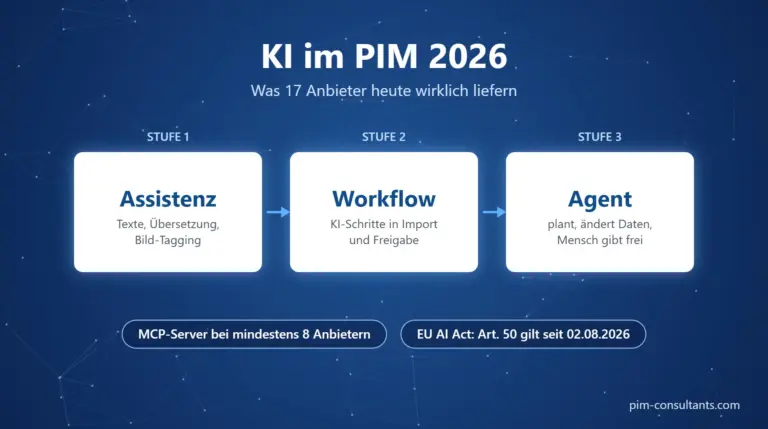
AI in PIM 2026: What vendors actually deliver today
Which AI capabilities PIM vendors actually deliver in 2026: an overview of agents, MCP servers, custom AI models and pricing across 17 vendors, plus obligations under the EU AI Act.

Akeneo Community Edition 2026: Not discontinued, but changing
Has the Akeneo Community Edition been discontinued? No. Support for Akeneo 7 On-Premise and PaaS ended on 30 September 2026. Here are the facts and the five options now available to Enterprise customers.

Billion-Dollar Deals, Private Equity and Platform Mergers: The Comprehensive PIM Consolidation Report 2026
Cinven buys Salsify, Tenzing takes over Pimcore, Akeneo acquires PricingHUB: an overview of all PIM deals in 2025/2026, the three patterns behind them and what users should now look out for in their contracts.