- PIM comparisons
PIM for Construction and Building Services: Vendor Comparison 2026
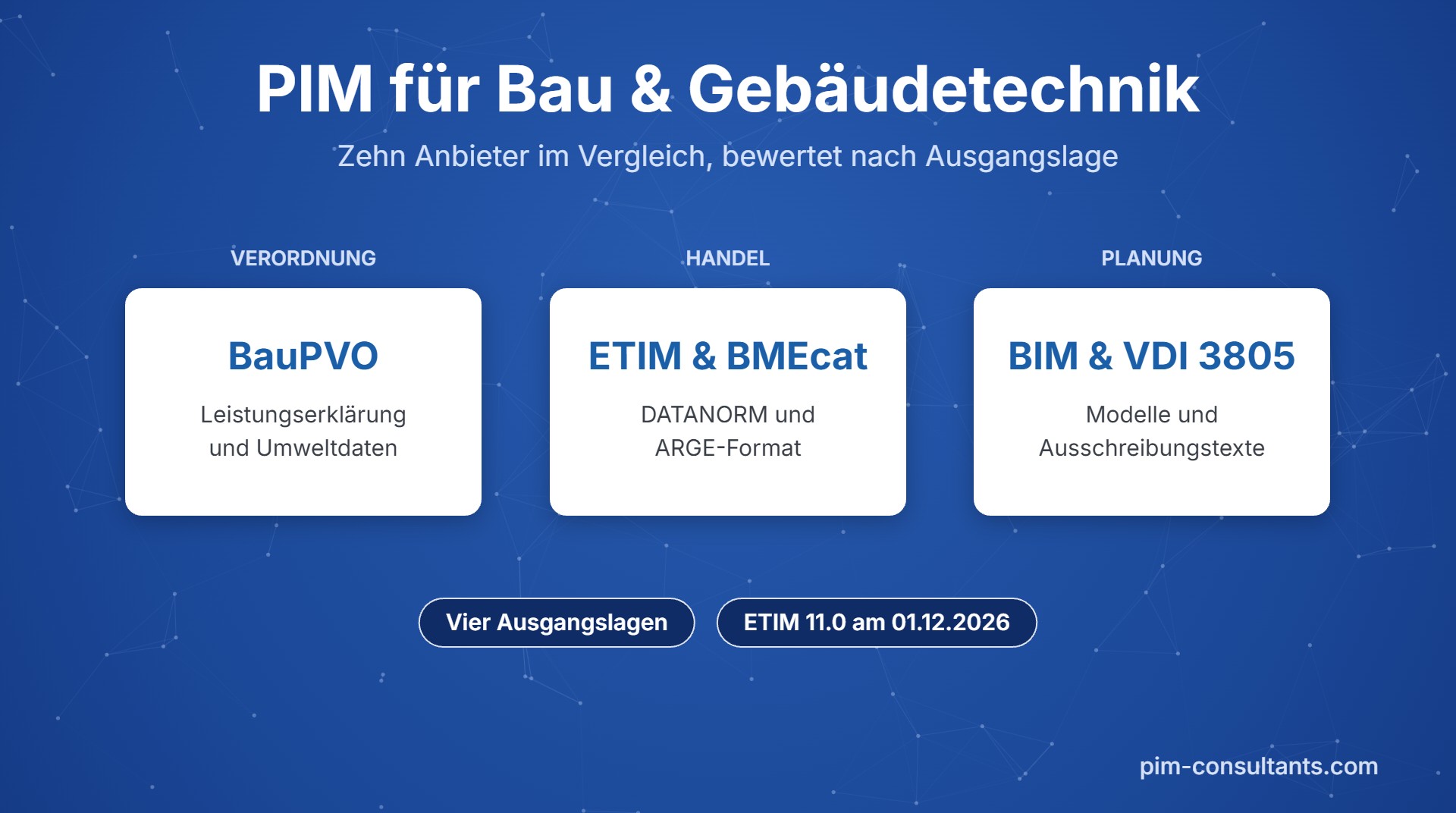
In brief: In construction and building services, your starting point determines the right PIM, not the vendor’s name. The new Construction Products Regulation (EU) 2024/3110 has applied since 8 January 2026, introducing a declaration of performance and conformity and initial environmental information requirements. ETIM 11.0 will be released on 1 December 2026, and from 2028, new buildings over 1,000 m² must disclose their life-cycle global warming potential. We assessed ten vendors against seven requirements: declarations of performance and environmental data, classification and trade formats, BIM and specifier data, tender specifications, sizing and variants, countries and approvals, and documents and spare parts. This yields four typical business scenarios: plumbing and HVAC manufacturers; building materials and building component manufacturers; international groups with many brands; and specialist wholesalers. Our assessment following the comparison shows which solution fits which scenario.
What a PIM needs to do in construction and building services
- Declaration of performance and environmental data: The new Construction Products Regulation requires a declaration of performance and conformity, which can be provided electronically. Environmental information is being added in stages: first global warming potential, then all core indicators from 2030, followed by further indicators under EN 15804+A2 from 2032. The PIM should manage performance characteristics, references to applicable standards and environmental values for each product and version.
- Classification and trade formats: Wholesalers expect data classified according to ETIM, usually in BMEcat format. DATANORM and the ARGE Neue Medien format are also widely used in the plumbing and HVAC trade. ETIM 11.0 will be released on 1 December 2026. The PIM should manage multiple classifications and releases in parallel and generate exports without manual work.
- BIM and specifier data: Designers work with BIM models (IFC, Revit, ArchiCAD) and, in building services engineering, with datasets based on VDI 3805, which is being taken forward internationally as ISO 16757. The PIM supplies the attributes used to create these models and datasets, often in collaboration with a geometry service provider.
- Tender specifications: Designers and architects specify products using tender specification texts, for example via ausschreiben.de in GAEB format. The PIM should generate these texts from attributes using rules, in multiple languages and with an approval workflow.
- Sizing, formulations and variants: Components are selected using sizing tables, building materials by formulation, while building components such as windows, gates and railings are configured. The PIM needs a data model for sizing values, formulations and variants, and integration with configurators.
- Countries, standards and approvals: Many construction products vary by country in terms of standards, approvals and language, for example general building authority approvals in Germany. The PIM must manage country-specific values, documents and texts, and support inheritance of shared values.
- Documents, spare parts and service: Data sheets, installation instructions, declarations of performance and spare parts catalogues must match the correct product version. Technical documentation and spare parts often require an additional component content management system that works with the PIM.
Deadlines affecting product data in construction and building services
The new Construction Products Regulation phases in its obligations over several years, depending on when new harmonised standards become available for a product family. For every deadline, the information must be maintained and approved for each product, then delivered simultaneously for the declaration of performance, wholesalers and specifiers.
| Date | Regulation | What it means for product data |
|---|---|---|
| 7 January 2025 | Construction Products Regulation (EU) 2024/3110 | Entered into force; replaces Regulation (EU) No. 305/2011. |
| 8 January 2026 | Construction Products Regulation, application begins | Declaration of performance and conformity, with provision for electronic delivery. The first environmental indicator is global warming potential, where required by the harmonised specification. Standards under the old regulation continue to apply during the transition. |
| 1 December 2026 | ETIM 11.0 | New classification release; update data supplied to wholesalers and portals to the new classes and attributes. |
| Q2 2027 (planned) | Digital product passport for construction products | The Commission plans to set the requirements for construction products by delegated act; mandatory 18 months after that act enters into force. |
| 1 January 2028 | Energy Performance of Buildings Directive (EU) 2024/1275 | Calculate and disclose life-cycle global warming potential for new buildings over 1,000 m²; specifiers need environmental data for the products. |
| 01.01.2030 | Energy Performance of Buildings Directive (EU) 2024/1275 | Life-cycle global warming potential for all new buildings. |
| 09.01.2030 | Construction Products Regulation, environmental information | All core environmental impact indicators under EN 15804+A2. |
| 09.01.2032 | Construction Products Regulation, environmental information | Additional environmental indicators under EN 15804+A2. |
PIM vendors for construction and building services compared
Vendors are listed alphabetically, not ranked. We have only included vendors with publicly documented customer references in construction, building materials or building services. Features are based on vendor statements; customer references require public evidence.
| Vendor | Focus | Strengths in construction and building services | Customer references (publicly documented) | Best suited to |
|---|---|---|---|---|
| ANTEROS by INCONY (Paderborn) | PIM with an industry solution for construction suppliers | ETIM alongside BIM and proprietary structures, category trees and scheduled exports for BIM data exchange; standard exports in ARGE and BMEcat formats at Oventrop, DATANORM export at TECE | Oventrop, TECE, Poloplast, MC-Bauchemie | Manufacturers in plumbing, heating and construction chemicals supplying wholesalers and specifiers in standard formats |
| ATAMYA (Bochum) | PIM with an ETIM structure, formerly eggheads | At Wilo, over 35,000 products in 31 languages classified using ETIM, BIM and CAD catalogues via CADENAS; at SAKRET, 500 products and 3,000 variants in 13 languages for a European group | Wilo, SAKRET, Grünbeck | Manufacturers with international subsidiaries and ETIM and BIM requirements |
| crossbase (Böblingen) | PIM, media asset management and database publishing | At Schöck, over 500,000 structural design values and publications in 40 languages for 29 countries; at Gebr. Kemper, multilingual product descriptions and specification texts for DATANORM, the plumbing, heating and air conditioning industry portal, ausschreiben.de (GAEB) and the VDI-3805-WebSelektor | Schöck, Gebr. Kemper, HOPPE, Max Frank, Sievert | Manufacturers with technical catalogues, structural design data and specification texts |
| inriver (Malmö) | PIM focused on product experience | Dedicated Tools + Construction industry page; at ITW Construction Products Europe, 50,000 items from multiple ERP systems for 10 European markets; at Swegon, PIM with DAM for 3D renderings | ITW Construction Products Europe, Swegon, Bygma, Brødrene A&O Johansen | International manufacturers and distributors operating across many countries and websites |
| MeDaPro by ITB (Kamp-Lintfort) | PIM and catalogue system focused on wholesale | Customer reference list featuring 16 plumbing and air conditioning wholesalers in Germany, Austria and Switzerland; over 20,000 items at Fritz Holter | Meier Tobler, Sanitas Troesch, Fritz Holter, Leysser, ACO | Specialist wholesalers in plumbing, heating, air conditioning and building materials in the DACH region |
| Pimcore (Salzburg) | Open-core platform for PIM, MDM, DAM and CMS | At Saint-Gobain Weber, PIM, DAM and MDM for over 800 products and 26,321 media assets, with automated production of price lists, packaging and technical data sheets | Saint-Gobain Weber, Caleffi, SOMMER | Manufacturers with an in-house development team or partner looking to connect PIM, their website and publishing |
| prodexa (Dortmund) | PIM with an industry solution for plumbing and HVAC | At Viessmann, PIM and an online product catalogue connected to central SAP master data management, reducing the effort required to prepare quotations by 75% | Viessmann, Assmann | Manufacturers in heating, ventilation and plumbing using SAP |
| Stibo Systems (Aarhus, Hamburg office) | Multi-domain MDM (STEP) with PIM, now available only as SaaS | At Kingspan, PIM for three of seven divisions with over 40 brands in 80 countries, reducing technical documents from 13,000 to just over 2,000 | Kingspan, LIXIL, Saint-Gobain Distribution Bâtiment France, Zehnder | Large groups with many brands, divisions and countries |
| Viamedici (Ettlingen) | Platform for PIM, MDM, DAM and product configuration | At Baumit, a product database with over 900 formulations, piloted in Germany and then rolled out to 27 other European countries, with rule-based distribution to specifiers, installers and distributors; configuration (CPQ) with SAP integration | Baumit | Building materials and components manufacturers managing formulations, variants and configuration across multiple countries |
| xmedia by myview (Büren) | PIM with an industry solution for plumbing, heating and air conditioning | At Sita, BIM models for Revit and ArchiCAD generated directly from the PIM and published via Heinze’s BIM portal; at S+S Regeltechnik, rule-based specification texts with direct export to ausschreiben.de | Sita Bauelemente, S+S Regeltechnik, Duscholux, maxit | Manufacturers looking to generate BIM data and specification texts from their PIM |
Other vendors with customer references in construction and building services: Akeneo (ASSA ABLOY, Tarkett), Alterra::PIM by Sepia (Halfen, over 20,000 products, documentation in up to 16 languages), catXmedia by lisocon (Schüco), Centric PXM (Belimo, data sheets in over 25 languages), PDM-X lisa by datacrossmedia (DATANORM and BMEcat for construction suppliers and the plumbing, heating and air conditioning sector), Perfion (Dornbracht), Sales Layer (Válvulas Arco), Struct PIM (STARK), Quanos as a content authoring and spare parts system (Geberit, Grünbeck, Windhager) and Wabric as a configurator for roofs, façades, railings and gates.
Our assessment: which solution fits which starting point
We assessed the ten vendors against the seven requirements in the first section, based on the publicly available evidence. Many vendors with construction industry references are based in Germany and offer exports in industry-specific formats; the differences lie in BIM, specification texts, configuration and support for corporate groups. We therefore distinguish between four starting points.
Starting point 1: plumbing, heating and air conditioning manufacturers
Here, the key requirements are ETIM, BMEcat, DATANORM and the ARGE format for wholesalers, plus VDI 3805 and BIM for specifiers. crossbase has a documented implementation at Gebr. Kemper: multilingual product and specification texts are generated for DATANORM, the SHK industry portal, ausschreiben.de and the VDI-3805-WebSelektor. At Oventrop and TECE, ANTEROS provides the ARGE, BMEcat and DATANORM formats as standard. At Wilo, ATAMYA manages over 35,000 products in 31 languages classified according to ETIM and supplies BIM catalogues via CADENAS. prodexa has a documented implementation at Viessmann with SAP integration, while xmedia offers a dedicated industry solution. Use your own data in the proof of concept to check how ETIM 11.0 is imported and which formats can be generated without custom development.
Starting point 2: building materials and components manufacturers
For building materials and components, the focus is on formulations, structural design, variants and specification texts. At Baumit, Viamedici manages a product database with over 900 formulations, rolled out to 27 other European countries following a pilot in Germany, and provides configuration on the same platform. At Schöck, crossbase manages over 500,000 structural design values and generates publications in 40 languages. At Sita, xmedia generates BIM models directly from the PIM, and at S+S Regeltechnik it produces specification texts for ausschreiben.de. Pimcore has a documented implementation at Saint-Gobain Weber with automated price lists and data sheets, while ATAMYA manages 3,000 variants in 13 languages at SAKRET. The Construction Products Regulation adds product-specific environmental values to the requirements; check how the PIM handles versioning for values from environmental product declarations.
Starting point 3: international groups with multiple brands
When multiple divisions, brands and ERP systems come together, a data model that works across organisational and national boundaries is essential. Stibo Systems has a documented implementation at Kingspan: PIM for three of seven divisions with over 40 brands in 80 countries, reducing technical documents from 13,000 to just over 2,000. Stibo now offers its solution only as SaaS (read more). At ITW Construction Products Europe, inriver manages 50,000 items from multiple ERP systems for 10 European markets. Clarify early on which attributes apply group-wide and which are maintained locally by each country.
Starting point 4: specialist wholesalers for plumbing, heating, air conditioning and building materials
Wholesalers import manufacturer data in many formats, add their own content and supply trade professionals through online shops, apps and catalogues. MeDaPro from ITB lists 16 plumbing and climate control wholesalers from Germany, Austria and Switzerland as references, including Meier Tobler and Sanitas Troesch. inriver has documented deployments at Bygma and Brødrene A&O Johansen, and Stibo Systems at Saint-Gobain Distribution Bâtiment France. Check how each system imports DATANORM, BMEcat and ARGE data and validates supplier data quality.
Questions to ask every vendor
- How do you manage performance characteristics, references to standards and environmental values under EN 15804+A2 for each product and version, and how do you use these to generate the declaration of performance and conformity?
- Which ETIM releases do you support in parallel, and how will you introduce ETIM 11.0?
- Which exports do you provide as standard: BMEcat with ETIM, DATANORM, ARGE format, data compliant with VDI 3805?
- How are BIM models and properties generated from the PIM, and which service providers do you work with?
- How do you generate specification texts, and how are they delivered to portals such as ausschreiben.de?
- How do you manage design tables, formulations and variants, and how do you integrate configurators?
- Which customers in construction or building services in Germany, Austria or Switzerland can we speak to as references?
Frequently asked questions
Which PIM is suitable for construction suppliers and manufacturers in plumbing, heating and air conditioning?
That depends on your starting point. crossbase, ANTEROS, ATAMYA, prodexa and xmedia have documented deployments at plumbing, heating and air conditioning manufacturers that need to support wholesale and design specification formats. Manufacturers of building materials and components with requirements for formulations, design calculations and configuration can find references at Viamedici, crossbase, xmedia and Pimcore. Groups with many brands often choose Stibo Systems or inriver, while specialist wholesalers in Germany, Austria and Switzerland use solutions including MeDaPro.
What does the new Construction Products Regulation change for product data?
The Construction Products Regulation (EU) 2024/3110 has applied since 8 January 2026. Manufacturers prepare a declaration of performance and conformity, which can be made available electronically. Environmental information is being added in stages, starting with global warming potential, followed by all core indicators from 2030 and further indicators under EN 15804+A2 from 2032. When a requirement applies to a product depends on the harmonised standards for its product family.
Which data formats do wholesalers expect?
Wholesalers expect product data classified according to ETIM, usually in BMEcat format. DATANORM and the ARGE Neue Medien format are also widely used in the plumbing, heating and air conditioning trade. ETIM 11.0 will be released on 1 December 2026. A PIM should generate these exports from a single dataset and support multiple ETIM releases in parallel.
Can a PIM supply BIM data?
Yes, as the source of properties. At Sita, xmedia generates BIM models for Revit and ArchiCAD directly from the PIM. At Wilo, BIM catalogues are generated from ATAMYA data via CADENAS, while ANTEROS prepares product data for BIM structures. Datasets compliant with VDI 3805 are widely used in building services engineering. This standard is being developed internationally as ISO 16757.
When will the digital product passport for construction products be introduced?
The Construction Products Regulation provides for a digital product passport intended to bring together the declaration of performance and conformity, technical documentation and safety information. The Commission plans to set out the requirements for construction products in a delegated act in the second quarter of 2027. The passport will become mandatory 18 months after that act enters into force. Structuring your product data in a PIM today will allow you to populate the passport from it.
Your next step
Industry formats, BIM and specifications, or enterprise MDM? We provide a vendor-neutral comparison based on your products, channels and system landscape. The initial consultation is free: book an appointment. Our PIM selection page explains the structured selection process, while the PIM-Finder provides an initial shortlist.
Last updated: October 2026. Information on features, standards and interfaces is based on vendor statements and should be verified during your project. This article does not constitute legal advice. Deadlines under the Construction Products Regulation depend on the harmonised standards for your product family.
Sources
- IHK Bodensee-Oberschwaben: EU Construction Products Regulation 2024/3110
- ZDH: Revised Construction Products Regulation published in the Official Journal of the EU
- One Click LCA: Environmental information under the Construction Products Regulation
- Forum Media: The new Construction Products Regulation
- Energy Performance of Buildings Directive (EU) 2024/1275, Art. 7
- ETIM International: Release Planning ETIM 11.0
- Baunetz Wissen: From VDI 3805 to ISO 16757
- INCONY: PIM for construction suppliers
- ATAMYA: Customer Story Wilo
- ATAMYA: Customer Story SAKRET
- ATAMYA: Customer Story Grünbeck
- crossbase: Success Story Schöck
- crossbase: Success Story Gebr. Kemper
- crossbase: Building components and materials
- inriver: ITW Construction Products Europe
- inriver: Swegon
- inriver: Tools + Construction
- ITB: Wholesale plumbing, heating and air conditioning references
- Pimcore: Saint-Gobain Weber
- Pimcore: Caleffi Hydronic Solutions
- prodexa: Case Study Viessmann
- prodexa: Sanitary and HVAC
- Stibo Systems: Kingspan
- Stibo Systems: Success Story LIXIL
- Stibo Systems: Success Story Saint-Gobain
- Viamedici: Case Study Baumit (PDF)
- Viamedici: Construction & Building Services
- myview: Success Story Sita (BIM)
- myview: Success Story S+S Regeltechnik
- myview: Industry solution for plumbing, heating and air conditioning
- Sepia: PIM implementation at Halfen
- lisocon: Schüco
- Centric Software: Success Story Belimo
- Akeneo: Customer Story ASSA ABLOY
- Perfion: Case Study Dornbracht
- Sales Layer: Case Study Válvulas Arco
- Struct: Case Study STARK
- Quanos: Geberit reference
- Wabric: Roof & Facade
More PIM insights
News & Blog
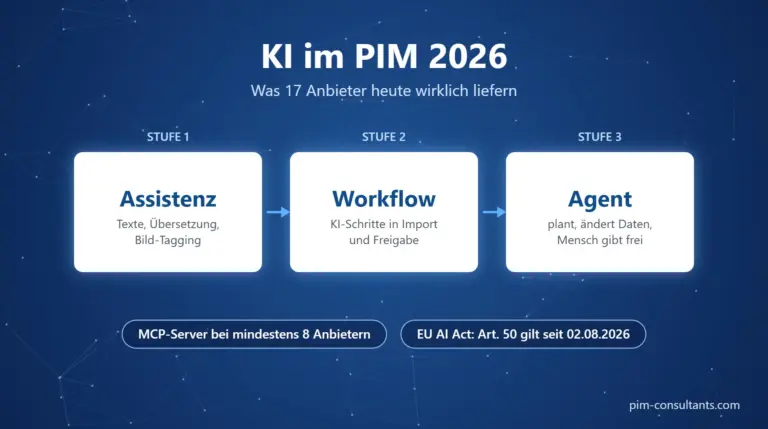
AI in PIM 2026: What vendors actually deliver today
Which AI capabilities PIM vendors actually deliver in 2026: an overview of agents, MCP servers, custom AI models and pricing across 17 vendors, plus obligations under the EU AI Act.

Akeneo Community Edition 2026: Not discontinued, but changing
Has the Akeneo Community Edition been discontinued? No. Support for Akeneo 7 On-Premise and PaaS ended on 30 September 2026. Here are the facts and the five options now available to Enterprise customers.

Billion-Dollar Deals, Private Equity and Platform Mergers: The Comprehensive PIM Consolidation Report 2026
Cinven buys Salsify, Tenzing takes over Pimcore, Akeneo acquires PricingHUB: an overview of all PIM deals in 2025/2026, the three patterns behind them and what users should now look out for in their contracts.