- PIM comparisons
PIM for Wholesale: Providers Compared 2026
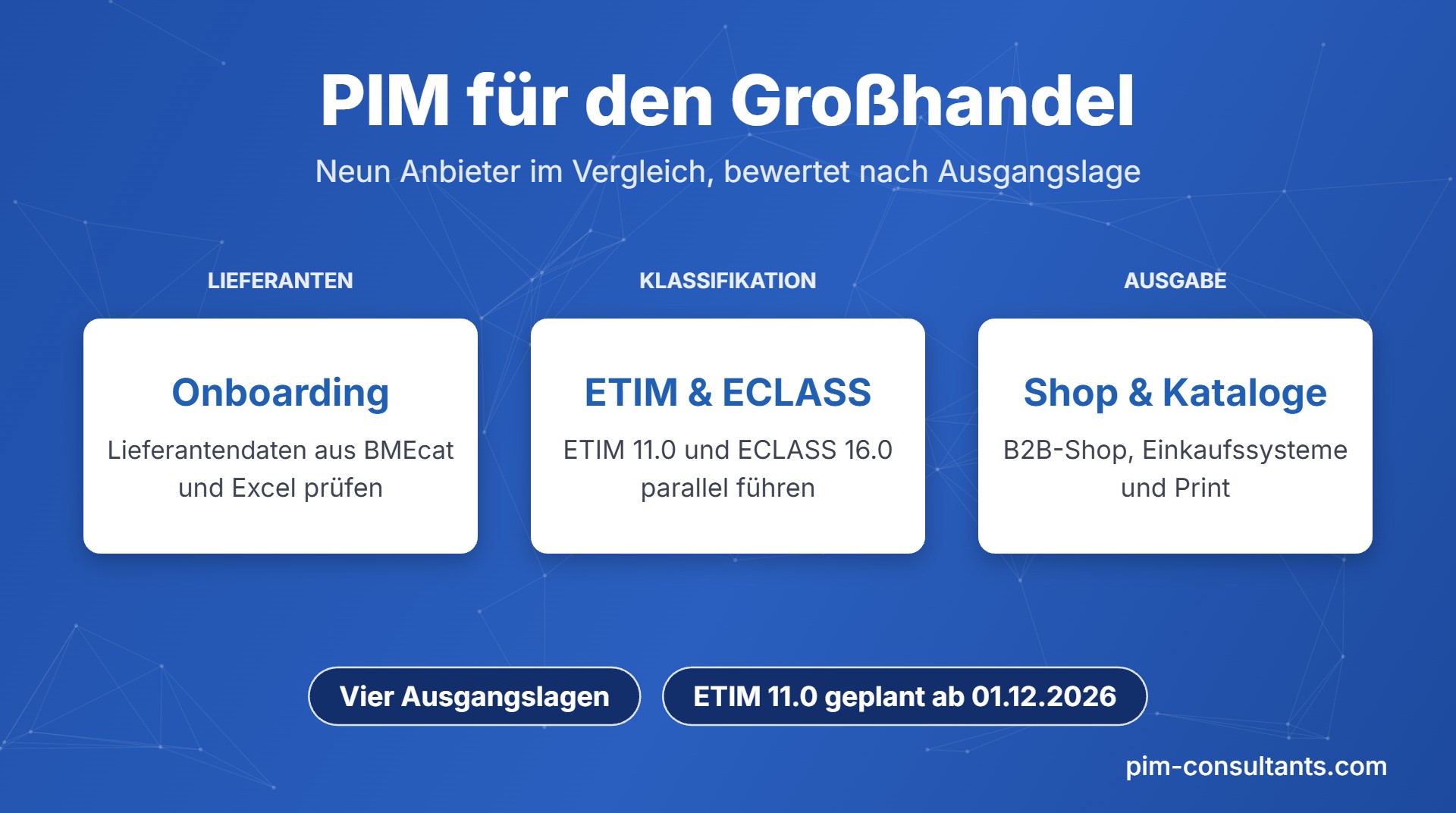
In brief: In wholesale, your starting point determines the right PIM, not the provider’s name. Wholesalers rarely manage products of their own. Instead, they take data from hundreds of suppliers, standardize it and pass it on to their own B2B store, customers’ procurement systems, catalogs and specialist retailers. Product ranges span a few thousand to several million items. Added to this are new versions of classification standards (ECLASS 17.0 planned by the end of November 2026, ETIM 11.0 for 1 December 2026) and mandatory information for online listings. We assessed nine providers against seven requirements: supplier onboarding, classification, product range size, ERP integration, delivery to stores and customers, catalogs, and support for multiple legal entities and countries. This gives us four typical business scenarios: technical wholesalers with very large product ranges; wholesalers with many suppliers; mid-sized wholesalers with a B2B store; and wholesale groups operating across multiple legal entities and countries. Our assessment following the comparison shows which solution fits each scenario.
What a PIM for wholesale needs to do
- Supplier onboarding: Suppliers deliver data as BMEcat, Excel spreadsheets, in DATANORM format or via data pools. The PIM must map this data to the wholesaler’s own data model, validate mandatory fields and report discrepancies back to the supplier, ideally through a supplier portal rather than by email.
- Classification: In technical distribution, ETIM and ECLASS are established standards. The PIM must manage classes and attributes in multiple versions, support version changes with mapping tables and export data in the version required by each recipient.
- Product range size: Wholesalers often manage hundreds of thousands to millions of items. Imports, bulk updates, searches and exports at this scale must run in minutes rather than hours.
- ERP integration: Prices, stock levels, lead times and logistics data usually remain in the ERP. The PIM imports item master data and item numbers from the ERP and enriches descriptions, attributes, images and documents. Clear rules defining which system is the source of truth for each field are essential.
- Delivery to stores and customers: Beyond the wholesaler’s own B2B store, customers require catalogs for their procurement systems (usually BMEcat, connected via OCI or cXML), customer-specific product ranges and data feeds for specialist retailers.
- Catalogs and print: Many wholesalers still produce printed or PDF catalogs, price lists and data sheets. Output should come directly from the PIM, for example through an InDesign integration.
- Multiple legal entities and countries: Wholesale groups manage the same items across multiple legal entities, languages and subsets of their product range. The PIM must combine shared master data with country-specific variations.
Standards and deadlines affecting product data in wholesale
For wholesalers, individual laws are less decisive than the versions of classification standards used by suppliers and customers. Other considerations include mandatory information for online listings and the Digital Product Passport.
| Date | Regulation or standard | What it means for product data |
|---|---|---|
| Since 13 December 2024 | General Product Safety Regulation (EU) 2023/988 (GPSR) | Every online listing for consumer products must identify the manufacturer or importer with a postal and email address, provide product identification details including an image, and include any warnings and safety information (Art. 19). This affects wholesalers that also sell to consumers or through marketplaces. |
| 28 November 2025 | ECLASS 16.0 released | Current version of the classification; suppliers and customers are transitioning gradually. The PIM must be able to manage old and new versions in parallel. |
| 15 October to 15 November 2026 | ETIM 11.0, beta version | Time to prepare mappings from ETIM 9 or 10 to 11 and coordinate them with key suppliers. |
| By 30 November 2026 (planned) | ECLASS 17.0, release in English and German | Change requests could be submitted until 22 September 2026. As with ETIM, old and new versions should be managed in parallel for a period of time. |
| 1 December 2026 (planned) | ETIM 11.0, release | New classes and attributes; suppliers, data pools and customers generally transition gradually. |
| From 18 February 2027 | Batteries Regulation (EU) 2023/1542, battery passport | First Digital Product Passport for industrial batteries over 2 kWh, batteries for light means of transport and electric vehicle batteries. Further product groups will follow under the Ecodesign Regulation (EU) 2024/1781. Read more in our article Digital Product Passport and PIM. |
PIM vendors for wholesale compared
Vendors are listed alphabetically, not ranked. We have only included vendors with public references from wholesale and distribution. Features are based on vendor information, and references are included only where publicly documented.
| Vendor | Focus | Strengths in wholesale | References (publicly documented) | Best suited to |
|---|---|---|---|---|
| Akeneo (Nantes, Düsseldorf office) | SaaS PIM with a supplier data module | Supplier Data Manager imports supplier data and automatically maps it to the company’s own data model; at Legallais, 50,000 SKUs for the online store, ERP, DAM and print, with enrichment five times faster; at Kitwave, ingredients and allergens managed centrally across 13 trading companies | Legallais (hardware and fittings wholesaler, France), Kitwave (food and beverage wholesaler) | Wholesalers with many suppliers that prefer SaaS |
| Dynamicweb (Aarhus, Berlin office) | Combined PIM, commerce and CMS platform | At Norsk Stål, around 4,500 stocked items with a live connection between the ERP (Microsoft Dynamics NAV) and PIM, with the online store and website on a single platform (partner: Solteq) | Norsk Stål (steel and metal distributor, Norway), Fritzøe Engros (B2B ordering) | Mid-sized wholesalers using Microsoft ERP that want an online store and PIM from a single provider |
| Litium (Stockholm) | B2B commerce with integrated PIM | At Industri Belos, product data centralised in PIM, a new B2B online store, integration with the Pyramid ERP and the Swedish industry database RSK, with PDF data sheets and catalogues generated from the system (partner: Toxic, 2026) | Industri Belos (machinery and equipment for grounds maintenance, construction and property management, Sweden) | B2B distributors modernising their online store and product data together |
| novomind iPIM (Hamburg) | PIM rooted in commerce | At Alexander Bürkle, around 2.7 million items from three data sources consolidated centrally, a data model largely based on ETIM, and syndication to the B2B online store handling over half a million online orders a year; product data feeds for registered specialist dealers are planned (January 2025) | Alexander Bürkle (electrical wholesaler, Freiburg) | Technical wholesalers in the DACH region with very large product ranges |
| Pimberly (Manchester) | SaaS PIM with a supplier portal | At EVO Group, over 90,000 SKUs consolidated from six ERP systems, automatic import of supplier files via the Vendor Portal, 45 workflows for enrichment and approval, syndication to 21 sales channels as well as print, API and EDI; 40% faster time to market | EVO Group (office supplies distribution, UK and Ireland) | Wholesalers with many suppliers and multiple ERP systems |
| Pimcore (Salzburg) | Open-source platform for PIM, MDM and DAM | At W.EG, a central PIM for nine companies in six countries, with seven languages and around four million products (up to one million per company), ETIM classification, four instances synchronised in real time; syndication to the online store, print catalogues, customers and ERP | W.EG (electrical supplies wholesaler, Eastern Europe) | Wholesale groups with in-house IT or a partner that want extensive customisation |
| Precisely EnterWorks (Burlington, USA) | MDM and PIM | At Orgill, the system of record since 2001 for over 75,000 SKUs, an online catalogue, numerous print catalogues and marketing materials, with workflows, translation and data enrichment; IDI provides product data to its member distributors through EnterWorks | Orgill (the world’s largest independent hardlines wholesaler, according to the company, USA), IDI (Independent Distributors Inc.) | Large distributors focused on master data; check availability and partners in the DACH region |
| Sales Layer (Valencia) | SaaS PIM with catalogue and channel integration | At Frans Bonhomme, orders from major customers are processed in 24 hours instead of three days, and catalogues are produced in days rather than months; at Rexel (partner: Telematel), 40,000 additional items and up to 80% less time spent on catalogue design through the EasyCatalog InDesign integration | Frans Bonhomme (civil engineering and construction wholesaler, over 400 locations, France), Rexel (electrical wholesaler) | Wholesalers with many catalogues and customer-specific catalogues |
| Stibo Systems (Aarhus, Hamburg office) | Multidomain MDM with PIM, now available only as SaaS | At Fabory (Grainger Group), around 200,000 SKUs across eleven countries and multiple languages on the standard platform without customisation, with the range almost doubling in two years; at Brammer, consistent product data across Europe | Fabory (fasteners, tools, workplace safety), Brammer (industrial supplies), Manutan, Wolseley | International wholesalers with a master data strategy spanning multiple domains |
Not included in the comparison: You can find additional providers with wholesale customers in the provider directory under Wholesale and Distribution. For electrical wholesalers and technical distributors, our PIM comparison for the electrical industry is also worth a look, as is our PIM comparison for the food industry for food wholesalers.
Our assessment: Which solution fits which starting point
We assessed the nine providers against the seven requirements in the first section, wherever public evidence is available. No provider is equally strong across all seven: some have their roots in master data management, others in commerce or catalogue production. We therefore distinguish between four starting points.
Starting point 1: Technical wholesalers with very large product ranges
Electrical, plumbing, heating and air conditioning, and industrial wholesalers carry hundreds of thousands to millions of items, classified using ETIM or ECLASS. Documented deployments include novomind iPIM at Alexander Bürkle with around 2.7 million items and an ETIM-based data model, Pimcore at W.EG with around four million products and ETIM classification, and Stibo Systems at Fabory with around 200,000 SKUs across eleven countries. Use your actual data volumes in the proof of concept to check how long imports, bulk updates and exports take, and how the system supports migration to ETIM 11.0.
Starting point 2: Wholesalers with many suppliers
If you take in data from hundreds of suppliers, effective onboarding is a priority. Akeneo offers Supplier Data Manager for this purpose, while Pimberly provides a Vendor Portal at EVO Group that automatically imports supplier files. Precisely EnterWorks has been the system of record at Orgill for more than 75,000 SKUs for over 20 years. Ask for a demonstration of how a new supplier is onboarded using a typical BMEcat or Excel file, who maintains the mapping, and how incorrect data is sent back to the supplier.
Starting point 3: Mid-sized wholesalers with a B2B online store
For wholesalers with a few thousand to tens of thousands of items and a B2B online store as their primary channel, a combined PIM and commerce platform may make sense. Documented deployments include Dynamicweb at Norsk Stål with a live connection to Microsoft Dynamics NAV, and Litium at Industri Belos with a B2B online store, ERP integration and catalogues generated from the system. Sales Layer demonstrates strengths in catalogues and customer orders at Frans Bonhomme and Rexel. Consider whether you really want to replace your online store and PIM together; replacing just one component later is more complex with all-in-one platforms.
Starting point 4: Wholesale groups with multiple companies and countries
Groups with multiple national subsidiaries need shared master data with variations by country and company. Documented deployments include Pimcore at W.EG with nine companies in six countries, Stibo Systems at Fabory in eleven countries and at Brammer with consistent data across Europe, and Akeneo at Kitwave with 13 trading companies. Here, it is worth considering PIM or MDM: if supplier, customer or location data also needs to be maintained centrally, this points towards a multidomain solution. Stibo Systems now offers its platform only as SaaS.
Questions you should ask every provider
- How is a new supplier onboarded using a BMEcat, Excel or DATANORM file, who maintains the mapping, and how are errors reported back to the supplier?
- Which ETIM and ECLASS versions are supported, and how does migration to ETIM 11.0 and ECLASS 16.0 or 17.0 work, including running them alongside the old version?
- How long do imports and bulk updates take with our data volumes? Please demonstrate this with real data in the proof of concept.
- Which fields come from the ERP and which from the PIM, and how are prices and availability passed to the online store and customers?
- Which formats for procurement systems, data pools and specialist retailers are available out of the box (which version of BMEcat, OCI, cXML, custom feeds)?
- How are catalogues, price lists and data sheets generated, and who maintains the templates?
- How do you support multiple legal entities, languages and customer-specific product ranges, and what licence costs apply per entity or item?
Frequently asked questions
Which PIM is suitable for wholesale?
That depends on your starting point: technical wholesalers with millions of items and ETIM primarily need performance and classification capabilities. Wholesalers with many suppliers need a good supplier portal, while mid-sized wholesalers often need a shared platform with their B2B online store. Our assessment above maps nine vendors to four starting scenarios.
How does a PIM for wholesalers differ from a PIM for manufacturers?
Manufacturers create their own product data, while wholesalers obtain most of it from suppliers. Wholesale therefore focuses on imports, mapping, validation rules and supplier feedback, along with very large product ranges and data delivery to customers’ procurement systems.
What role do ETIM and ECLASS play?
ETIM and ECLASS define the attributes of products within a class, such as voltage, ingress protection rating or material. Suppliers often provide data that is already classified, and customers require it in a specific version. ECLASS 16.0 has been available since 28 November 2025, ECLASS 17.0 is planned for release by 30 November 2026, and ETIM 11.0 is scheduled for release on 1 December 2026. A PIM should be able to manage multiple versions in parallel.
Do I need a supplier portal?
Once you have a few dozen active suppliers, a portal saves considerable time: suppliers upload data themselves, view validation results and correct errors instead of sending files back and forth by email. Several vendors in this comparison offer dedicated modules for this.
Do prices and stock levels belong in the PIM?
Generally, no. Prices, stock levels and lead times remain in the ERP and are passed directly to the online store and customers. The PIM manages item descriptions, attributes, images and documents. One exception is list prices for catalogues, which the PIM can import from the ERP.
Your next step
A supplier portal, a platform with a B2B online store or a master data solution for the entire group? We provide a vendor-neutral comparison based on your suppliers, product range and system landscape. The initial consultation is free: Book an appointment. Our PIM selection page explains the structured selection process, the PIM Finder helps you create an initial shortlist, and our directory of PIM integrators helps you find implementation partners.
As of November 2026. Information on features, formats and interfaces is based on vendor specifications; please verify it during your project. ETIM and ECLASS dates are based on the organisations’ release schedules. This article does not constitute legal advice.
Sources
- ETIM Deutschland: ETIM 11.0 release schedule
- ECLASS: Releases (16.0 released on 28 November 2025)
- ECLASS: Release 17.0 schedule (publication by 30 November 2026)
- ECLASS: Change requests for Release 17.0 by 22 September 2026
- IHK Köln: General Product Safety Regulation (GPSR)
- Akeneo: Solutions for distributors and retailers
- Akeneo case study: Legallais
- Akeneo case study: Kitwave
- Dynamicweb: Norsk Stål
- Dynamicweb case study: Fritzøe Engros
- Litium: Industri Belos
- novomind: Alexander Bürkle automates product data management (28 January 2025)
- Pimberly case study: EVO Group
- Pimcore: W.EG
- Precisely case study: Orgill
- Precisely case study: IDI
- Sales-Layer case study: Frans Bonhomme
- Sales-Layer case study: Rexel
- Stibo-Systems case study: Fabory
- Stibo-Systems case study: Brammer
- Stibo-Systems case study: Manutan
- Stibo-Systems case study: Wolseley
More PIM insights
News & Blog
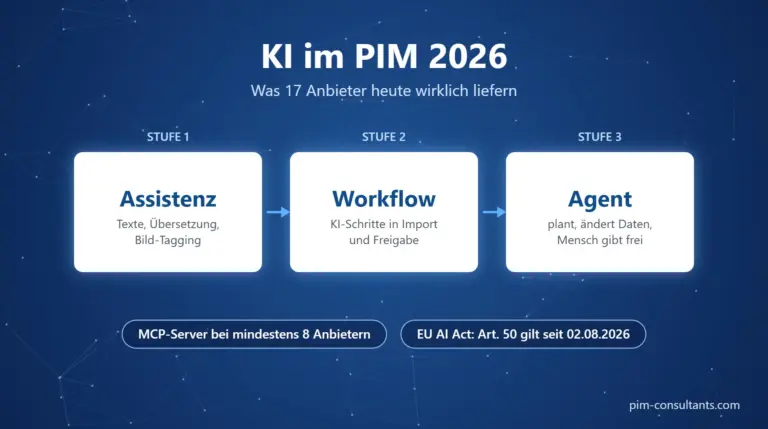
AI in PIM 2026: What vendors actually deliver today
Which AI capabilities PIM vendors actually deliver in 2026: an overview of agents, MCP servers, custom AI models and pricing across 17 vendors, plus obligations under the EU AI Act.

Akeneo Community Edition 2026: Not discontinued, but changing
Has the Akeneo Community Edition been discontinued? No. Support for Akeneo 7 On-Premise and PaaS ended on 30 September 2026. Here are the facts and the five options now available to Enterprise customers.
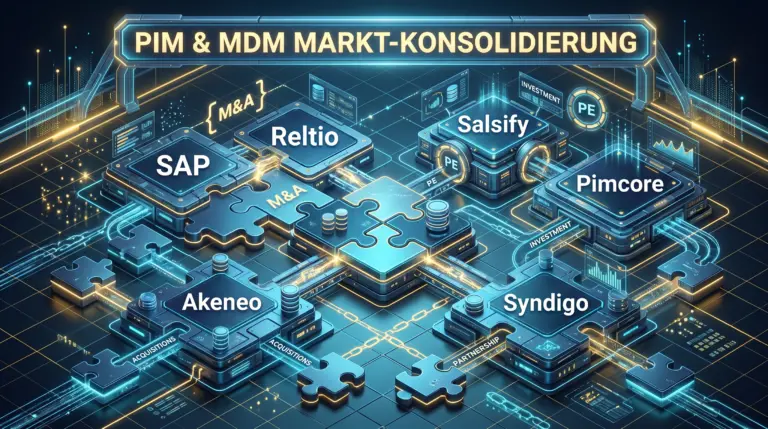
Billion-Dollar Deals, Private Equity and Platform Mergers: The Comprehensive PIM Consolidation Report 2026
Cinven buys Salsify, Tenzing takes over Pimcore, Akeneo acquires PricingHUB: an overview of all PIM deals in 2025/2026, the three patterns behind them and what users should now look out for in their contracts.